
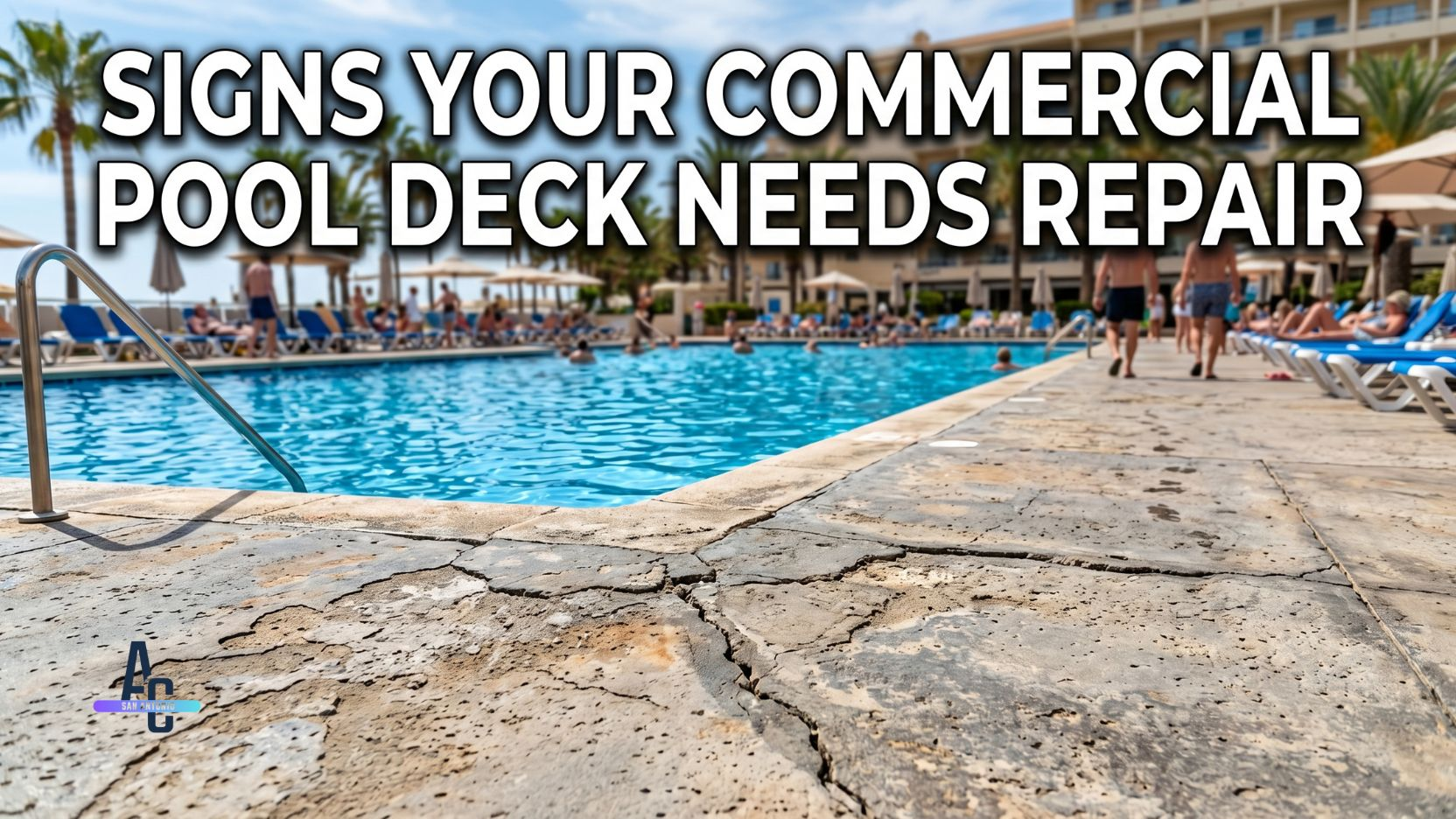
Most commercial pool deck damage does not announce itself all at once. It builds quietly: a hairline crack here, a soft spot there, until a liability incident or a failed inspection forces an expensive, rushed repair. This guide walks through every warning sign, what it means structurally, and how urgently it needs attention.
San Antonio’s commercial pool decks take a punishment that most property managers underestimate. The combination of intense UV exposure, summer heat that regularly exceeds 100 degrees, an expanding and contracting clay soil base, pool chemicals, and constant wet-dry cycling from splash zones creates conditions that break down concrete faster than almost any other application in the region. A deck that looked fine at the start of the season can develop serious problems by fall if the early warning signs were missed.
The warning signs covered in this guide are organized by urgency. Some require immediate action to protect guests and limit liability. Others are early-stage indicators that give you a repair window of weeks or months before the damage becomes costly. Knowing the difference determines whether you spend $3 per square foot or $30 per square foot fixing the same underlying problem.
The most dangerous commercial pool deck defects are often not the most visible ones. A deck can look cosmetically rough while remaining structurally sound, and it can look acceptable on the surface while concealing a base failure underneath. The signs that matter most are changes in drainage patterns, areas that sound hollow when tapped, cracks with vertical displacement, and soft or spongy spots underfoot. A visual walk-around alone is not a sufficient inspection. This guide covers both surface-visible and non-visible warning signs so that your inspection process catches what a casual look will miss.
Each warning sign below is assigned one of three urgency levels. Use these to prioritize your response and budget your repair timeline accordingly.
Address Soon / Urgent
Not all cracks are equal. A hairline shrinkage crack that formed during the original cure is fundamentally different from a growing crack driven by soil movement underneath the slab. The mistake most property managers make is treating cracks as a cosmetic issue across the board, when a subset of them are structural failures in progress.
| Crack type | What it looks like | What it means | Urgency |
|---|---|---|---|
| Hairline shrinkage cracks | Very thin lines, under 1/16″ wide, often in a random map pattern | Normal curing byproduct from the original pour. Cosmetic concern only unless they widen. | Monitor |
| Cracks at control joints | Cracking along or through the planned saw-cut lines in the slab | Control joints are doing their job by directing cracking to planned locations. Seal the joint to prevent water intrusion. | Monitor to Address Soon |
| Cracks wider than 1/4″ | Visible gap in the surface, often with ragged edges | Water is penetrating to the base. Soil erosion and base failure can follow. Repair before the next heavy rain. | Address Soon |
| Cracks with vertical displacement | One side of the crack sits higher than the other, with a raised edge | Ground movement or base failure has shifted the slab. Trip hazard and structural issue. Immediate assessment required. | Urgent |
| Cracks running toward the pool bond beam | Crack lines pointing toward the pool shell edge | Possible pool shell movement or deck-to-pool interface failure. Can compromise the pool structure itself. | Urgent |
San Antonio’s expansive clay soil is a significant factor here. Bexar County’s Vertisol soils swell during rainy periods and shrink dramatically during drought. That movement puts constant stress on the slab from below, particularly for decks that were not built on a properly compacted crushed limestone base. If your pool deck is developing multiple cracks in a short period, the cause is almost always base movement rather than surface deterioration.
- Measure crack width at its widest point with a crack gauge or credit card edge test
- Check for vertical displacement by running your hand across the crack surface; any ledge is a trip hazard
- Note whether the crack runs toward the pool edge, bond beam, or deck drain
- Photograph with a ruler or coin for scale and document the date for comparison at next inspection
- Check whether the crack is growing by marking both ends with a pencil mark and date, then re-checking in 30 days
Address Soon
Spalling is the process by which the surface layer of a concrete slab separates and flakes away, exposing the coarser aggregate underneath. On a commercial pool deck, spalling is accelerated by three factors that are uniquely concentrated in this environment: pool chemicals (particularly chlorine and pH-adjusting acids), constant wet-dry cycling in splash zones, and San Antonio’s UV intensity breaking down unprotected concrete surfaces.
Early-stage spalling looks like pitting or a roughened surface texture where the finish has worn away. Advanced spalling produces visible chunks or flakes of concrete that break loose, sharp aggregate exposure at the surface, and in severe cases, exposed rebar. All of these are active hazards for bare feet, which is the standard footwear at a pool.
Pool chemical concentration near the deck edge is the primary spalling driver in this market. Splash zones adjacent to pool entries, splash pads, and pool edges receive concentrated chlorine exposure every day the pool is in use. An unsealed or inadequately sealed deck in these zones will begin to show chemical spalling within two to three seasons of opening. The fix is resurfacing the damaged area combined with a chemical-resistant sealer rated for pool deck use. Resealing the entire deck on a consistent two-year cycle is the prevention strategy.
Spalling repair on a commercial deck is typically a resurfacing or overlay application, not a full replacement. A bonded concrete overlay of 3/8″ to 1/2″ can restore a spalled surface to full service condition if the underlying slab is structurally sound. If spalling is accompanied by hollow spots or base movement, a full slab section replacement may be necessary before resurfacing.
- Walk splash zones and pool entry areas specifically, as spalling begins here first
- Look for pitting, surface roughness, or visible aggregate where the surface finish has worn away
- Check for loose concrete fragments on the deck surface, which is a clear sign of active flaking
- Run your hand across the surface in deteriorating areas to feel for sharp edges that pose a cut hazard to bare feet
- Check whether rebar is visible anywhere; exposed rebar is an urgent repair regardless of surrounding condition
Urgent
Hollow spots are one of the most underdiagnosed problems on commercial pool decks because they are not visible from the surface. A section of deck that looks perfectly intact can be completely delaminated from its base underneath, with nothing but an air pocket supporting it. When a section like this collapses under a guest or a maintenance vehicle, the failure is sudden and severe.
The inspection method is simple: a sounding test, also called a tap test. Walk the deck with a solid metal rod or the back of a hammer and tap the surface systematically every two to three feet. A healthy slab produces a solid, dense sound. A delaminated or hollow area produces a distinctly hollow, drum-like sound. Mark every area that sounds hollow with chalk and have a professional assess the extent before the pool opens or reopens after an off-season.
The most common cause of hollow spots on San Antonio pool decks is soil washout from underneath the slab. Water that enters through cracks or deck drains that have lost their seal can erode the base material over time, leaving the concrete slab unsupported. This is why crack sealing and proper drain maintenance are not just cosmetic tasks. They directly prevent the base erosion that leads to hollow spots and eventual collapse.
- Conduct a full sounding test at the start of each season and tap every section of the deck systematically
- Walk the perimeter of the pool edge specifically, as this zone is most vulnerable to water intrusion from splash and deck drain overflow
- Mark hollow areas with chalk and photograph with dimensions noted
- Check for soft or spongy feel underfoot in addition to hollow sound; both indicate a loss of base support
- Any hollow area larger than 12″ in diameter should be assessed by a concrete contractor before the area is reopened
Address Soon
A properly designed commercial pool deck is sloped at a minimum of 1/8 inch per foot away from the pool to direct water to perimeter drains. When standing water appears after rain or after the deck is hosed down, one of three things has happened: the drain has clogged or failed, the deck has settled and reversed its slope, or a combination of both. All three cause the same downstream damage regardless of their source.
Water sitting on an unprotected or inadequately sealed concrete surface penetrates into the slab. In San Antonio’s climate, that moisture then expands during heat cycles, slowly disrupting the concrete’s internal bond. Over time, standing water zones develop spalling, surface delamination, and biological growth including algae and moss that further degrade the surface and create slip hazards.
Check your deck drains at the start of every season. Remove and clean drain grates, clear any debris from the drain body, and verify that water flows freely through the drain line. A drain that appears open at the surface can still be partially blocked at depth, causing slow drainage that allows water to sit on the deck longer than the surface suggests. If deck settlement has reversed the slope in a zone, localized grinding or an overlay with a corrected slope grade can restore proper drainage without replacing the full slab.
Standing water is a slip-and-fall hazard that goes beyond the property damage it causes to the concrete. A pool deck that chronically holds water creates a wet surface condition that significantly increases slip risk for guests, particularly around entry points and transition areas between wet and dry zones. If a slip-and-fall incident occurs in a zone where standing water was a known and documented issue, your liability exposure increases substantially. Address drainage failures with the same urgency as visible surface defects.
- Pour a bucket of water on the deck in each zone and observe the direction and speed of flow
- Check all deck drains for debris, rust, or restricted flow and clean at the start of each season
- Photograph any zones where water pools after rain or washing and document the extent and date
- Look for dark staining or biological growth patterns that indicate chronic wet zones
- Verify slope direction with a 4-foot level in areas where standing water is observed
Urgent
Any section of deck where one slab panel has shifted vertically relative to the adjacent panel creates a raised edge. At a pool, where guests are moving quickly, often barefoot, and frequently looking at the water rather than the ground, a raised edge of even 1/4 inch can cause a serious fall. This is the single highest-urgency defect on a commercial pool deck from a liability standpoint, and it requires action before the area is reopened to guests.
Raised sections are caused by soil movement pushing up under one panel while the adjacent panel remains in place, or by one panel settling while the adjacent panel stays level. Both are results of base instability from San Antonio’s expansive clay soils. They tend to develop at control joint locations where adjacent slab sections are free to move independently. If you see one raised edge, inspect all control joint locations on the deck, because the underlying cause is typically affecting the entire base rather than one isolated spot.
- Walk all control joint locations and run your foot across each joint to check for vertical displacement
- Use a straightedge or level to measure vertical displacement at any suspected raised edge
- Any edge with 1/4″ or more of vertical displacement should be flagged and barricaded immediately
- Check the pool-to-deck transition edge specifically, as movement at the bond beam is common in San Antonio
- Document all raised edges with photos and measurements and include in your inspection record
Urgent
The joint where the pool deck meets the pool shell is designed to allow for independent movement between the two structures. The pool shell and the surrounding deck slab are not bonded together; they must be free to expand, contract, and settle at different rates without one pulling the other apart. This joint is filled with a flexible backer rod and sealant, which must be maintained on a regular schedule.
When this joint fails, water from splash and rain infiltrates the gap and reaches the pool shell’s bond beam and the deck’s base. In San Antonio’s clay soils, that water creates differential soil movement that accelerates cracking on both the deck and the pool shell. In severe cases, deck settlement pulls the coping stones along the pool edge, or cracks develop in the pool shell itself, creating a structural problem that is far more expensive to address than the original joint maintenance would have been.
Joint resealing at the pool-to-deck interface should be part of your standard annual maintenance schedule, not a repair you address only after failure is visible. Budget for it as a routine line item. The cost is minimal compared to the expense of addressing pool shell damage that develops when the joint is neglected across multiple seasons.
- Walk the full perimeter of the pool and inspect the deck-to-pool joint continuously
- Check for any gaps, open voids, or sealant that has pulled away from one or both sides of the joint
- Press lightly on coping stones to check for movement or rocking; coping should be fully bonded
- Look at the pool shell just below the coping for any cracking at or near the bond beam
- Schedule joint resealing if the existing sealant is cracked, brittle, or more than three years old
Monitor / Address Soon
Staining and discoloration on a commercial pool deck are not always cosmetic. The source and color of the staining tells you what is happening below the surface. Some staining is purely aesthetic and caused by algae, tannins from leaves, or chemical imbalances in the pool water reaching the deck. Other staining indicates rebar corrosion or base moisture infiltration that needs attention before the underlying problem worsens.
| Stain type | Appearance | What it indicates | Action |
|---|---|---|---|
| Efflorescence | White or gray powdery residue on the surface, often in streaks | Water is moving through the slab and depositing dissolved salts on the surface as it evaporates. Indicates water infiltration. | Seal the deck and address any cracks allowing water entry |
| Rust staining | Orange-brown streaks or spots, sometimes with a raised surface bump | Rebar inside the slab is corroding. As rebar rusts, it expands and can crack the concrete from within. This is a structural concern. | Locate the source, assess the rebar condition, and repair before the corrosion advances |
| Dark or green biological staining | Green, black, or dark patches, especially in shaded or wet areas | Algae, mold, or moss growth in chronically wet areas. Slip hazard and surface degradation concern. | Pressure wash, treat with appropriate cleaner, seal to reduce moisture retention |
| Chemical bleaching or spotting | Lighter patches or irregular fading on a previously uniform surface | Chemical exposure from pool water or cleaning agents is attacking the surface layer. Often precedes spalling. | Assess sealer condition and reseal; check pool chemical application practices |
- Photograph all staining with the date for comparison at the next inspection
- Check whether white efflorescence is present at crack locations, which confirms water is moving through those cracks
- Run your hand over any rust staining to check for a raised surface bump indicating rebar expansion below
- Note the location of biological staining relative to drains and shade patterns to identify the chronic moisture source
- Evaluate sealer condition across the deck surface; chalking, peeling, or water that no longer beads indicates resealing is needed
Address Soon
Commercial pool decks are finished with textures specifically chosen for slip resistance: broom finishes, exposed aggregate, kool deck coatings, or non-slip stamped patterns. Over time, that texture wears down from foot traffic, cleaning equipment, and UV degradation. A deck that passes a visual inspection can still present a serious slip hazard if its surface coefficient of friction has dropped below safe levels for a wet environment.
The standard test used in the industry for wet slip resistance is the British Pendulum Test (BPT), which measures the dynamic coefficient of friction. For pool decks specifically, the recommended wet slip resistance rating is 0.6 or higher on this scale. Most property managers do not have access to this testing equipment, but there is a field test that provides a useful approximation: walk the deck in bare wet feet and note whether the surface feels secure or noticeably slippery underfoot in the wet zones near the pool edge and splash areas.
When a commercial pool deck’s texture has worn below an acceptable slip resistance threshold, the solution depends on the surface type. Broom-finished concrete can be profiled with a light scarification treatment and resurfaced with a new textured overlay. Kool deck and similar coatings can be reapplied over a properly prepared existing surface. For a stamped or decorative deck, an anti-slip additive in the sealer application can restore safe wet friction without altering the visual appearance of the surface.
- Walk the deck surface in bare wet feet, paying close attention to the pool edge zone and entry points from the facility
- Compare the current surface texture to what it looked like when installed; significant smoothing indicates texture loss
- Check coating surfaces (kool deck, rubberized coatings) for peeling, bubbling, or areas where the coating has worn through
- Evaluate sealer condition: if the deck has received multiple sealer applications over the years, over-sealing may be contributing to reduced wet traction
- Consider a professional wet slip resistance assessment if the deck has been in service for 5 or more years without resurfacing
The frequency and scope of inspection should match the intensity of use and the age of the deck. Use this table to structure your inspection program across the year.
| Inspection type | Frequency | Who performs it | What it covers |
|---|---|---|---|
| Daily walk-around | Every operating day during season | Facility staff on opening | Visible debris, standing water, newly formed cracks or raised edges, drain obstruction |
| Monthly documented inspection | Once per month during operating season | Facility manager with written log | Crack measurement and comparison, drain function, surface texture assessment, staining, coping condition |
| Pre-season formal inspection | Annually, before pool opens for the season | Concrete contractor or inspector | Full sounding test, slab level survey, joint condition, drainage slope verification, slip resistance assessment |
| Post-season inspection | Annually, after pool closes for the season | Facility manager | Document end-of-season condition to capture summer damage before winter; plan off-season repairs |
| Post-event inspection | After any significant rain event or reported incident | Facility manager | New cracking, drainage performance during rain, any changes near impact area if an incident occurred |
- Crack with vertical displacement of 1/4″ or more at any location on the deck
- Hollow or delaminated area larger than 12″ in diameter detected by sounding test
- Raised slab edge or lifted section creating any level change that poses a trip hazard
- Exposed rebar visible anywhere on the deck surface
- Crack running toward the pool bond beam or pool shell
- Coping stones that are loose, rocking, or have shifted from their original position
- Cracks wider than 1/4″ without vertical displacement
- Active spalling in splash zones or pool entry areas, including flaking or sharp aggregate exposure
- Standing water after rain or washing in any zone of the deck
- Deck drain restricted, clogged, or failing to move water effectively
- Open joint at the pool-to-deck perimeter where sealant has failed or pulled away
- Surface texture worn to the point that wet traction feels reduced or unreliable
- Rust staining with a raised surface bump indicating rebar expansion below
- Kool deck or coating peeling, bubbling, or worn through in areas
- Hairline cracks under 1/8″ wide with no vertical displacement; measure and photograph for comparison
- Efflorescence (white salt deposits) on the surface, which indicates water movement through the slab
- Biological staining (algae, moss, dark patches) in wet zones; address the moisture source
- Early-stage surface pitting or texture roughening in chemical exposure zones
- Sealer condition showing chalking or reduced water-beading, which means approaching the resealing threshold
- Minor chemical bleaching or spotting with no accompanying surface deterioration
How do I know if a crack is cosmetic or structural on our commercial pool deck?
Can we repair sections of the deck while the pool stays open, or do we have to close the whole facility?
How long does a commercial pool deck typically last in San Antonio before major repair is needed?
What is the difference between repairing and resurfacing a commercial pool deck?
Are there specific inspection requirements for commercial pool decks in San Antonio?
Get a free commercial pool deck assessment in San Antonio
Not sure whether what you are seeing is cosmetic or structural? We will walk your deck, document every defect, and give you a written repair recommendation with no cost or obligation.