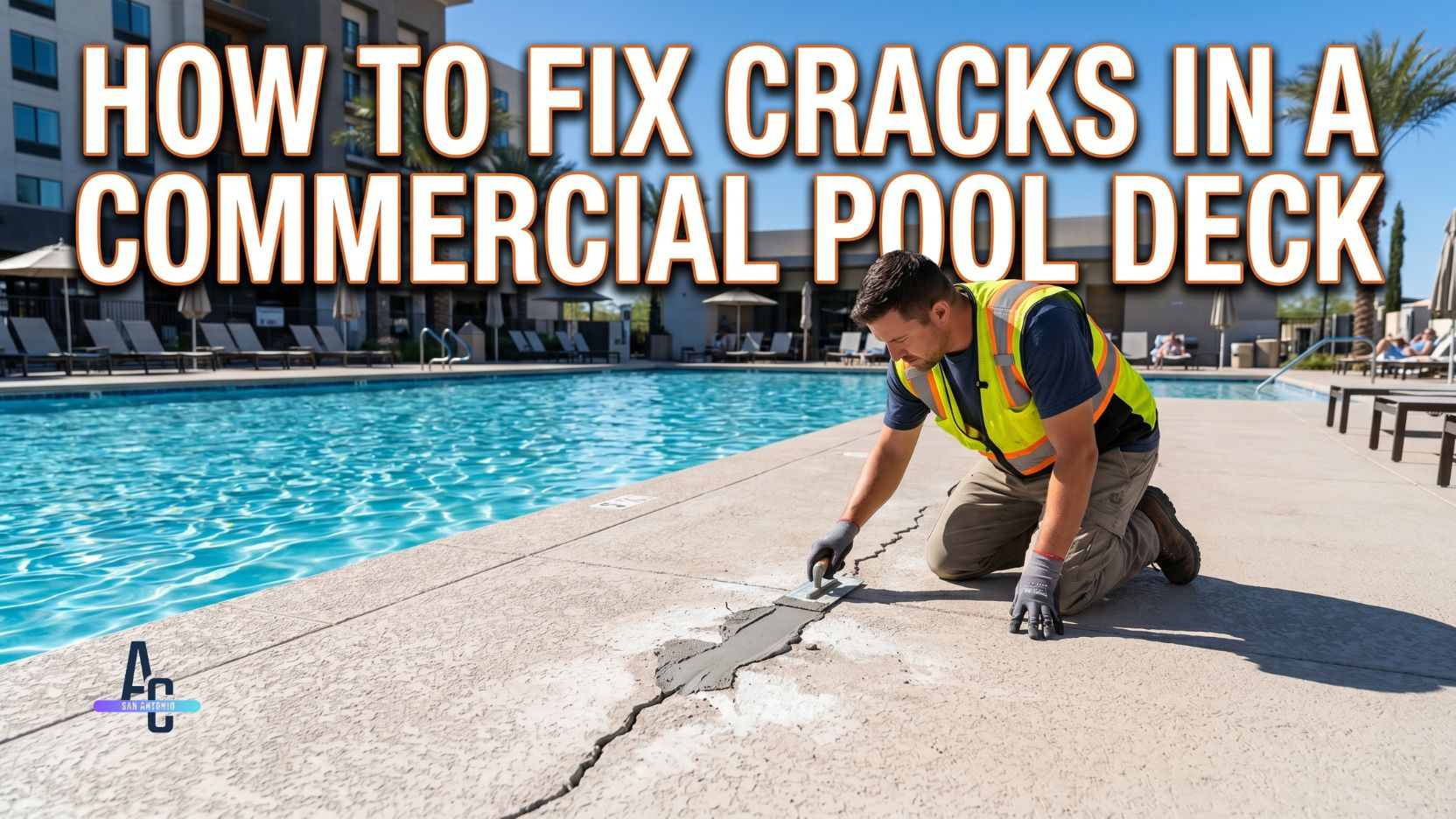
Commercial Pool Deck Repair Guide San Antonio, TX
Not every crack in a commercial pool deck is a crisis, but every crack needs a decision. This guide walks you through how to identify what type of crack you are dealing with, which repairs you can handle in-house, and when the damage requires a licensed concrete contractor before your deck becomes a liability.
Commercial pool deck crack repair San Antonio How to fix concrete cracks pool deck Repair cost guide · Step-by-step process Hotels · HOAs · Apartments · Aquatic Centers Updated 2026
A
Affordable Concrete San Antonio Editorial Team
With over 10 years of residential and commercial concrete experience in San Antonio and the surrounding areas, our team has completed thousands of driveways, patios, pool decks, and commercial slabs across Bexar County. Every guide we publish reflects real on-the-ground expertise not generic contractor advice.
· affordableconcretesanantonio.com · Licensed & Insured · $2M Liability Coverage
Part of our complete commercial pool deck guide
Commercial Pool Deck Guide: Repair, Resurface & Design (2026)
→
1/4″
Crack width threshold where structural assessment becomes mandatory before any surface repair
$3–8/sqft
Typical professional crack repair cost in San Antonio for commercial pool decks
24–48hrs
Minimum cure time before the repaired area can safely handle foot traffic and pool use
10+yrs
Extended deck lifespan achievable with timely crack repair and proper sealing
A cracked commercial pool deck in San Antonio is not just a cosmetic problem. It is a liability exposure, an ADA compliance concern, and the early warning sign of a repair bill that grows with every season you wait. Hotel pools, apartment complexes, HOA common areas, and aquatic centers all face the same reality: concrete in direct Texas sun expands, contracts, and eventually cracks. The question is not whether to repair it, but how to do it correctly.
This guide covers everything a property manager or facilities team needs to know about fixing cracks in a commercial pool deck, from the initial assessment that determines what kind of crack you are actually dealing with, to the step-by-step repair process for each crack type, to the cost expectations and the decision point between a DIY patch and a professional repair.
The rule that changes every crack repair decision: identify before you repair
The single most common mistake in commercial pool deck crack repair is skipping assessment and going straight to a filler product. Surface patching a structural crack does not fix the problem. It hides it. Within one to two seasons, the crack reopens, often wider, and the patch separates, creating a new trip hazard on top of the original one. Before any repair material is applied, you need to know whether the crack is cosmetic shrinkage, active movement, or a symptom of base failure. That determination changes everything about the repair method, the materials used, and whether a licensed contractor needs to be involved.
● ● ●
Five steps to a correct commercial pool deck crack repair
From crack assessment to finished surface
01
Assess the crack type before touching anything
Width, depth, displacement, and movement pattern determine the correct repair method
Assessment
Walk the entire deck surface before you commit to any repair approach. Cracks rarely appear in isolation, and the pattern they form tells you more about the cause than any single crack measurement. Mark every crack with chalk and photograph the full deck from above before you start. This documentation matters for insurance purposes and for tracking whether cracks are growing.
Hairline cracks (under 1/8″ wide): Almost always cosmetic shrinkage cracks from the original cure or normal thermal cycling. No vertical displacement. Common in San Antonio due to the temperature swings between summer heat and cooler evenings. These can be surface-filled.
Medium cracks (1/8″ to 1/4″ wide): Require more thorough preparation and a flexible polyurethane or epoxy filler. Check carefully for vertical displacement before deciding on a DIY repair versus professional work.
Wide or structural cracks (over 1/4″): Mandatory professional assessment before any repair. Likely indicates base failure, soil settlement, or rebar corrosion. Surface patching alone will not hold.
Hairline: Under 1/8″ wide, no displacement, cosmetic Medium: 1/8″ to 1/4″ wide, check for movement Structural: Over 1/4″ wide, vertical offset, call a pro Spalling: Surface flaking, not a crack, different repair method
| Crack characteristic |
What it indicates |
Repair path |
| Under 1/8″ wide, flat, stable |
Normal shrinkage or thermal cycling |
DIY surface filler, then seal |
| 1/8″ to 1/4″ wide, no vertical offset |
Moderate movement, drying shrinkage, or joint failure |
Professional prep and flexible epoxy or polyurethane injection |
| Over 1/4″ wide, any width |
Probable structural or base failure |
Licensed contractor assessment required before repair |
| Vertical displacement (one side higher) |
Soil movement, erosion, or rebar-driven heaving |
Structural repair, potential slab lifting or mudjacking |
| Radial or star pattern |
Impact damage or point load failure |
Remove damaged section, patch or partial slab replacement |
| Cracks running parallel to pool edge |
Hydrostatic pressure or pool shell movement |
Pool structural engineer evaluation before concrete repair |
| Network of small connected cracks (map cracking) |
Alkali-silica reaction or poor original mix design |
Full resurfacing, not individual crack filling |
⚠️ Liability alert for commercial property managers: a crack with vertical displacement on a commercial pool deck is a trip hazard and a premises liability exposure. It needs to be barricaded, documented, and repaired by a licensed contractor. Do not patch over a heaved section with mortar or caulk and call it fixed. That repair will fail, and the documentation trail of an improper fix can significantly increase liability in a slip-and-fall claim.
Assessment checklist before starting any repair
- Full deck walk-through completed, all cracks marked and photographed
- Each crack measured for width: hairline, medium, or structural category confirmed
- Vertical displacement checked: place a straightedge across the crack to detect any height difference
- Crack pattern noted: linear, radial, map cracking, or parallel to pool edge
- Any cracks over 1/4″ wide or with displacement flagged for licensed contractor assessment
- Pool area barricaded if any structural cracks or trip hazards are present
02
Surface preparation the step that determines whether the repair lasts
A repair applied to a dirty, wet, or contaminated crack will fail within one season
Surface Prep
Pool decks are exposed to water, sunscreen, algae, pool chemicals, and foot traffic constantly. All of that contamination lives inside the crack, and if it is not removed before repair material is applied, the bond between the filler and the existing concrete fails quickly. Preparation is not the optional first step. It is the step that determines whether the repair holds for ten years or ten months.
Step 1: Pressure wash the full deck, focus on crack interiors Step 2: Rout or grind hairline cracks to open them for filler Step 3: Remove all loose concrete with a chisel or grinder Step 4: Let the area dry completely before applying any filler
Crack routing for hairline cracks: Hairline cracks are too narrow for most filler products to penetrate and bond properly. A crack router or angle grinder with a diamond blade is used to widen the crack to approximately 1/4″ wide by 1/4″ deep, creating a uniform channel that gives the repair material enough surface area to bond. This step is skipped by many DIY repairs, and it is one of the main reasons pool deck crack patches fail early.
Cleaning the crack interior: After routing, use a wire brush and compressed air to remove all dust, debris, and organic material from inside the crack. For pool decks with algae growth inside cracks, a diluted muriatic acid wash followed by thorough rinsing and drying may be needed. The interior of the crack must be completely dry before any filler product is applied. In San Antonio’s summer heat, this typically takes one to two hours in direct sun after pressure washing.
Pro tip
Time prep around the weather, not around convenience: In San Antonio, the best time to schedule commercial pool deck crack repairs is early morning on a day with no rain forecast for 48 hours. The concrete needs to be dry at repair time and stay dry through initial cure. Afternoon repairs in summer are workable but require faster-setting products because the heat accelerates cure time, which can reduce bond strength if the material skins over before it has fully penetrated the crack.
Surface preparation checklist
- Full deck pressure-washed, crack interiors cleaned of all debris and organic growth
- Hairline cracks routed or ground to 1/4″ wide by 1/4″ deep using a crack router or grinder
- All loose or delaminating concrete removed with a chisel; edges are sound and clean
- Wire brush used on crack interior, followed by compressed air to remove all dust
- Surface allowed to dry completely before any filler is applied, minimum two hours in direct sun
- No rain in the forecast for at least 48 hours from repair time
03
Crack repair materials and methods by crack type
The right product for each crack width, depth, and movement profile
Repair Methods
Using the wrong repair product is as damaging to your outcome as skipping prep. Rigid cementitious patching compounds applied to cracks that are still moving will crack again within a season. Flexible polyurethane sealants applied to deep structural cracks do not provide adequate load transfer. Material selection must match the crack type identified in Step 1.
Polyurea
best for hairline
Polyurea joint filler (Roadware, Metzger/McGuire): The professional standard for hairline and narrow cracks on high-traffic surfaces. Cures in 15 to 30 minutes, is rigid once set, and can be sanded flush and recoated. Excellent bond to dry concrete. Used by professional contractors on commercial pool decks throughout San Antonio.
Epoxy injection (two-part system): Used for medium cracks in stable slabs where structural integrity needs to be restored. Epoxy bonds are typically stronger than the surrounding concrete. Requires proper injection equipment and experienced application. Not appropriate for cracks that are still actively moving, as the rigid epoxy will crack again.
Polyurethane
moving cracks
Flexible polyurethane sealant: The correct choice for cracks that experience thermal movement or are located at control joints that have failed. Remains flexible through San Antonio’s temperature range. Not load-bearing, so it is appropriate for surface sealing at expansion joints rather than interior structural crack repair.
Polymer-modified concrete patch mortar: Appropriate for wider surface voids, spalling, and damaged edges where a shaped patch is needed. Must contain a bonding agent or acrylic modifier. Plain Portland cement patching without a bonding agent fails consistently on pool decks due to the wet environment and foot traffic. Always use a polymer-modified mix.
Application process for polyurea or epoxy crack filler: Pour or inject the material from one end of the crack to the other in a single continuous pass. Overfill slightly and let it cure to the manufacturer’s specified time. Once cured, use a grinder or belt sander to knock the filler flush with the surrounding deck surface. The crack should be invisible at walking height. If the repair area will receive a coating or resurfacer, apply that over the filled crack within the coating product’s recoat window.
🏊 Pool deck-specific note: all crack repair materials used on a commercial pool deck should be verified as safe for pool environments before application. Some epoxy and urethane products off-gas during cure in ways that affect pool water chemistry. Check the product data sheet or consult your pool water chemistry vendor before scheduling the repair adjacent to an operating pool. For most commercial jobs, the pool is taken offline for 24 to 48 hours during deck repair and the return-to-service window is confirmed before reopening.
Repair material checklist
- Repair product selected based on crack type: polyurea for hairlines, epoxy for stable medium cracks, polyurethane for moving joints
- Product verified as compatible with pool environment (check product data sheet)
- Bonding agent or primer applied to crack interior per manufacturer instructions, where required
- Filler applied in one continuous pass, slightly overfilled to allow for grinding flush
- Cure time observed per product data sheet before grinding or sanding flush
- Repaired area checked for flush finish at standing height before moving to sealing
04
Structural crack repair when the damage goes beyond the surface
Slab lifting, mudjacking, partial replacement, and when full resurfacing is the right call
Structural Repair
When a crack has vertical displacement, when sections of the deck have settled or heaved, or when the crack pattern covers more than 15 to 20 percent of the deck surface, surface repair alone is not the right answer. These conditions indicate that the problem is in the base or subgrade, not just the concrete surface. Filling the visible crack without addressing what caused it is a temporary fix that will cost more in the long run.
Slab lifting and foam injection (polyjacking): For settled sections where one side of a crack is lower than the other, polyurethane foam is injected through small drilled holes beneath the slab. The foam expands and lifts the settled section back to grade. Faster than mudjacking and less disruptive to the surrounding deck. Standard turnaround for commercial pools is one day with a 15-minute reopen window after injection.
Mudjacking (slabjacking): A cement-soil-water slurry is pumped beneath the settled slab to lift it. More affordable than polyjacking but heavier, which can cause issues in areas with poor subgrade. Effective for large settled sections.
Polyjacking: Fast, lightweight, 15-min cure to foot traffic Mudjacking: Cost-effective, heavier fill, 24-hr cure Partial replacement: Saw-cut and re-pour the damaged section Full resurfacing: Best when cracking is widespread across deck
Partial slab replacement: When a section of deck is beyond repair, that section is saw-cut at the nearest control joints, the old concrete is removed, the base is inspected and corrected, and new concrete is poured to match the surrounding deck thickness. Color matching is imperfect on partial replacements, but it is the correct structural fix when a section has failed. In San Antonio’s climate, partial replacements are common around pool equipment pads and at the pool edge where water infiltration is highest.
Full resurfacing as structural repair: When cracking is widespread and the underlying slab is still structurally sound but the surface is deteriorated, a bonded concrete overlay or polymer resurfacing system applied over the full deck addresses both the aesthetic and the water infiltration issues at once. This is typically the most cost-effective option when more than 20 percent of the deck surface shows cracking or spalling.
Cost tip
The repair versus replace decision point for San Antonio commercial decks: If individual crack repairs cost more than $4 to $5 per square foot over more than a third of the deck, full resurfacing at $6 to $10 per square foot typically makes more financial sense. You get a uniform surface, a fresh warranty, and you address all of the cracks at once rather than chasing them one by one each season.
Structural repair decision checklist
Licensed contractor assessment completed for any crack over 1/4″ or with vertical displacement
Subgrade condition evaluated before any surface repair begins
Slab lifting option evaluated if settled sections are present and the concrete is otherwise sound
Saw-cut replacement considered for localized sections with severe cracking or rebar corrosion
Full resurfacing evaluated if widespread cracking covers more than 20% of deck area
Pool closure timeline confirmed with operations team before structural repair begins
05
Sealing, finishing, and ongoing prevention
The final step that protects the repair and extends the life of the full deck
Seal and Protect
Every commercial pool deck crack repair, regardless of the method used, should be finished with a penetrating sealer or surface coating appropriate for wet environments. Unsealed repairs allow water to re-enter the repaired crack immediately, beginning the freeze-thaw and chemical deterioration cycle again. In San Antonio, even with mild winters, pool chemicals and UV exposure are aggressive enough on unsealed concrete to degrade a repair within two to three seasons.
Penetrating sealer: Silane-siloxane, soaks in, invisible finish, 3-5 yr interval Acrylic coating: Surface film, adds color and sheen, 2-3 yr interval Polyurethane topcoat: Most durable, chemical-resistant, 3-5 yr interval Anti-slip additive: Required on all commercial pool deck coatings per ADA
Anti-slip requirements for commercial pool decks: Texas Health and Safety Code and local Bexar County requirements mandate slip-resistant surfaces on all commercial pool decks. Any sealer or coating applied to a commercial pool deck must include an anti-slip additive, typically aluminum oxide or silica sand broadcast into the wet coating. This is not optional on a commercial facility. If you are having crack repair work done professionally, confirm in writing that the contractor’s sealer spec includes an approved anti-slip treatment.
Preventing future cracks: The best crack prevention on a commercial pool deck in San Antonio is a combination of a well-maintained sealer schedule, functional expansion joints, and control over pooling water. Water that sits on the deck surface instead of draining finds its way into existing micro-cracks and accelerates deterioration. Confirm that all deck drains are clear and flowing, and that the deck slope toward drains is at least 1/8 inch per foot. Standing water on a commercial pool deck is both a crack accelerant and a slip liability.
🔐 Commercial compliance note: in Texas, commercial swimming pools are regulated by the Texas Department of State Health Services. Pool deck repairs that alter the drainage pattern, surface slope, or barrier configuration may require notification or inspection. For significant structural repairs or full resurfacing, confirm with your local health authority whether a re-inspection is required before reopening the pool to the public.
Post-repair sealing checklist
All repaired areas cured to manufacturer spec before sealer is applied
Penetrating sealer or surface coating appropriate for wet/pool environments selected
Anti-slip additive confirmed in the sealer spec (required for commercial pool decks in Texas)
Full deck sealed, not just the repaired areas, to maintain uniform protection
All deck drains verified clear and functional; standing water eliminated before reopening
Deck slope toward drains confirmed at minimum 1/8″ per foot
Resealing schedule set on calendar: every 2 to 3 years for coated surfaces, 3 to 5 years for penetrating sealers
● ● ●
Cost reference for commercial pool deck crack repair in San Antonio
What different repair types cost in 2026
Commercial pool deck repair costs in San Antonio vary significantly based on crack severity, deck size, accessibility, and whether the pool must be taken offline. The table below reflects typical professional contractor pricing in Bexar County for 2026. DIY material costs are noted where applicable.
| Repair type |
Crack category |
Professional cost (San Antonio) |
DIY material cost |
| Polyurea hairline crack fill and seal |
Hairline, stable |
$3–5/sqft or $150–400 minimum call |
$30–80 for filler kit |
| Epoxy injection, medium cracks |
Medium, stable |
$5–10/linear ft per crack |
$50–120 per kit (2-part) |
| Polyurethane joint re-sealing |
Moving joints |
$3–6/linear ft |
$15–40 per tube |
| Polyjacking (slab lifting) |
Structural, settled |
$5–25/sqft of lifted slab |
Not DIY-appropriate |
| Partial concrete replacement |
Structural, severe |
$12–20/sqft of replaced section |
Not DIY-appropriate |
| Full deck resurfacing (bonded overlay) |
Widespread cracking |
$6–12/sqft of full deck |
Not DIY-appropriate |
| Sealing after repair (penetrating) |
All types |
$1–2/sqft |
$40–120 per gallon (covers 200–400 sqft) |
Budget note
Minimum call-out fees apply for commercial concrete repair in San Antonio: Most licensed concrete contractors in Bexar County have a minimum service call fee of $150 to $400 for commercial work, regardless of the repair size. If you have multiple small cracks to address, it is almost always more cost-effective to schedule all repairs in a single visit rather than calling a contractor out separately for each crack as it appears. Preventive annual inspections with a repair contractor before the busy summer pool season are the standard approach for HOA pools, hotel pools, and apartment complexes with 20 or more units.
● ● ●
Commercial pool deck crack repair master checklist
Complete before starting any repair or signing a contractor agreement
Assessment and safety
Full deck photographed and all cracks marked before any repair work begins
Each crack categorized: hairline, medium, structural, or spalling
Any crack over 1/4″ wide or with vertical displacement flagged for licensed contractor assessment
Trip hazards barricaded and pool area closed to the public during repair
Insurance and incident documentation completed if any trip hazard was identified
Surface preparation
Full deck pressure-washed and crack interiors cleaned of all debris
Hairline cracks routed to 1/4″ wide and 1/4″ deep using appropriate equipment
All loose concrete removed, crack edges sound and clean
Surface completely dry before any filler product applied
No rain forecast for at least 48 hours from repair start time
Repair materials and method
Repair product selected based on crack type and movement status
Product verified as safe for use adjacent to pool environments
Structural cracks referred to a licensed contractor, not patched with surface filler
Repaired areas ground flush with surrounding deck surface after curing
Sealing and compliance
Anti-slip sealer or coating applied over all repaired areas and full deck
Anti-slip additive confirmed in sealer specification (required for commercial pools in Texas)
All deck drains clear and functional; standing water eliminated
Texas DSHS notification confirmed if structural repair or resurfacing altered drainage or barriers
Resealing schedule documented and set on the facility maintenance calendar
● ● ●
Common questions answered
Frequently asked questions
Q
Can I fix cracks in a commercial pool deck myself, or do I need a contractor?
Hairline and small cracks under 1/8″ wide can be handled by a maintenance team with the right products and proper surface prep. The key steps are crack routing, thorough cleaning and drying, the correct filler product, and a compliant anti-slip sealer. Medium cracks from 1/8″ to 1/4″ wide are manageable DIY if there is no vertical displacement, but the prep and product requirements are more demanding. Any crack over 1/4″ wide, any crack with one side higher than the other, and any crack pattern that suggests base failure should go directly to a licensed contractor. The liability risk of an improperly repaired structural crack on a commercial property far exceeds the cost of a professional repair.
Q
How long does a commercial pool deck crack repair take, and how long before we can reopen?
Surface crack filling with polyurea typically cures to foot traffic in 15 to 30 minutes and allows pool reopening within 24 to 48 hours after sealing. Epoxy injection repairs take 6 to 24 hours to cure depending on temperature and product. Polyjacking repairs allow foot traffic in as little as 15 minutes after foam injection. Partial concrete replacement requires a minimum of 7 days before foot traffic and 28 days before full cure, though accelerated-cure mixes are available if pool downtime is a business-critical issue. For scheduled annual maintenance windows, most commercial pool operators target early spring before the peak season, which gives adequate cure time before high-traffic summer use.
Q
Why do cracks in our commercial pool deck keep coming back after we fill them?
Recurring cracks after repair almost always point to one of three causes. First, the underlying cause of the crack was not addressed, meaning the base or subgrade is still moving, and the surface repair is just covering the symptom. Second, the wrong repair material was used, specifically a rigid filler in a crack that is still experiencing thermal movement, which causes the filler to crack again as the concrete expands and contracts through San Antonio’s seasonal temperature range. Third, surface prep was inadequate and the filler did not bond properly to the crack interior. If repairs are failing within one to two seasons, a professional assessment of the full deck and base condition is the correct next step rather than another surface fill.
Q
What causes cracks in commercial pool decks in San Antonio specifically?
San Antonio’s pool decks face a combination of stresses that accelerate cracking compared to many other U.S. markets. Bexar County’s expansive clay soils shrink in the dry summer months and swell when rain returns, creating ground movement beneath the slab year-round. Thermal cycling between summer highs above 100 degrees and winter lows in the 30s causes the concrete to expand and contract repeatedly, stressing any weak points. Pool chemical splash and runoff, particularly chlorine and muriatic acid used for pH control, degrade unsealed concrete surfaces faster than typical foot traffic alone would. Finally, many older commercial pool decks in San Antonio were poured with inadequate base preparation or insufficient expansion joint spacing, making them more susceptible to cracking from normal environmental stresses.
Q
At what point does crack repair stop making sense and full resurfacing become the better option?
The general threshold used by commercial concrete contractors in San Antonio is when cracking affects more than 15 to 20 percent of the deck surface, when individual repair costs would exceed $4 to $5 per square foot across a significant portion of the deck, or when the cracks are so numerous and varied that addressing them individually would result in a visually inconsistent surface. Full resurfacing with a bonded overlay at $6 to $12 per square foot addresses all surface cracking at once, provides a uniform appearance, resets the maintenance clock, and typically comes with a contractor warranty. For a 2,000 square foot commercial pool deck, the decision between $8,000 to $12,000 in crack repairs versus $12,000 to $24,000 in full resurfacing often comes down to the underlying slab condition. If the base is sound and the cracks are surface-level, targeted repairs may still make sense. If the deck shows widespread deterioration, resurfacing is the smarter investment.
More from Affordable Concrete SA
Explore expert commercial pool deck guides from Affordable Concrete SA, including repair signs, resurfacing options, and heat-related damage insights.
Learn more about professional concrete pool deck repair services for San Antonio commercial properties.
🏊
Guide 1
Commercial Pool Deck Guide: Repair, Resurface & Design
→
🔍
Guide 2
Signs Your Commercial Pool Deck Needs Repair
→
☀️
Guide 3
How San Antonio Heat Damages Commercial Pool Decks
→
🛠️
Service page
Concrete Pool Deck Repair San Antonio
→
Get a free commercial pool deck repair quote in San Antonio
Tell us about your deck, the cracks you are seeing, and the size of the affected area. We will assess the damage, identify the correct repair method, and give you a detailed written quote at no cost.