
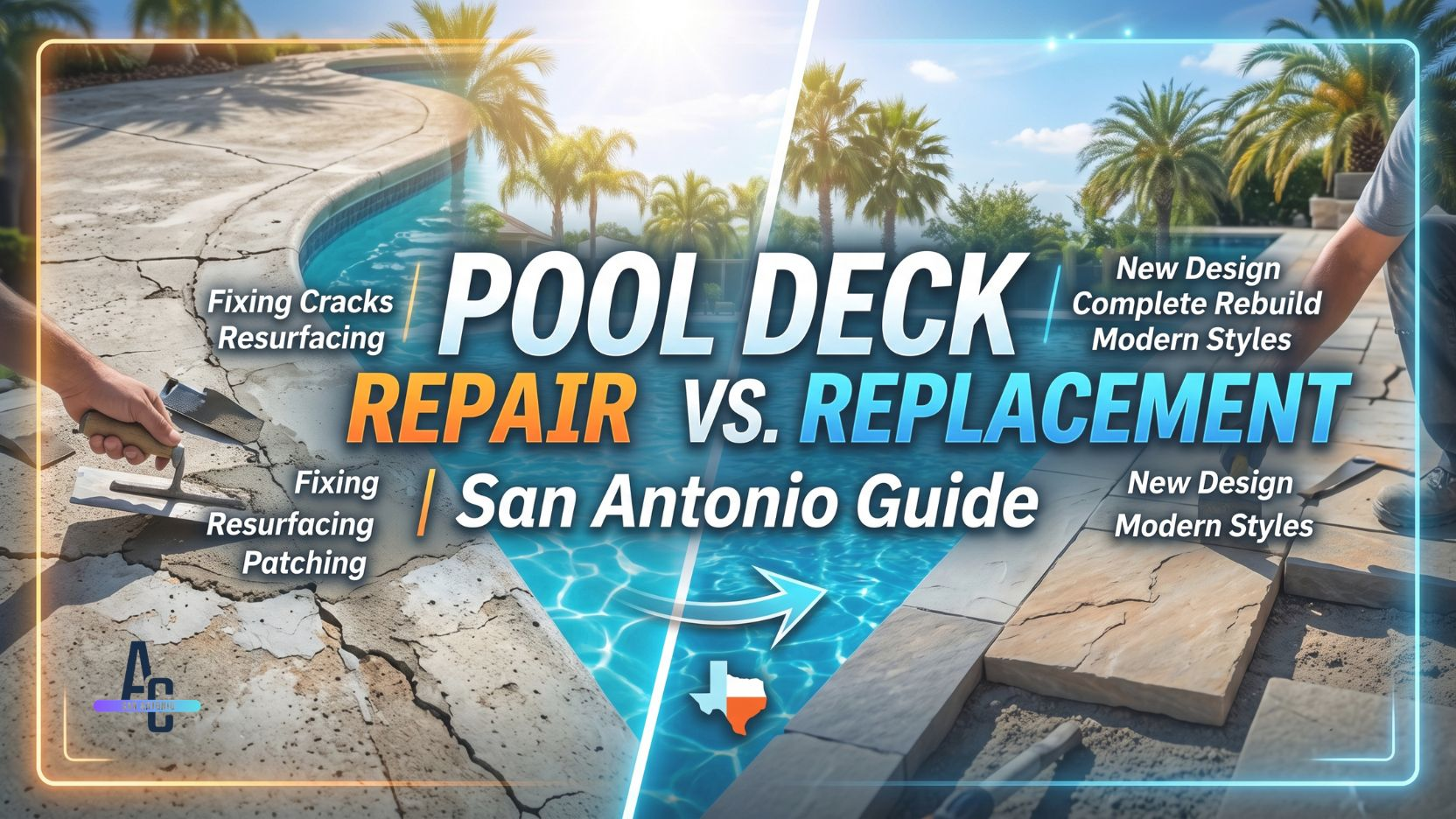
Should you repair your cracked, faded, or uneven pool deck or tear it out and start fresh? This guide covers every factor: damage type, costs, timelines, and when each option makes financial sense for San Antonio homeowners.
A damaged pool deck is one of those problems that seems cosmetic from the outside but can become a structural issue faster than most San Antonio homeowners expect. The intense summer heat, UV exposure, and Bexar County’s expansive clay soils all work together to stress concrete year-round. When cracks appear or the surface starts to spall, the first question is always the same: should you repair it or replace it?
The honest answer depends on four things: the type of damage, how far it has spread, the age of the existing deck, and what you want the finished surface to look like. This guide walks through every scenario with specific cost numbers, realistic timelines, and the exact conditions that make each option the right call.
Repair makes sense when the problem is in the surface layer. Replacement is necessary when the problem is in the slab itself. A contractor who cannot clearly tell you which category your deck falls into has not done a thorough enough assessment. Before any contract is signed, the diagnosis should be specific: surface spalling, structural cracking, base failure, or settling. Each one has a different solution and a very different price tag.
Repair: Yes
Surface spalling is what happens when the top layer of concrete begins to flake, pit, or scale away. In San Antonio, this is almost always caused by a combination of UV degradation, chlorine contact, and freeze-thaw cycles that penetrate an unsealed or improperly sealed surface. The concrete beneath is structurally intact the damage is limited to the top half-inch or inch of the slab.
This is the ideal candidate for resurfacing rather than replacement. A bonding agent is applied to the existing slab, followed by a polymer-modified concrete overlay at 3/8″ to 1/2″ thickness. The result looks and performs like new concrete at a fraction of the replacement cost.
- Damage is limited to the surface layer slab sounds solid throughout when tapped
- No cracks wider than 1/4″ anywhere on the deck
- No sections of the deck are higher or lower than adjacent sections (no vertical displacement)
- Deck is less than 20 years old and was properly installed with adequate base prep
- You are satisfied with the current layout and size of the deck
Repair: Usually
Hairline cracks are common in San Antonio pool decks and are not automatically a sign of structural failure. Concrete shrinks as it cures and expands and contracts with temperature changes. Cracks under 1/4″ wide with both sides sitting at the same level are typically cosmetic and can be filled with a flexible polyurethane or epoxy crack filler before resurfacing.
The key variable is whether the crack is active or stable. An active crack continues to grow; a stable crack has reached its full extent. If you marked a hairline crack with tape six months ago and it has not extended, it is stable. If it keeps growing, something in the base or subgrade is still moving, and resurfacing over it will only delay the problem.
Before signing a resurfacing contract, ask the contractor how they will treat existing cracks. The correct answer is: clean the crack, fill with flexible polyurethane sealant, allow to cure, then apply the overlay. Any contractor who skips the crack treatment step and goes straight to the overlay is setting you up for the same cracks to reappear through the new surface within a year or two.
- Crack width is under 1/4″ at its widest point
- Neither side of the crack is higher than the other no vertical displacement
- Crack has not extended in the past 90 days (mark ends with pencil and recheck)
- Crack does not run continuously from one edge of the deck to the other (full-width cracks suggest base issues)
- Contractor has a documented crack fill procedure before overlay application
Replace: Likely
When one side of a crack sits higher than the other, or when a crack is wider than 1/4″ and still growing, the problem is no longer in the surface. The slab itself is moving, almost always because of what is happening underneath it. In Bexar County, the culprit is usually one of three things: expansive clay soil swelling and contracting with moisture changes, tree root intrusion, or an inadequate base that was not properly compacted when the deck was first poured.
Resurfacing over structural cracks is a short-term fix that typically lasts 12 to 24 months before the same cracks telegraph through the new surface. The financially sound approach is to address the root cause. In most cases, that means removing the damaged sections or the full deck, correcting the base, and pouring fresh concrete.
- Get a written assessment from the contractor identifying the root cause of structural cracking, not just the surface symptoms
- Ask whether section repair (removing only affected areas) is viable, or if full demo is required
- Confirm that base correction is included in any replacement quote new concrete over an uncorrected base will fail again
- Check for tree roots within 10 feet of the deck roots can be the source of ongoing slab movement
- If cracking is localized to one area, compare the cost of section replacement versus full replacement before deciding
Replace: Yes
Some decks have deteriorated past the point where any surface repair makes financial sense. Decks older than 25 to 30 years with widespread cracking, multiple sections at different heights, and an original base that did not include proper compacted fill are candidates for full replacement. So are decks where the homeowner wants a significantly different finish, a larger footprint, or a complete layout change.
Full replacement also makes sense when you have already had a resurfacing job fail within a few years. That is a clear signal that the underlying slab was not sound enough to support an overlay. Putting a second overlay on top of a failed first overlay is not a solution any reputable contractor should recommend.
Full replacement includes demolition, hauling, new base preparation, forming, reinforcement, pour, and finishing. In San Antonio, expect $12 to $20 per square foot all-in for a standard broom or exposed aggregate finish. A 400-square-foot deck comes to $4,800 to $8,000 in most cases. Decorative finishes like stamped or stained concrete add $4 to $8 per square foot to that baseline.
- Quote includes full demolition and concrete haul-off, not just a new pour on top
- Base preparation is itemized separately: minimum 4″ compacted crushed limestone in San Antonio
- Reinforcement type specified: rebar recommended for pool deck slabs due to load and moisture exposure
- Non-slip finish specified broom, exposed aggregate, or stamped with texture required for pool safety
- Expansion joints included in design: every 8 to 10 feet around the perimeter and across large deck surfaces
- Coping and bond beam interface addressed so new deck does not undercut pool waterproofing
Use this framework as your starting point. The damage type and slab condition are the primary drivers. Cost is secondary a cheaper repair that fails in two years is not actually cheaper than a replacement done correctly the first time.
- Surface is spalling or pitting but slab sounds solid when tapped
- Cracks are under 1/4″ wide with no vertical displacement between sides
- Cracks are stable not actively growing over a 60 to 90 day observation period
- Deck is less than 15 to 20 years old with no prior failed repairs
- You are satisfied with the existing deck footprint and layout
- Budget is a significant constraint and the slab is structurally sound
- You need the deck back in service quickly resurfacing takes 2 to 4 days vs. 1 to 2 weeks for replacement
- Cracks exceed 1/4″ width or show vertical displacement between sides
- Multiple sections of the deck are at different heights
- You have already had one resurfacing job fail within 3 to 5 years
- Deck is over 25 years old with widespread cracking and base failure
- You want to significantly change the deck layout, size, or finish type
- Tree root intrusion or soil movement is the confirmed cause of damage
- The existing deck has no expansion joints and is cracking at predictable intervals because of it
Costs vary based on deck size, current condition, finish selection, and how much base correction is required. The numbers below reflect real project pricing in Bexar County. Always get three itemized quotes any quote that does not break out demo, base prep, pour, and finish separately is not giving you enough detail to compare fairly.
A $3 to $4 per square foot resurfacing job on a structurally damaged slab typically fails within 12 to 36 months. The cracks telegraph through the new overlay, water enters, and the cycle of damage accelerates. On a 400-square-foot deck, that is $1,200 to $1,600 spent and you still need the $5,000 to $8,000 replacement that was the right answer the first time. The contractor who tells you what your slab actually needs, even when it costs more, is the one saving you money over the next 10 years.
The San Antonio climate creates a specific set of stressors on pool deck concrete that are not as severe in other parts of the state. Understanding these helps you make better decisions about timing, materials, and maintenance intervals.
Local Factors
Expansive clay soils. Bexar County sits on predominantly Vertisol clay soils that absorb water and expand, then dry out and contract. This seasonal movement puts ongoing stress on any concrete slab sitting on top of it. A pool deck is particularly vulnerable because water is constantly present nearby, causing the soil directly under the deck edge to go through wet-dry cycles more often than soil farther from the pool.
Temperature swings and UV exposure. San Antonio routinely sees summer highs above 100°F and occasional winter nights below freezing. Concrete expands in heat and contracts in cold. A pool deck that was poured without adequate expansion joints every 8 to 10 feet will develop cracking at predictable intervals as the only way the slab has to relieve that thermal stress. In addition, San Antonio’s high UV index accelerates the breakdown of concrete sealers, meaning a sealer that holds up for 5 years in a northern climate may need reapplication every 2 to 3 years here.
Chlorine and chemical contact. Pool chemicals, especially chlorine, will degrade an unsealed or improperly sealed concrete surface over time. Acid washing, common during pool cleanings, also breaks down surface concrete if done too aggressively or too frequently. A sealed deck with regular maintenance intervals lasts significantly longer than one that is left unsealed or receives sporadic care.
- Annual inspection: walk the deck, tap test the surface, check expansion joints for deteriorated sealant
- Reseal every 2 to 3 years acrylic sealer for standard surfaces, polyurethane for high-traffic decks
- Crack fill immediately when cracks appear do not wait for an annual schedule if you see active cracking
- Keep soil around deck perimeter at consistent moisture avoid letting it dry out completely during summer drought
- No trees within 10 feet of the deck perimeter roots are a primary cause of structural cracking over time
| Factor | Repair / Resurfacing | Full Replacement |
|---|---|---|
| Typical cost (400 sqft deck) | $1,200 to $2,800 | $4,800 to $8,000+ |
| Project timeline | 2 to 4 days | 7 to 14 days (includes demo, base, cure) |
| Expected lifespan added | 10 to 15 years on a sound slab | 25 to 35 years with proper maintenance |
| Best for | Surface spalling, stable hairline cracks, fading | Structural cracking, base failure, major settling |
| Finish options | Overlay, exposed aggregate, Kool Deck, acrylic | Any finish broom, stamped, stained, exposed aggregate |
| Pool downtime | Minimal deck only, pool stays open | Longer coping work may require pool closure |
| Can expand deck footprint? | No works within existing slab only | Yes full layout redesign possible |
| Risk if slab is compromised | High overlay will fail if slab is not sound | Low new slab built to correct spec |
| Ideal slab age | Under 15 to 20 years | Any age required if over 25 with widespread damage |
- Contractor has performed a tap test across the full deck surface and identified any delaminated or hollow areas
- Crack width and displacement have been measured and documented in writing
- Root cause of damage is identified: surface wear, shrinkage, base failure, or soil movement
- Written recommendation specifies repair or replacement and explains why
- Existing cracks will be filled with flexible polyurethane or epoxy before overlay is applied
- Surface preparation includes mechanical grinding or shot-blasting not just pressure washing
- Bonding agent type and application method specified in writing
- Overlay thickness confirmed: minimum 3/8″ for functional durability
- Non-slip finish specified required for pool deck safety
- Sealer type and application timing included in contract
- Full demo and haul-off of existing concrete is included in the scope not an add-on
- Base preparation depth specified: minimum 4″ compacted crushed limestone
- Reinforcement type confirmed: rebar is recommended for pool decks in San Antonio
- Expansion joint spacing included in the design plan every 8 to 10 feet
- Coping interface plan documented so new deck does not compromise pool waterproofing
- Cure time confirmed: 7 days before foot traffic, 28 days before sealing
- Certificate of insurance received and verified $1M or more general liability coverage
- Quote is fully itemized: demo, base, pour, finish, and sealing listed separately
- Payment terms confirmed: deposit upfront, balance on completion not full payment before work starts
- San Antonio references available from pool deck projects specifically
How much does it cost to repair a pool deck in San Antonio?
How long does a resurfaced pool deck last in San Antonio?
Can you put new concrete over an old pool deck?
What is the best pool deck surface for San Antonio’s heat?
How long does pool deck replacement take in San Antonio?
Do I need a permit to replace a pool deck in San Antonio?
Get a free pool deck assessment in San Antonio
Not sure whether your pool deck needs repair or replacement? We will come out, assess the slab, and give you a straight answer along with a detailed written quote at no cost.