
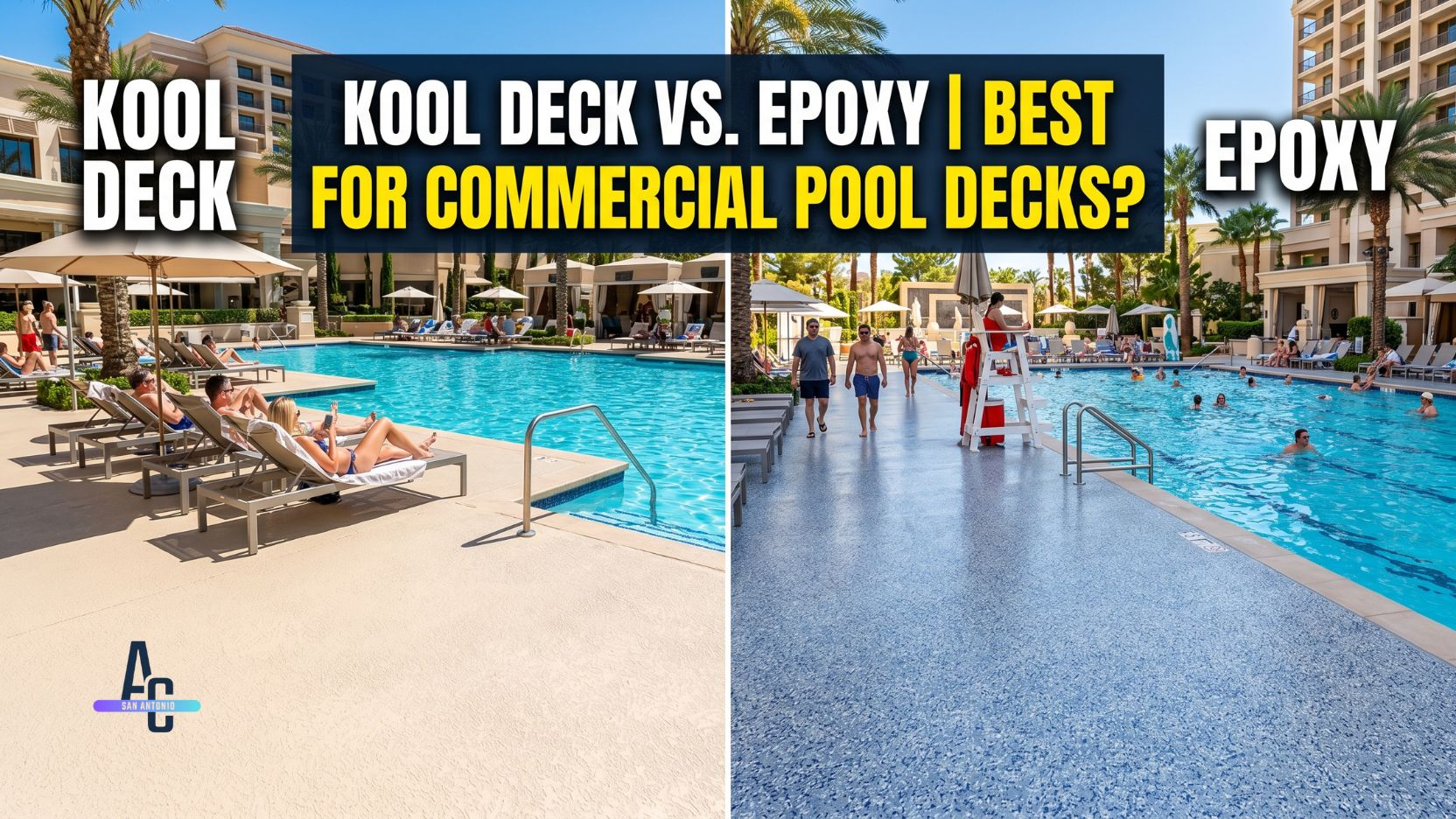
Hotels, apartment complexes, and recreation centers around San Antonio face the same question every time a pool deck needs resurfacing: Kool Deck or epoxy coating? Both products work. Both fail when misapplied. This guide breaks down exactly where each wins and where each falls short so you can make the right call for your property.
When a hotel pool deck starts showing its age cracking, spalling, faded color, or surfaces that burn bare feet in July two resurfacing options come up in nearly every contractor conversation: Kool Deck and epoxy coating. Both are legitimate commercial-grade products. Both are used on pool decks across San Antonio every week. But they are fundamentally different in how they work, what they cost over time, and which conditions push one clearly ahead of the other.
The wrong choice is not a minor inconvenience on a commercial property. A coating system that fails on a hotel pool deck means shutting down an amenity, scheduling emergency repairs, and absorbing costs that a better initial decision would have avoided. This guide gives you the complete picture material properties, installation requirements, cost breakdowns, maintenance demands, and the specific San Antonio conditions that make one product a better fit for most high-traffic commercial applications.
Kool Deck is a cementitious overlay it bonds to concrete, breathes with the slab, and handles heavy foot traffic, direct UV exposure, and pool chemical splash without delaminating. Epoxy is a coating it seals the surface, delivers excellent chemical resistance and a polished look, but is sensitive to moisture vapor transmission and requires a structurally sound, contamination-free substrate to perform. On a high-traffic commercial deck with an older slab and Texas heat, the substrate conditions often determine the answer before aesthetics enter the conversation.
Before going into each product in depth, here is how they compare across the factors that matter most to a commercial property owner in San Antonio.
Kool Deck
Kool Deck is a proprietary cementitious overlay product manufactured by Mortex that has been the default choice for residential and commercial pool decks across the Sun Belt since the 1960s. It is not a paint, a sealer, or a coating in the traditional sense. It is a thin-set mortar topping typically applied at 1/4 to 3/8 inch thickness that bonds to the existing concrete substrate, adds texture, and significantly reduces surface temperature through its reflective, porous composition.
The product’s most recognized feature is its ability to stay measurably cooler underfoot than exposed concrete or dark coatings under direct sun. Independent testing consistently shows Kool Deck surfaces running 20 to 30 degrees Fahrenheit cooler than bare concrete at peak Texas summer temperatures. On a commercial pool deck in San Antonio where surface temps can push past 140 degrees on plain concrete in July, that difference is not a marketing claim it is a liability consideration for barefoot guests.
For commercial applications hotels, apartment complexes, HOA pools, and recreation centers Kool Deck is installed by licensed concrete contractors who mix the product on-site, apply it with a trowel, and texture it before the set. The surface is then sealed with a penetrating or film-forming sealer appropriate for pool environments. The total system, from prep to seal, typically takes two to three days on a standard commercial deck.
- The pool deck is outdoors and exposed to direct Texas summer sun heat reduction is a genuine priority
- Heavy barefoot traffic is expected the texture provides reliable slip resistance without additives
- The existing slab has minor surface defects, hairline cracks, or spalling that needs to be bridged
- Moisture vapor from the slab is a known issue or the slab is near grade level
- The budget favors a lower upfront cost with moderate recoating frequency over time
- The aesthetic goal is a classic pool deck look rather than a high-gloss or decorative floor finish
Epoxy
Commercial-grade epoxy pool deck coatings are a two-part polymer resin system an epoxy base and a hardener that are mixed on-site and applied to the prepared concrete surface. When properly installed on a clean, dry, mechanically profiled substrate, epoxy coatings deliver exceptional chemical resistance, a seamless surface that is easy to clean, and a broad range of aesthetic finishes including solid colors, metallic effects, and decorative chip systems that are popular on covered pool decks, indoor pool facilities, and spa areas.
The distinction between epoxy performing well versus failing completely almost always comes down to two factors: substrate moisture content and surface preparation. Epoxy is a vapor barrier. Once it cures, it seals the concrete surface and prevents moisture from escaping through the slab. If the concrete contains residual moisture above the acceptable threshold typically measured with a calcium chloride test or a relative humidity probe the moisture pushing up from below will break the epoxy bond over time, causing blistering, bubbling, and delamination. This failure mode is not a product defect. It is a substrate condition issue that proper testing before installation would have identified.
A properly specified commercial epoxy pool deck system typically consists of three layers: a penetrating primer that consolidates the concrete and improves adhesion, a high-build epoxy body coat (often 20 to 30 mils total), and a UV-stable polyurethane or polyaspartic topcoat that prevents the epoxy from yellowing under direct sun exposure.
UV yellowing is a real issue with epoxy on outdoor pool decks in Texas: Standard epoxy coatings yellow and chalk under direct UV exposure within one to two seasons in San Antonio’s sun intensity. Any outdoor epoxy pool deck application must specify a UV-stable polyaspartic or aliphatic polyurethane topcoat not a standard epoxy finish coat. Contractors who quote a straight two-part epoxy system for an outdoor deck in Texas are either unaware of this limitation or are pricing the work low by omitting the necessary topcoat. Confirm the topcoat specification before accepting any bid.
Where epoxy genuinely outperforms Kool Deck is in chemical resistance and cleanability. Pool chemical splash chlorine, algaecides, pH adjustment compounds affects all pool deck surfaces over time. Epoxy’s sealed surface resists chemical penetration far more effectively than a porous cementitious overlay. For indoor pool facilities, covered spa decks, locker room floors, and mechanical equipment areas adjacent to pools, epoxy is typically the correct choice. For a fully outdoor commercial pool deck under Texas sun with a moderate to older slab, the calculus shifts significantly toward Kool Deck.
- The pool deck is covered, partially shaded, or indoors UV degradation is not a primary concern
- The slab passes a moisture vapor emission test at or below the manufacturer’s specified limit
- High chemical exposure is expected spas, chemical storage areas, and equipment rooms favor epoxy
- A decorative, high-gloss, or color-coordinated aesthetic is a property requirement
- The substrate is in excellent condition with no active moisture issues or significant cracking
- The budget accommodates higher installation cost and more frequent recoating cycles
Commercial pool deck resurfacing costs in San Antonio vary based on slab condition, square footage, surface preparation requirements, and product specification. The ranges below reflect typical 2026 pricing for commercial properties in Bexar County on slabs in serviceable condition not emergency repairs or severely deteriorated substrates.
Kool Deck costs less upfront but requires recoating every 5 to 7 years in a commercial high-traffic setting. Epoxy costs more upfront and typically needs recoating every 3 to 5 years on an outdoor deck (more frequently if the topcoat specification was inadequate). On a 10,000 sqft commercial pool deck over a 20-year period, total lifecycle costs for both systems are closer than the upfront numbers suggest. The decision should be driven by substrate suitability and application environment not by which quote is lower on day one.
Use this table as your reference when evaluating bids and making a final product decision for your commercial pool deck resurfacing project.
| Factor | Kool Deck | Epoxy Coating | Winner |
|---|---|---|---|
| Surface temperature (direct sun) | 20-30 degrees F cooler than bare concrete | Minimal improvement over bare concrete; dark colors can be hotter | Kool Deck |
| Slip resistance | Built-in texture; excellent wet traction without additives | Good with broadcast aggregate; requires anti-slip additive specification | Kool Deck |
| Chemical resistance (pool chemicals) | Good porous surface absorbs some chemical splash over time | Excellent sealed surface resists chemical penetration | Epoxy |
| Moisture vapor tolerance | High breathable cementitious material allows vapor transmission | Low trapped moisture causes delamination; requires dry slab | Kool Deck |
| UV stability (outdoor) | Stable cementitious material does not yellow under UV | Requires UV-stable topcoat; standard epoxy yellows in 1-2 seasons | Kool Deck |
| Aesthetic range | Limited to earth-tone palette; classic pool deck appearance | Broad solids, metallics, chips, quartz broadcast; high-gloss available | Epoxy |
| Substrate tolerance | Tolerates minor surface defects; bridges hairline cracks | Requires sound, clean, dry substrate; defects must be corrected first | Kool Deck |
| Installation speed | 2-3 days typical for commercial deck | 3-5 days (moisture testing, multiple coats, cure time between coats) | Kool Deck |
| Upfront installed cost | $3-6/sqft typical | $4-9/sqft typical | Kool Deck |
| Recoating frequency | Every 5-7 years in commercial use | Every 3-5 years on outdoor deck; longer indoors | Kool Deck |
| Indoor/covered deck performance | Adequate works well but heat reduction benefit is irrelevant indoors | Excellent no UV or moisture vapor concern; chemical resistance maximized | Epoxy |
| High-traffic durability | Excellent when properly sealed; handles heavy commercial foot traffic | Good with proper topcoat; hard floor chips on sharp point impacts | Comparable |
Installation
A properly installed commercial Kool Deck job follows a specific sequence that does not change regardless of project size. The surface preparation is the most critical phase any contractor proposing to skip or abbreviate the prep is proposing a product that will fail prematurely.
The texturing step done by hand with a brush, trowel, or knockdown pattern tool while the overlay is still workable — must be completed before the product reaches initial set. In San Antonio summer heat, that working window can be as short as 30 to 45 minutes. Experienced commercial crews manage this by working in smaller sections and adjusting mixing water slightly for temperature. Contractors who mix too-large batches in summer and rush the texture work produce inconsistent surfaces that wear unevenly.
- Pressure wash and surface cleaning completed before any overlay application
- Acid etch or mechanical scarification specified bonding agent included in the scope
- All cracks and spalls repaired and fully cured before overlay is applied
- Overlay thickness specified in writing: 1/4″ to 3/8″ for commercial applications
- Texture pattern confirmed and shown in a sample area before full application
- Sealer specified by product name penetrating sealer appropriate for pool deck use
- Deck closed to traffic for minimum 24 hours after sealing; 48 hours preferred
Installation
Commercial epoxy pool deck installation is more demanding in its substrate requirements than Kool Deck, and the consequences of cutting corners are more severe. Epoxy that delaminates on a commercial pool deck does not just look bad it creates a trip and fall liability surface that has to be fully removed before any recoating can be done.
The moisture test is non-negotiable and must happen before any other work is quoted as final. If the slab fails the moisture vapor emission rate test (typically above 3 lbs per 1,000 sqft per 24 hours using calcium chloride, or above 80% relative humidity using an in-slab probe), the project either requires a moisture mitigation primer which adds cost or Kool Deck is the more appropriate product for that slab. Any contractor who bids an epoxy job without specifying moisture testing has either omitted a line item or does not understand why the test matters.
- Moisture vapor emission test completed and results documented before accepting bid
- Shot blast or diamond grind prep specified acid etch alone is not adequate for commercial epoxy
- Primer coat specified by product name compatible with body coat system
- Body coat mil thickness specified in writing (20-30 mils total is typical for commercial use)
- Anti-slip aggregate broadcast confirmed type and broadcast density specified
- Topcoat specified as UV-stable polyaspartic or aliphatic polyurethane not standard epoxy
- Cure time between coats and before traffic loading confirmed per manufacturer data sheet
The combination of San Antonio’s summer heat intensity, the moisture vapor transmission characteristics of most commercial pool deck slabs poured at or near grade, and the heavy barefoot traffic typical of hotel and apartment pool environments makes Kool Deck the more reliable long-term choice for the majority of outdoor commercial pool decks in Bexar County.
Kool Deck’s built-in heat reduction is a measurable safety and comfort benefit in a city that regularly sees pool deck surface temperatures exceeding 130 degrees on bare concrete. Its cementitious composition tolerates the moisture conditions that cause epoxy to fail prematurely. It is less expensive to install, tolerates a wider range of substrate conditions, and provides adequate chemical resistance for standard pool deck splash exposure. The recoating cycle is longer, and the total lifecycle cost over 20 years is competitive with epoxy even accounting for the lower initial cost.
Epoxy is the right choice for covered or indoor pool facilities, spa areas, equipment rooms, and situations where a high-end decorative finish is a property requirement. If your commercial pool deck is a covered cabana, a resort-style indoor facility, or an area where chemical resistance and aesthetics outweigh surface temperature concerns specify a properly designed epoxy system with a UV-stable topcoat and invest in the substrate preparation it requires.
- Deck location confirmed: outdoor and exposed = Kool Deck; covered or indoor = evaluate epoxy
- Moisture vapor emission test specified in the scope for any epoxy bid
- Surface temperature concern assessed: barefoot traffic in direct sun favors Kool Deck
- Aesthetic requirement confirmed: if high-gloss or decorative finish is required, epoxy with UV-stable topcoat
- Existing coating assessed: failed coating removal cost added to any recoating bid
- Surface preparation method specified in writing: acid etch vs. shot blast vs. mechanical scarify
- Product name and manufacturer specified not just “Kool Deck-type overlay” or “epoxy coating”
- Number of coats, application thickness, and topcoat system all itemized in the bid
- Anti-slip specification confirmed: texture type for Kool Deck; aggregate broadcast rate for epoxy
- Sealer or topcoat product name specified UV-stable required for any outdoor epoxy application in Texas
- Certificate of insurance with $1M+ general liability received and verified before work begins
- Commercial pool deck references from San Antonio properties available on request
- Payment terms confirmed: deposit on start, balance on completion not full payment upfront
- Warranty terms specified in writing: what is covered, for how long, and what voids coverage
- Resealing schedule confirmed in writing: Kool Deck every 2-3 years; epoxy topcoat per manufacturer
- Cleaning protocol specified: approved cleaners that will not degrade the coating system
- Traffic restriction period confirmed: deck closed for minimum 24-48 hours after final coat
- Warranty inspection date scheduled for 12 months after installation
Can Kool Deck be applied over an existing Kool Deck surface, or does the old coating have to come off first?
How long does a commercial pool deck have to be out of service for each product?
Is Kool Deck or epoxy better for a hotel pool deck in San Antonio specifically?
What causes Kool Deck to crack, and can those cracks be repaired without resurfacing the entire deck?
Do I need a permit to resurface a commercial pool deck in San Antonio?
Get a free commercial pool deck quote in San Antonio
Tell us about your property hotel, apartment complex, HOA pool, or recreation center. We will assess the slab, recommend the right product system, and give you a detailed written quote at no cost.