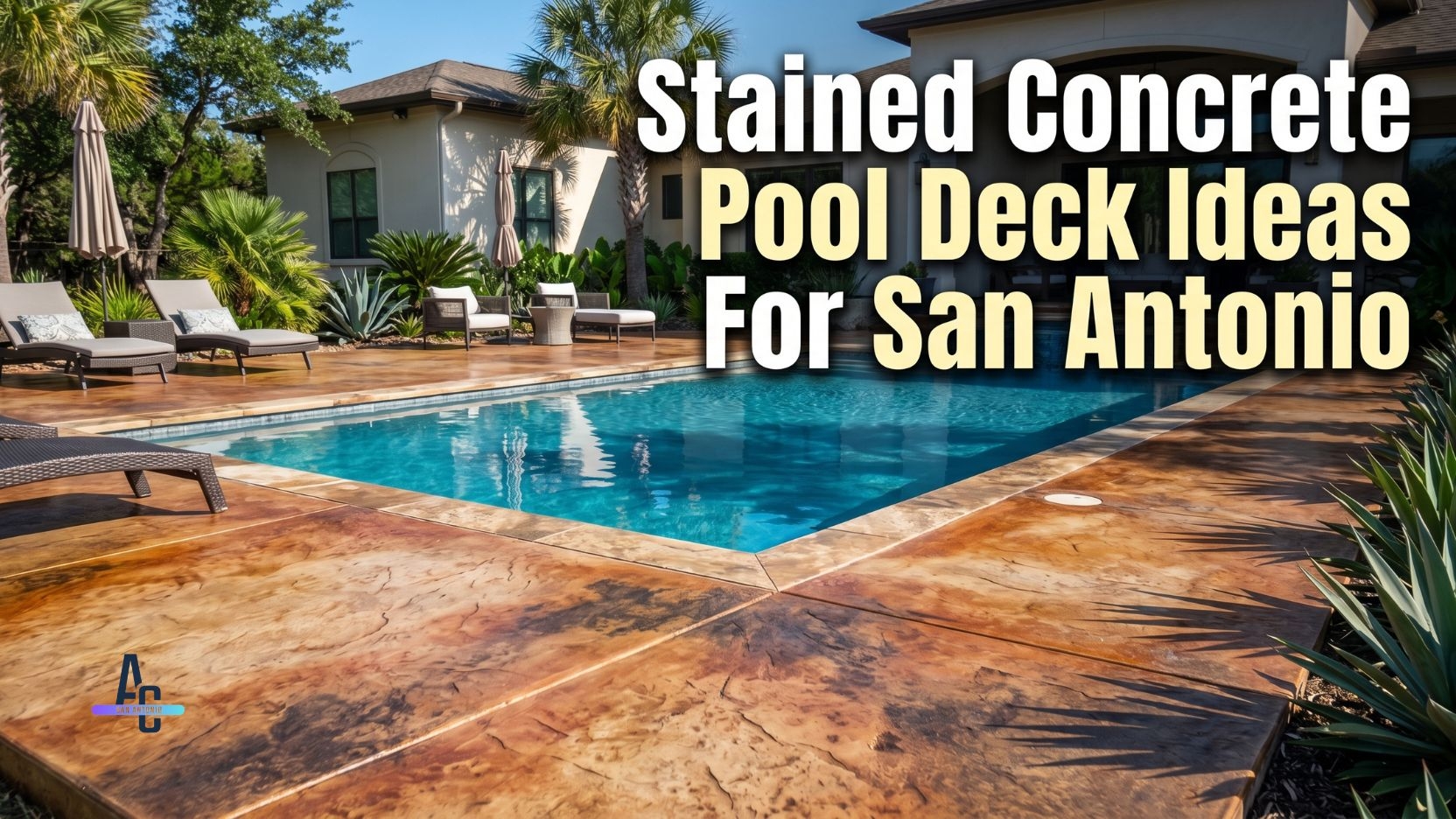
Stained Concrete Pool Deck Ideas For San Antonio

Stained Concrete Pool Deck Ideas For San Antonio

Stained Concrete Pool Deck Ideas for San Antonio | Affordable Concrete SA
Pool Deck Guide, San Antonio, TX

From acid-stained terra cotta to water-based charcoal, this guide covers every stained concrete pool deck option available in San Antonio with real cost numbers, what holds up in South Texas heat, and how to avoid the finishes that fade in two summers.

Stained concrete pool deck San Antonio Acid stain vs. water-based stain Cost guide · Color ideas · Heat ratings Slip resistance · Sealing · Drainage Updated 2026
A
Affordable Concrete San Antonio Editorial Team
With over 10 years of residential and commercial concrete experience across Bexar County, our team has completed hundreds of pool deck projects in San Antonio's climate. Every recommendation in this guide comes from what we see hold up and what we see fail on real pool decks in the Texas heat.
· affordableconcretesanantonio.com · Licensed & Insured · $2M Liability Coverage
$8–15/sqft
Typical installed cost for a stained concrete pool deck in San Antonio
2–3yrs
Recommended resealing interval in San Antonio's UV-heavy climate
4"
Minimum slab thickness required for a residential pool deck surface
100°F+
San Antonio summer surface temps that make color and sealer choices critical

A stained concrete pool deck solves a problem that plain gray concrete can't: it gives you a surface that looks like natural stone, tile, or weathered terra cotta without the cost or the maintenance headaches of the real thing. In San Antonio, where pools are used six months or more out of the year and summer temperatures push concrete surface temps well past 100 degrees, the material you choose for your deck matters as much as how it looks.

This guide covers every stained concrete option available for San Antonio pool decks. We explain the difference between acid staining and water-based staining, which colors hold up in South Texas UV exposure, what the deck should be built on before any stain touches the surface, and what a realistic project budget looks like start to finish.

The most important thing to understand about stained pool decks in San Antonio

Staining is a finish applied on top of concrete, not a structural product. The reason stained pool decks fail prematurely in San Antonio is almost never the stain or the color. It is a base that was not properly compacted, a slab that was poured too thin, or a sealer that was applied before full cure. Get the concrete right first. The stain is the last five percent of the job, not the first decision you make.

● ● ●
Understanding your options
Stain types for San Antonio pool decks: what each one actually does
01
Acid staining: the classic choice for rich, mottled earth tones
A chemical reaction that permanently bonds color into the concrete surface
Acid Stain

Acid staining is not a paint or a coating. It is a chemical solution that reacts with the minerals in the concrete itself, producing a permanent color that becomes part of the slab. Because it works through reaction rather than adhesion, acid-stained concrete will never peel, chip, or flake the way paint or coating-based products can. The color penetrates the surface and stays there.

The palette for acid staining is limited to earth tones: terra cotta, amber, walnut brown, rusty orange, and muted greens. These are not arbitrary style choices. The chemical reaction only produces certain hues based on the metallic salts in the solution and the calcium in the concrete mix. You cannot get a true blue or gray from acid staining. What you can get is a depth and variation that looks like natural stone and ages beautifully over years.

For San Antonio pool decks, acid staining in warm terra cotta and amber tones works exceptionally well. The mottled variation means every slab looks slightly different, and poolside use and UV exposure tend to add character to an acid-stained surface rather than degrading it.

Color range: Terra cotta, amber, walnut, sage green, rusty brown Appearance: Mottled, no two slabs identical Penetration depth: 1/16" to 1/8" into slab Can it peel? No, it is chemically bonded
Pool deck note: Acid staining works on existing concrete as well as new pours, which makes it one of the few finishing options that can transform an ugly but structurally sound existing deck without a full demo and replacement.
Acid stain: what to confirm before starting
  • Existing concrete must be free of sealers, coatings, or curing compounds, as these block the acid reaction
  • Concrete age: slab should be at least 28 days old before acid staining on new pours
  • Surface prep: mechanical grinding or acid washing required to open the concrete pores
  • Neutralization step must follow application; residue must be fully removed before sealing
  • Sealer selection matters for pool use: penetrating silane/siloxane or non-slip epoxy topcoat recommended
02
Water-based staining: expanded color range, more predictable results
Acrylic pigments that penetrate the surface and offer colors acid staining cannot produce
Water-Based

Water-based concrete stains use acrylic pigments suspended in water to penetrate and color the concrete surface. Unlike acid stain, water-based stains are not relying on a chemical reaction. The color is more consistent and predictable, and the palette is significantly broader; blues, grays, charcoals, and even near-blacks are achievable, which acid staining cannot produce.

For San Antonio pool decks, water-based staining in slate blue, charcoal, or cool gray creates a look that complements pool water rather than competing with it. Cooler-toned colors also reflect more sunlight than warm earth tones, which can make a meaningful difference in surface temperature on a 95-degree July afternoon.

The tradeoff versus acid staining is that water-based stains sit slightly closer to the surface and can be more sensitive to foot traffic wear over time without proper sealing. A high-quality penetrating sealer or slip-resistant topcoat applied on the recommended schedule is essential for any water-based stained pool deck.

Color range: Full spectrum, blues, grays, greens, custom blends Consistency: More uniform than acid stain Application: Spray, brush, or roller, easier DIY option Heat performance: Cooler tones reduce surface temperature vs. dark stains
Water-based stain: key considerations
  • Surface must be clean and free of oil, grease, or previous sealer for proper penetration
  • Multiple coats often required for deeper color saturation; factor this into the project timeline
  • Sealer is mandatory: water-based stain is more vulnerable to moisture and pool chemical exposure without topcoat
  • Color samples on your actual slab are essential; pigment appearance varies by concrete mix and age
  • Slip-resistant additive (aluminum oxide or silica sand) must be mixed into the sealer for pool use
03
Stain plus texture: combining staining with stamped or exposed aggregate
The option that delivers both color and built-in slip resistance
Combination

Staining does not have to be applied to a smooth slab. Many San Antonio homeowners combine acid or water-based staining with a stamped pattern or exposed aggregate texture. The result is a surface that has both the color depth of staining and the natural slip resistance of texture, without relying entirely on the sealer to create traction.

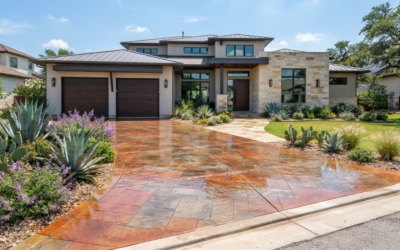
Stained stamped concrete in a flagstone or slate pattern is one of the most popular high-end pool deck options in San Antonio. The stamps create grout lines and surface variation that mimic natural stone convincingly, and the acid stain fills those variations with the warm color shifts that make the imitation look genuine from a few feet away. It is more labor-intensive than staining a plain slab and comes at a higher cost, but the result is the closest thing to natural stone at a concrete price point.

Stamped + stained: $15–25/sqft installed in San Antonio Exposed aggregate + stained: $12–18/sqft, natural texture with added color Slip resistance: Texture provides baseline traction, sealer additive supplements it Best for: Homeowners wanting a natural stone look without natural stone cost
Design tip

The most requested combination in San Antonio right now: Stamped concrete in a random flagstone pattern, acid-stained in a mix of terra cotta and walnut brown, sealed with a matte penetrating sealer plus slip-resistant additive. It photographs like real stone, holds up to pool chemicals, and never needs regrouting. The sealer needs refreshing every 2 to 3 years, but that is the full maintenance requirement.

● ● ●
Color ideas for San Antonio
Stained pool deck color options: what works in South Texas

Color choice for a pool deck in San Antonio is not just an aesthetic decision. Dark colors absorb more heat, making the surface uncomfortable in July and August without shade. Certain pigments fade faster under South Texas UV exposure than others. These are the color approaches that consistently perform well here.

Terra Cotta
Warm Terra Cotta
The most popular acid stain color in San Antonio. Complements limestone homes and blends with the South Texas landscape. Ages gracefully; UV exposure deepens the tone over time rather than washing it out.
Acid stain · $8–12/sqft
Slate Blue
Slate Blue / Charcoal
Water-based stain only; acid staining cannot produce true blue tones. A modern choice that complements blue pool water and reflects more heat than dark earthy tones. Popular in contemporary and Spanish colonial-style San Antonio homes.
Water-based · $9–13/sqft
Walnut
Walnut Brown
A deep, neutral brown achievable with acid stain. Pairs well with travertine tile coping and natural stone features. The variation in walnut-toned acid stain makes each section of the deck slightly different, which adds character rather than uniformity.
Acid stain · $8–12/sqft
Sandstone
Sandstone Beige
A light, neutral tone that reflects heat effectively and complements nearly any pool finish or coping material. Achievable with light-tinted water-based stain or a diluted acid stain application. The easiest color to maintain and touch up over time.
Water-based · $8–11/sqft
Sage Green
Sage Green / Olive
A nature-inspired tone that blends with landscaping and garden features. Green is one of the few non-earth-tone colors achievable with acid staining. Works best in shaded or partially shaded pool areas where cooler tones do not feel out of place.
Acid stain · $8–12/sqft
Charcoal
Charcoal Gray
A modern, high-contrast look that pairs with white or black pool finishes. Water-based stain only. Note: dark colors absorb significantly more heat in San Antonio summer. Charcoal decks should be paired with ample shade structure and anti-slip additive in the sealer to avoid surface discomfort on hot afternoons.
Water-based · $9–13/sqft
Heat tip

San Antonio surface temperature reality check: A dark charcoal-stained pool deck in direct San Antonio sun can reach 140 to 150 degrees Fahrenheit on a July afternoon. A light sandstone or beige-toned deck in the same conditions typically stays 20 to 30 degrees cooler. If your pool area gets full afternoon sun, light to mid-range tones are not just a style choice; they are a comfort and safety consideration for bare feet, especially for children.

● ● ●
What goes under the stain
Pool deck slab requirements: the foundation that makes staining last
04
Base prep, slab thickness, and drainage slope: the spec your contractor must hit
A beautiful stain on a poorly built slab is money spent on something that will crack in a few years
Structural

Stained concrete is only as good as the slab it is applied to. In Bexar County, the soil is predominantly expansive clay; Vertisol soils that swell when wet and shrink when dry. This movement puts constant stress on concrete slabs. A pool deck slab poured without adequate base preparation will crack regardless of how well the stain and sealer are applied. The stain is the last step, not the most important one.

4–6"
base depth
Crushed limestone base: The standard base material for San Antonio pool decks. Compacted in 2-inch lifts using a plate compactor. This base layer is what keeps the slab from moving with the clay beneath it. Never skip or reduce this step.
4"
slab thickness
Minimum 4-inch slab: The absolute minimum for a residential pool deck. Anything thinner is prone to cracking under foot traffic and the thermal expansion cycles San Antonio's summers create. Wire mesh reinforcement is standard; rebar at 18-inch centers is the stronger spec.
1/8"
per foot slope
Drainage slope away from pool: Pool decks must slope away from the pool edge and toward drainage points. The minimum is 1/8 inch per foot, enough to move water off the surface without creating a visible tilt. Flat decks pool water against the pool wall and accelerate surface and coping deterioration.
10 ft
joint spacing
Control joint spacing: Expansion joints cut every 8 to 10 feet allow the slab to expand and contract with temperature changes without cracking randomly. On a stained deck, joints are filled with flexible polyurethane sealant that matches the stain color as closely as possible.
Pool chemical note: Chlorine and saltwater pool systems both expose surrounding concrete to corrosive chemicals over time. A penetrating silane or siloxane sealer applied to the cured slab before staining provides a moisture barrier that significantly extends the life of both the concrete and the stain in pool environments.
Slab specification checklist
  • Base preparation: 4 to 6 inches of compacted crushed limestone, confirm this is itemized in your quote
  • Slab thickness: 4 inches minimum, specified in writing before pour day
  • Reinforcement: wire mesh or rebar grid elevated to mid-slab height, not resting on the ground
  • Drainage slope: 1/8 inch per foot away from pool confirmed in the layout plan
  • Control joints: planned at 8 to 10-foot intervals, filled with color-matched flexible sealant
  • Cure time before staining: minimum 28 days for new pours
● ● ●
Safety for pool use
Slip resistance on stained pool decks: what is required and how to get it
05
Keeping a stained concrete pool deck safe when wet
Staining alone does not create slip resistance; the sealer system determines pool-safe traction
Safety

Smooth, sealed concrete is one of the most slippery surfaces imaginable when wet. A pool deck covered in wet feet all summer is one of the highest-risk surfaces in a residential property. Staining a pool deck without addressing slip resistance is not acceptable. The good news is that the fix is straightforward and does not require any compromise to the appearance of the stain.

Slip-Resistant Sealer Additive
Aluminum oxide or silica sand particles are mixed into the liquid sealer before application. The particles suspend in the sealer and create a fine grit on the cured surface. This is the most common and most cost-effective approach for stained pool decks; it preserves the look of the stain while adding meaningful traction.
Add cost: $0.50–1.00/sqft above standard sealer. Must be reapplied with each resealing cycle.
Broom Texture Before Staining
A light broom finish applied during the pour creates surface texture that provides baseline traction. When staining is applied over a broom-finished slab, the stain fills the texture rather than eliminating it. This is the recommended spec for pool decks that prioritize barefoot safety; texture plus sealer additive is the strongest combination.
No add cost. Must be specified during the pour; it cannot be added after the concrete cures.
Anti-Slip Epoxy Broadcast System
An epoxy topcoat with broadcast aggregate (fine quartz or aluminum oxide) applied over the stained surface. The most durable slip-resistance system available for pool decks and the best choice for high-traffic commercial pool environments. The aggregate is broadcast into wet epoxy and locked in when the epoxy cures.
Cost: $2–4/sqft add-on. Extremely durable; resists pool chemicals, UV, and heavy foot traffic.
Stamped Texture (Built-In)
Stamped concrete patterns create surface relief that functions as inherent slip resistance. When combined with acid or water-based staining, the result is a surface that looks like natural stone and has texture-based traction rather than relying solely on sealer additives. The most aesthetically seamless slip-resistance solution available.
Already included in stamped + stained pricing. Sealer additive still recommended for maximum safety.
Pool deck slip resistance checklist
  • Slip-resistant additive (aluminum oxide or silica sand) confirmed in sealer specification
  • Surface texture method confirmed: broom finish, stamp pattern, or aggregate broadcast
  • Coefficient of friction standard: pool decks should meet a minimum COF of 0.6 when wet
  • Sealer type appropriate for pool chemical exposure confirmed with contractor
  • Anti-slip treatment repeated with each resealing cycle; it is not a one-time permanent treatment
● ● ●
What to budget
Stained concrete pool deck cost in San Antonio: a realistic breakdown

Pool deck pricing in San Antonio varies by slab condition, square footage, stain type, and whether the project involves new construction or refinishing an existing deck. These are the real numbers based on what local contractors are charging in 2026.

Scope Stain type Includes Installed cost (San Antonio)
Stain existing deck only Acid stain Surface prep, stain, seal, slip additive $3–6/sqft
Stain existing deck only Water-based stain Surface prep, stain, seal, slip additive $4–7/sqft
New slab + acid stain Acid stain Demo, base prep, pour, stain, seal $8–13/sqft
New slab + water-based stain Water-based stain Demo, base prep, pour, stain, seal $9–14/sqft
New slab + stamped + acid stain Acid stain over stamp Full build, stamp, stain, seal $15–25/sqft
Reseal existing stained deck Sealer only Light prep, sealer, slip additive $1–2.50/sqft
Why low bids on pool decks in San Antonio should concern you

Pool deck staining is skill-dependent. The application window for acid staining is narrow; temperature, humidity, and concrete moisture all affect the reaction. A contractor who undercuts the market by 30 to 40 percent is almost certainly skipping surface preparation steps, using diluted product, or rushing the neutralization and sealing process. Any of these shortcuts shows up within one to two seasons as blotchy color, sealer failure, or a surface that cannot be resealed without full stripping. Request references for completed stained pool decks and ask how long ago the work was done.

● ● ●
Keeping it looking good
Maintenance schedule for a stained concrete pool deck in San Antonio
06
Sealing, cleaning, and long-term care in South Texas conditions
San Antonio's UV intensity and pool chemical exposure make sealer maintenance non-negotiable
Maintenance

Stained concrete pool decks in San Antonio require more frequent sealer maintenance than stained surfaces in cooler climates. South Texas UV exposure accelerates sealer degradation; a sealer that would last five years in the Pacific Northwest may show breakdown in two to three years in San Antonio. This is not a product failure. It is a climate reality that every pool deck owner here needs to plan for.

First seal: Applied after staining on cured slab, at 28+ days Resealing: Every 2–3 years in San Antonio; inspect annually Cleaning: pH-neutral cleaner only; avoid acid-based deck washes that strip sealer Chlorine splash zones: Rinse promptly; concentrated chlorine etches unsealed concrete

The best indicator that your sealer needs refreshing is a simple water bead test. Splash a small amount of water on the stained surface. If the water beads up on the surface, the sealer is still intact. If the water soaks into the concrete, the sealer has broken down and needs to be reapplied before the next pool season. Do this test once a year, and you will never have to wonder when to reseal.

Timing tip

Best time to reseal a pool deck in San Antonio: October through early March. Sealer application requires surface temperatures above 50 degrees and below 90 degrees Fahrenheit, and the surface needs to stay dry for 24 to 48 hours after application. San Antonio's spring season, February through April, is ideal. Avoid resealing during the rainy season (May through September) when afternoon thunderstorms are common.

Annual pool deck maintenance checklist
  • Water bead test in early spring to assess sealer condition before pool season
  • Pressure washing with pH-neutral cleaner; avoid citrus or acid-based deck cleaners
  • Inspect control joints annually: refill cracked or missing joint sealant with flexible polyurethane
  • Check for surface cracking; hairline cracks under 1/4" can be filled, wider or displaced cracks need professional assessment
  • Reseal every 2 to 3 years with slip-resistant additive included in the sealer mix
  • Rinse chlorine splash zones after heavy pool use; do not allow concentrated chlorine to dry on the surface
● ● ●
Complete stained pool deck project checklist
Review before signing any contract or approving any color
Slab and structural specification
  • Base depth confirmed: 4 to 6 inches of compacted crushed limestone specified in the quote
  • Slab thickness: minimum 4 inches confirmed in writing
  • Reinforcement: wire mesh or rebar at mid-slab height, not resting on the ground
  • Drainage slope: 1/8 inch per foot away from pool edge confirmed in the layout
  • Control joints: every 8 to 10 feet, filled with color-matched flexible sealant
Stain type and color
  • Stain type selected: acid stain for earth tones, water-based for blues and grays
  • Color sample applied to your actual slab, not just a brochure reference
  • Heat reflectance considered: lighter tones recommended for full-sun pool areas
  • If existing deck: surface confirmed free of previous sealer or coating before staining
  • Cure time confirmed: 28 days minimum for new slab before staining begins
Slip resistance and sealer
  • Slip-resistant additive (aluminum oxide or silica sand) included in sealer specification
  • Sealer type appropriate for pool chemical exposure confirmed with contractor
  • Surface texture method confirmed: broom, stamp, or aggregate broadcast
  • First sealing scheduled at 28 to 30 days after pour
Contractor and contract
  • Certificate of insurance received and verified, $1M or more in general liability
  • Quote itemizes base prep, pour, stain, seal, and cleanup separately
  • References for completed stained pool decks available; ask how old the work is
  • Payment terms: deposit at signing, remainder on completion, not full payment before work
● ● ●
Common questions answered
FAQs
Q
Can I stain my existing concrete pool deck, or does it need to be replaced?
In most cases, an existing pool deck in good structural condition can be stained without replacement. The key requirements are that the concrete must be structurally sound (no heaving, no displaced cracks), free of sealers or coatings that would block the stain from penetrating, and properly prepared with mechanical grinding or acid washing before application. If the existing deck has significant cracking, base failure, or a previous coating that cannot be fully removed, replacement is the better option. A contractor can assess your current deck and give you an honest recommendation after a site visit.
Q
How hot does a stained concrete pool deck get in San Antonio summer?
Surface temperature depends primarily on color. A dark charcoal or walnut-stained deck in full San Antonio sun can exceed 140 degrees Fahrenheit on a 100-degree July afternoon, which is uncomfortable and potentially dangerous for bare feet. A light sandstone or beige-toned deck in the same conditions typically stays 20 to 35 degrees cooler. If your pool area receives direct afternoon sun from 1 to 6 p.m. (which most San Antonio backyards do in summer), light to medium tones are strongly recommended. Shade structures over a portion of the deck also help significantly, regardless of color.
Q
How long does stained concrete last on a pool deck?
Acid-stained concrete, once fully cured and properly sealed, is a permanent color; the chemical reaction cannot be reversed. The stain itself does not fade or wear out. What degrades over time is the sealer on top of it. In San Antonio's climate, the sealer on a pool deck needs refreshing every two to three years. If the sealer is maintained on schedule, a well-applied acid-stained pool deck can look great for 20 years or more. Water-based stains have a similar lifespan with proper sealing, though they are slightly more sensitive to long-term UV exposure than acid stains in direct sun applications.
Q
Is stained concrete slippery around a pool?
Plain sealed concrete is slippery when wet. Stained concrete with no slip-resistant treatment is not appropriate for pool deck use. The standard approach is to mix a slip-resistant additive (aluminum oxide or silica sand particles) into the liquid sealer before application. This creates a fine grit on the surface that provides traction when wet without affecting the appearance of the stain. For maximum safety, particularly in households with children, a broom-textured slab or stamped pattern provides additional built-in traction beneath the sealer. Any reputable San Antonio contractor will include slip-resistant sealer as a standard part of any pool deck staining project.
Q
What is the best stain color for a San Antonio pool deck?
The most practical choice for San Antonio conditions is a warm, mid-range tone such as terra cotta, sandstone beige, or walnut brown. These tones balance heat reflectance and aesthetics, complement the South Texas landscape and common limestone or stucco home exteriors, and age well under heavy UV exposure. If a modern, cool-toned look is the goal, slate blue or charcoal through water-based staining works well but should be paired with a shade structure given the higher surface temperatures dark colors generate. The most important step before committing to any color is requesting a test patch on your actual slab; color varies by concrete mix age and composition, and what you see in a catalog is not always what you get on your specific deck.
Q
How much does it cost to stain a pool deck in San Antonio?
Staining an existing pool deck in San Antonio typically runs $3 to $7 per square foot installed, including surface preparation, stain application, sealing, and slip-resistant additive. A full project involving demolition of the old deck, new slab construction, staining, and sealing runs $8 to $14 per square foot for acid or water-based stain, and $15 to $25 per square foot when combined with stamped patterns. For a typical 500-square-foot pool deck, a stain-only refinishing project runs $1,500 to $3,500. A full replacement with stamped and stained concrete would run $7,500 to $12,500. Get at least three itemized quotes and confirm that each includes base preparation; that is where budget quotes cut corners.
More from Affordable Concrete San Antonio
Explore related pool deck guides covering drainage solutions, drain system comparisons, and safety tips for commercial properties in San Antonio. Learn more about maintaining durable, safe pool decks and discover our commercial pool deck resurfacing, coating, and repair services.

Get a free stained pool deck quote in San Antonio

Tell us about your pool deck: new build or existing slab, size, and the look you are after. We will visit the property, assess the slab condition, and give you a detailed written quote at no cost.
Brandon Wyatt

Author: Home Improvement & Roofing Specialist

Brandon Wyatt is a home improvement specialist with extensive experience in residential roofing, storm damage restoration, and exterior home maintenance in San Antonio, Texas.