Standing water on a commercial pool deck is not just a slip hazard. It is a liability exposure, a code violation waiting to happen, and the single fastest way to shorten the lifespan of your concrete. This guide covers every drainage decision for hotels, apartment complexes, and commercial aquatic facilities in San Antonio.
Most property managers and facility owners think about pool deck drainage after a problem shows up. Water pools near the building foundation. A guest slips and falls near the shallow end. A health inspector flags standing water during a routine inspection. By then, the concrete is already poured, and fixing the slope costs several times what it would have cost to build it right the first time.
Drainage is not a finishing detail on a commercial pool deck. It is a structural decision that has to be made before the first form is set. In San Antonio, where summer thunderstorms can drop several inches of rain in under an hour and commercial pools see heavy bather traffic nine months out of the year, a poorly drained deck creates compounding problems: slip liability, concrete deterioration, health code violations, and standing water that breeds mosquitoes and algae. This guide covers every drainage decision that matters, in the order you need to make them.
The most common and most expensive drainage mistake on commercial pool decks is treating drainage as a finishing step rather than a design constraint. Slope, drain placement, and collection points must be engineered into the deck layout before the pour. Sealers, coatings, and surface treatments cannot fix a deck that was poured flat or that drains toward the building. Getting drainage right requires a concrete contractor who understands commercial pool deck specs, not just residential flatwork.
Poor drainage on a commercial pool deck does not just mean wet concrete. It sets off a chain of problems that compound over time. Understanding the failure chain is the first step toward specifying a deck that avoids it entirely.
The most common root cause is insufficient slope. Residential pool decks are often poured at the minimum 1/8" per foot drop, which is just barely enough to move water under light use. On a commercial deck with 30 to 50 people in and out of the pool throughout the day, the volume of water on the surface at any given time is far greater. A residential slope simply cannot evacuate that volume fast enough before it pools.
The second major cause is drain placement that does not match the deck's actual traffic and use zones. Drains positioned at the far perimeter of a large deck require water to travel a long horizontal distance before reaching them. Bathers walking across the deck during that travel time track the water further, and puddles form in low spots created by minor concrete settlement.
- Confirm deck slope is 1/4" per foot minimum, not just 1/8" per foot (residential standard)
- Verify slope direction: water moves away from the building and toward drains, never toward the structure
- Check that drain placement matches actual high-use zones, not just the deck perimeter
- Inspect for settlement-related flat spots or low points that have developed since the original pour
- Document any observed standing water with photos and timestamps for your liability records
Texas pool deck slope requirements are governed by a combination of the Texas Department of State Health Services (DSHS) aquatic facility rules and locally adopted building codes. San Antonio commercial pools fall under DSHS Chapter 265 Subchapter L for public swimming pools, which establishes the minimum deck slope and drainage requirements that all commercial facilities must meet.
| Requirement | Minimum standard (code) | Recommended for commercial SA |
|---|---|---|
| Deck slope (away from pool) | 1/8" drop per foot minimum | 1/4" per foot for high-traffic commercial decks |
| Deck slope (toward pool edge drain) | 1/8" drop per foot to edge drain or gutter | 1/4" per foot to trench or channel drain at pool edge |
| Deck width (minimum unobstructed) | 4 feet minimum on all sides of public pool | 6 to 10 feet on main bather-access sides |
| Drain spacing | No standing water allowed after pool use | Drains within 10 to 12 feet of any point on deck |
| Drain cover requirement | Flush-mounted, slip-resistant grate | ADA-compliant flush grate, 1/4" max gap in grate |
| Deck surface finish | Non-slip, cleanable surface required | Brushed or exposed aggregate concrete (not smooth trowel) |
The critical distinction is between meeting the minimum code and building for actual commercial performance. A deck poured at exactly 1/8" per foot will technically pass inspection but will still show standing water during a heavy bather load or after a San Antonio thunderstorm dumps two inches of rain in 45 minutes. Experienced commercial concrete contractors in San Antonio build to the 1/4" per foot standard as a baseline for any deck that will see regular commercial use.
San Antonio's storm intensity is a key factor in drain sizing: The Edwards Aquifer region receives rain in concentrated bursts rather than prolonged steady rainfall. A commercial pool deck drain system sized for typical rainfall rates in other Texas cities may be undersized for San Antonio's flash-storm pattern. When designing drain capacity, use a 10-year storm event flow rate for the deck's square footage rather than average annual rainfall data. Your concrete contractor should be able to confirm the drain size required for your deck area.
- Slope specified in the written contract as 1/4" per foot minimum for commercial use, not just "per code"
- Slope confirmed in two directions: away from the building and toward the pool-edge drain system
- DSHS Chapter 265 Subchapter L requirements reviewed for your specific facility classification
- Drain grate specification included: flush-mounted, slip-resistant, ADA-compliant
- Drain capacity calculated against a 10-year storm event, not average rainfall
The drain type you choose affects how the deck is graded, where the concrete forms are set, and how effectively the system handles both routine bather splash-out and heavy storm rain. On a commercial pool deck, this is not a choice made by the property owner at the end of a project. It is a decision that drives the design from the start.
| Drain type | Best use case | Advantage | Limitation |
|---|---|---|---|
| Point drain (area drain) | Small to medium decks where the entire surface can slope to a single collection point | Lowest cost, simplest installation, easy to integrate into any deck layout | Large decks require multiple point drains with complex multi-directional slopes to prevent flat spots |
| Trench drain (linear drain) | Pool edge transition zones and main bather traffic corridors | Intercepts water at the source before it travels across the deck; high capacity for heavy bather loads | Higher upfront cost; grate must be specified as slip-resistant and ADA-flush for a pool deck application |
| Channel drain | Transition zones between the pool coping and the deck surface | Captures splash-out at the pool edge immediately, reducing water volume on the deck surface | Requires careful placement at the time of pour; cannot be effectively added after the fact |
| Scupper drain | Elevated or raised deck sections where water exits over the deck edge | No underground connection required; low maintenance; works well for second-floor or rooftop pool decks | Not suitable as the primary drainage system for grade-level commercial pool decks |
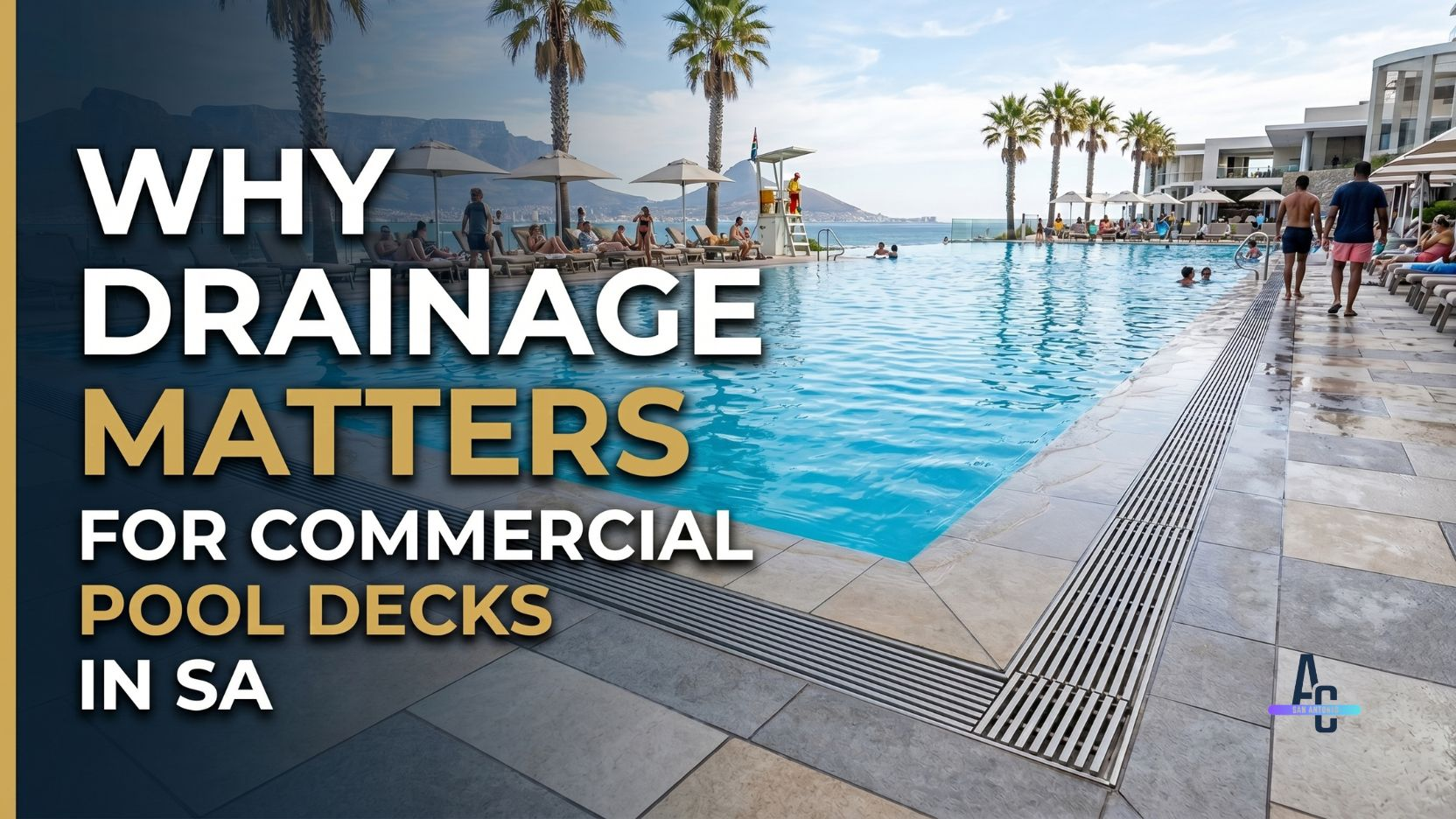
For most commercial pool decks in San Antonio, hotels and apartment complexes, the best-performing system combines a trench or channel drain at the pool edge with point drains positioned in the outer deck zones. The pool-edge trench drain captures the highest-volume water source (direct splash-out from swimmers) before it spreads. The outer point drains handle residual water from foot traffic and rain.
Specify the drain body material and grate type in writing: On commercial pool decks, the drain body should be cast iron or stainless steel, not plastic. PVC and ABS drain bodies are common in residential applications but are not rated for the foot traffic loading of a commercial deck. The grate must be specified as slip-resistant with a maximum 1/4" gap between bars. For pools serving guests with mobility aids, confirm that grate gaps run perpendicular to the primary direction of foot traffic so that wheelchair casters and cane tips cannot catch in the grate opening.
- Pool-edge trench or channel drain specified for the primary splash-out capture zone
- Point drain locations confirmed on the deck layout drawing before forming begins
- Drain body material specified as cast iron or stainless steel, not PVC, for commercial loading
- Grate type confirmed as slip-resistant, ADA-compliant, flush-mounted with 1/4" max gap
- Underground drain connection route planned to ensure adequate fall to the storm sewer or retention point
Property owners often understand that standing water is a slip hazard. Fewer understand what it does to the concrete underneath. Pool water, which contains chlorine and other sanitizing chemicals, is far more corrosive to concrete than rainwater. When pool water sits on an unsealed or lightly sealed deck surface, it does not just rest there. It penetrates the concrete through micro-pores and hairline cracks in the surface, and it begins breaking down the cement matrix from within.
In San Antonio's climate, the damage is accelerated by the heat cycle. During summer, deck surface temperatures regularly exceed 140 degrees Fahrenheit in direct sun. When water sits on that surface, it creates a thermal shock effect as wet concrete cools under the standing water while surrounding concrete stays hot. Over multiple summer seasons, this thermal cycling widens the micro-cracks that allow more water and chemical penetration.
San Antonio also experiences occasional hard freezes in winter. Water that has penetrated the concrete surface can freeze and expand, a process called freeze-thaw spalling. While San Antonio winters are mild compared to northern climates, even one or two hard freeze events per year are enough to cause measurable surface damage on a deck with chronic standing water and inadequate sealing.
The most underappreciated failure mode on commercial pool decks is base erosion. When water cannot drain off the deck surface quickly enough, it eventually finds its way to the slab edges, where it flows down and begins saturating the compacted base material beneath the concrete. In San Antonio, that base is typically crushed limestone. Sustained saturation softens the base, which allows differential settlement, which creates low spots on the deck surface, which holds more water. The failure cycle accelerates over time.
- Deck surface sealed with a commercial-grade pool deck sealer within 28 to 30 days of initial pour
- Re-sealing scheduled every 2 years for high-use commercial pool decks with chlorinated water exposure
- Expansion joints sealed annually and refilled with polyurethane joint sealant if cracked or deteriorated
- Base condition assessed if any settlement-related low spots have appeared since the original pour
- Drain covers inspected seasonally to confirm they are not clogged, which would back up water onto the surface
Commercial pool deck drainage is not a line item that shows up automatically in a concrete contractor's quote. It has to be specified by the property owner or facility manager before the quoting process begins. If you issue a bid without specifying slope, drain type, and drain placement, you will get bids that assume the minimum, and every contractor will quote something different, making the bids impossible to compare.
| What to require in writing | Acceptable contractor response | Red flag response |
|---|---|---|
| Deck slope specification | 1/4" per foot minimum specified in the written scope of work | "We'll slope it to code" without a number; or 1/8" per foot cited as the specification |
| Drain type and placement | Specific drain type, manufacturer or spec standard, and locations shown on a sketch or drawing | "We'll add drains where needed" with no layout detail |
| Drain body material | Cast iron or stainless steel body specified for commercial foot traffic loading | No material called out, or PVC/ABS body specified (residential-grade) |
| DSHS compliance | Contractor familiar with DSHS Chapter 265 Subchapter L requirements for public pools | Unfamiliarity with state aquatic facility rules or stating that only city building code applies |
| Pool-edge treatment | Trench or channel drain at pool edge specified, or an explanation of why it is not needed for your deck configuration | No mention of pool-edge drainage; only perimeter point drains included |
| Insurance and experience | Certificate of insurance with $2M+ general liability; references from completed commercial pool deck projects in San Antonio | Only residential pool deck references; general liability below $1M for commercial work |
Require a site visit before any quote is submitted: A commercial pool deck drainage spec cannot be written accurately from photos or a description. The contractor must walk the site to assess the existing grade, identify where the storm sewer connection or outfall point is located, and confirm the deck dimensions and elevation changes. Any contractor who quotes a commercial pool deck drainage project without a site visit is guessing on the most important variables. Require site visits from every bidder, and be skeptical of bids that arrive within hours of the visit.
- Site visit completed by all bidding contractors before quotes are submitted
- Written scope includes slope specification (1/4" per foot minimum), drain type, drain locations, and drain body material
- DSHS Chapter 265 Subchapter L compliance confirmed in writing as part of the project deliverable
- Certificate of insurance received showing $2M+ general liability for commercial work
- References from completed commercial pool deck projects in San Antonio requested and verified
- Payment terms confirmed: deposit upfront, balance on completion after drainage inspection
- Deck slope confirmed at 1/4" per foot minimum in all drainage directions
- Slope direction confirmed: water moves away from the building and toward drains, not toward the foundation
- Pool-edge trench or channel drain included to capture primary splash-out volume
- Point drain locations mapped against the deck layout, no point more than 10 to 12 feet from a drain
- Drain body specified as cast iron or stainless steel, not PVC or ABS
- Grate type confirmed as slip-resistant, flush-mounted, ADA-compliant with 1/4" max gap
- Underground drain connection route planned with adequate fall to storm sewer or outfall point
- Drain capacity sized against 10-year storm event flow rate for the deck area
- DSHS Chapter 265 Subchapter L requirements reviewed and confirmed applicable to your facility
- City of San Antonio building permit obtained if required for deck scope
- Inspection scheduled post-pour before facility reopens to confirm slope and drain installation
- Commercial-grade pool deck sealer applied within 28 to 30 days of initial cure
- Re-sealing scheduled every 2 years as a recurring facility maintenance item
- Drain grate inspection scheduled seasonally; clogs cleared immediately
- Expansion joint condition reviewed annually and refilled as needed
Get a free commercial pool deck quote in San Antonio
Tell us about your facility. We will visit the site, assess the existing drainage conditions, and give you a detailed written quote with slope, drain placement, and material specifications included.