
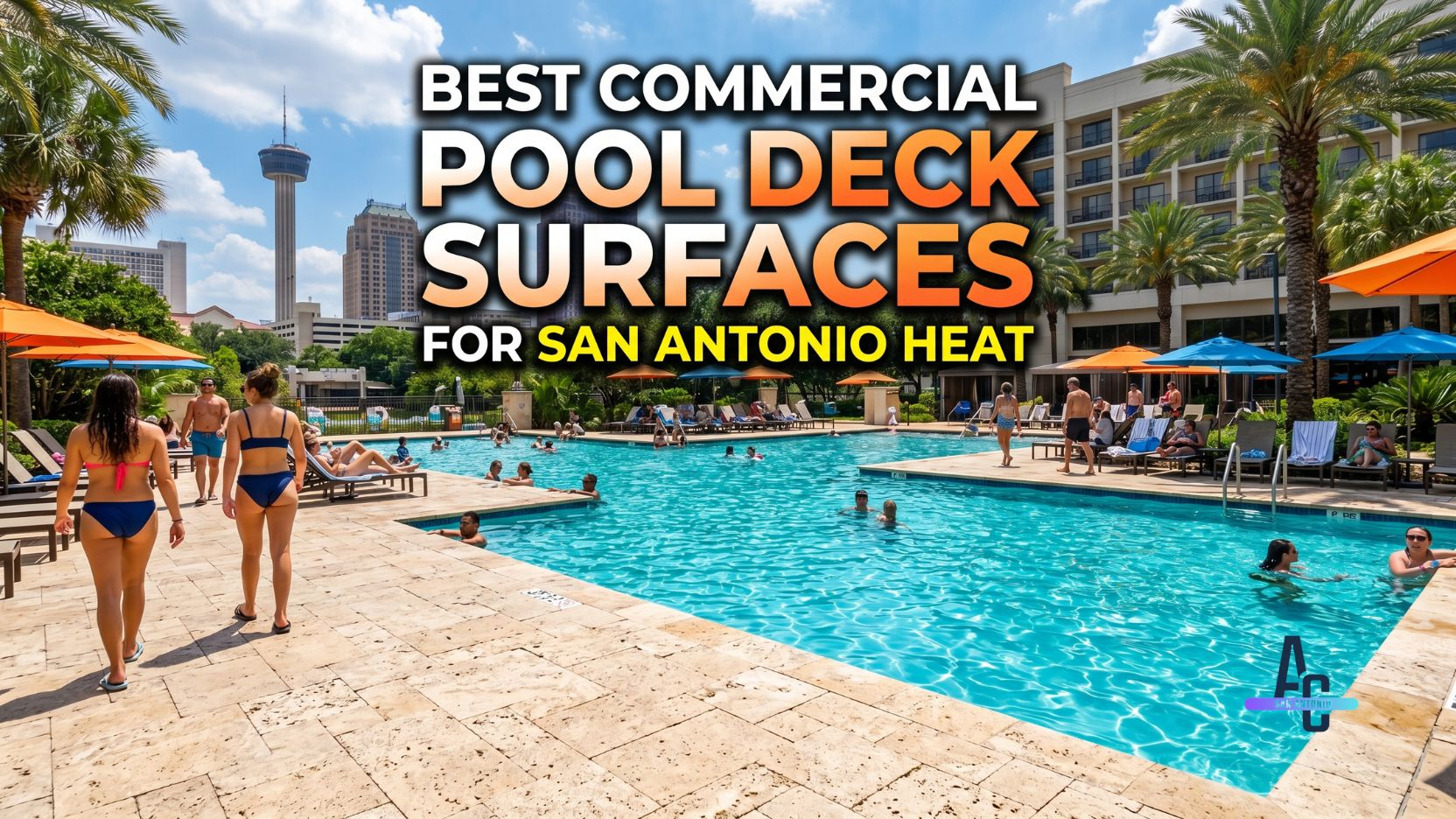
A complete comparison for property managers, hotel operators, and HOA facilities directors who need a pool deck surface that holds up to 100-degree-plus summers, meets ADA slip resistance standards, handles heavy daily foot traffic, and keeps guests safe and comfortable year after year.
San Antonio commercial pool decks face conditions that most surface materials were not designed to handle: sustained summer heat that pushes air temperatures past 100 degrees Fahrenheit, pool water and chemical splash that erodes unsealed surfaces, chlorine runoff that degrades certain coatings over time, and high-volume foot traffic from hotel guests, HOA residents, or apartment tenants who are barefoot every single visit. Choose the wrong surface and you get blistered feet in July, a failed slip inspection, and a resurfacing bill within five years. Choose the right one and your deck stays functional, safe, and presentable for two decades or more.
This guide breaks down every major surface option used on commercial pool decks in San Antonio, with honest performance ratings, cost ranges, maintenance requirements, and the specific situations where each material makes the most sense. If you are already past the selection stage and your current deck is showing signs of wear, read the pillar guide linked above on when to resurface before committing to any new installation.
Most property managers approach surface selection from an aesthetic standpoint, which is the wrong starting point for a commercial pool deck. The correct sequence is: (1) confirm the slip resistance requirement for your jurisdiction and insurance carrier, (2) assess how much direct sun exposure the deck receives and whether heat is a guest complaint, (3) determine whether you are installing new or resurfacing over an existing slab, then (4) select the surface that meets all three criteria within budget. Skipping steps one through three produces a pool deck that looks great on day one and fails inspection or generates injury claims within three seasons.
Most Popular
Exposed aggregate is produced by washing away the surface paste of fresh concrete to reveal the embedded stone, pebble, or quartz aggregate beneath. The result is a naturally textured surface that provides exceptional wet slip resistance, handles ultraviolet exposure without significant color degradation, and requires no special coatings to maintain its core functionality. For commercial pool decks in San Antonio, exposed aggregate is the baseline standard against which every other surface is measured.
Heat performance: Light-colored aggregate mixes (white quartz, beige river pebble) reflect significantly more solar radiation than standard gray concrete. Surface temperatures on a light-colored exposed aggregate deck run 20 to 35 degrees Fahrenheit cooler than an equivalent dark, smooth slab under the same San Antonio afternoon sun.
Slip resistance: The irregular surface texture of exposed aggregate delivers a wet coefficient of friction well above the 0.60 ADA minimum, typically in the 0.75 to 0.90 range depending on aggregate size. Larger aggregate sizes provide more texture; verify the friction rating with your installer before specifying for a commercial project.
Best for: HOA community pools, apartment complex pool decks, municipal aquatic centers, and any high-traffic commercial application where long-term durability and low maintenance take priority over premium aesthetics. The surface ages well, meaning it does not look noticeably worse at year 10 than it did at year one which matters for properties that cannot afford frequent resurfacing cycles.
- Aggregate type, size, and color specified in writing before the pour cannot be changed after the slab sets
- White or light-colored cement base specified if heat reflectance is a priority
- Iron-free aggregate confirmed with the concrete supplier to prevent chlorine-related staining
- Wet coefficient of friction rating confirmed (0.75 or higher for commercial use)
- First sealing scheduled at 28 days after pour; resealing every 3 to 4 years thereafter
- Expansion joints placed every 8 to 10 feet to prevent cracking from San Antonio’s heat cycles
Decorative
Stamped concrete uses patterned mats pressed into freshly poured concrete to create the appearance of stone, slate, tile, or brick. For commercial pool decks, stamped concrete can dramatically elevate the visual quality of a property a hospitality asset that translates directly into guest satisfaction scores and marketing photography. The trade-off is a more demanding maintenance schedule and one critical installation requirement that is frequently skipped: a texture pass over the stamped surface to meet slip resistance standards.
Smooth stamped concrete fails commercial slip resistance requirements when wet. A standard stamped pattern creates a decorative surface, not a slip-resistant one. Before any stamped pool deck is approved for commercial use, the contractor must apply a broadcast sand or broadcast aggregate finish over the stamped surface, or use a stamp pattern that incorporates a texture grid. Confirm the finished wet COF in writing. Any commercial pool deck with a smooth stamped surface is a liability exposure, regardless of how good it looks.
Heat performance: Stamped concrete with an integral color (pigment mixed throughout the slab, not just surface-applied) performs well in heat when light earth tones are selected. Darker color choices, such as charcoal or deep brown, absorb significantly more heat. For a hotel pool deck in full San Antonio sun, specify a light tan, cream, or sandstone integral color rather than a dark accent to keep surface temperatures manageable.
Best for: Hotel pool areas, country club facilities, upscale apartment communities, and any commercial property where the visual presentation of the pool deck contributes directly to the brand or the leasing pitch. The premium over standard exposed aggregate is typically $4 to $8 per square foot, which at a 2,000-square-foot commercial deck represents an $8,000 to $16,000 investment in visual quality. For a hospitality property, that investment is usually justified.
- Texture pass (broadcast sand or aggregate) confirmed over stamped surface before acceptance no smooth stamped pool decks for commercial use
- Wet coefficient of friction tested and documented at 0.60 or higher before opening to guests
- Integral color specified (not surface-only stain) for long-term color performance
- Light earth tone color selected if deck receives more than 4 hours of direct afternoon sun
- Resealing schedule documented: every 2 to 3 years for standard commercial use, every 1 to 2 years for high-traffic areas near pool edges
- Pattern and color confirmed in writing and signed off before pour day changes after the slab sets require full demolition
Heat-Reflective
Spray texture coatings (commonly called Cool Deck, Kool Deck, or acrylic spray texture) are polymer-modified cement systems applied over an existing concrete slab in a thin layer, typically 1/4 to 3/8 inch thick. They were developed specifically for swimming pool deck applications in hot climates, and they deliver on their core promise: a properly installed spray texture coating will run 30 to 50 degrees Fahrenheit cooler underfoot than bare concrete in the same sun conditions. For a commercial pool deck where heat complaints are already a documented guest issue, this is often the fastest and most cost-effective solution.
Why it stays cooler: The texture system traps air in its porous surface structure, which acts as a thermal break between the concrete slab beneath and the foot above. The lighter colors standard in most spray texture systems also reflect solar radiation rather than absorbing it. A white or light beige Kool Deck surface in direct San Antonio sun will typically register between 80 and 95 degrees Fahrenheit on an afternoon when bare gray concrete in the same location reads 115 degrees or higher.
Key limitation: Spray texture coatings are a surface system, not a structural one. They add no structural strength to a deteriorating slab. If the underlying concrete has active cracking, significant spalling, or base failure, the coating will replicate those failures within one to two seasons. The substrate must be structurally sound before any spray system is applied.
Best for: Commercial properties with an existing concrete pool deck that is structurally sound but has a surface heat complaint, a dated appearance, or minor surface wear. A spray texture system can be applied over an existing slab in one to two days with minimal disruption to pool operations, making it the preferred retrofit option for properties that cannot afford a multi-week full replacement. It is also appropriate for new construction when the budget favors a lower-cost surface system over full exposed aggregate.
Substrate preparation determines whether a spray texture system lasts 5 years or 12. Any oil, algae, efflorescence, or loose concrete must be ground or pressure-washed off before application. Cracks in the existing slab must be filled and bridged with a flexible filler before the coating goes down. Skipping or rushing the prep phase is the number one reason spray texture coatings delaminate or crack within the first two seasons. Require a written substrate preparation scope from any installer before approving the project.
- Existing slab assessed for structural integrity active cracks, spalling, or base failure disqualify the slab from coating; full replacement required instead
- Substrate preparation scope confirmed in writing: pressure washing, crack filling, and surface grinding included before coating
- Color selected from light spectrum (white, beige, light tan) to maximize heat reflectance performance
- Wet COF of the specified product confirmed at 0.60 or higher for commercial compliance
- Recoat schedule documented: most systems require recoating every 5 to 10 years depending on traffic volume and UV exposure
- Pool chemical compatibility confirmed with the manufacturer chlorine and acid wash exposure varies by product formulation
Resurfacing
Acrylic concrete overlays are polymer-modified thin-set systems that bond directly to an existing concrete slab, adding 1/8 to 1/4 inch of new surface material. Unlike spray texture coatings, overlays can be troweled into patterns, textured with aggregate broadcast, or finished with a decorative broom pass, giving property managers more aesthetic flexibility than a standard spray coat. The critical qualifier, identical to spray systems, is that the underlying slab must pass a bond test before any overlay is applied.
How the bond test works: Before applying any overlay to an existing commercial pool deck, a reputable installer will perform a pull-off adhesion test or a simple water absorption test to confirm the slab surface can accept the overlay bond. Slabs that have been sealed with a penetrating or film-forming sealer will often fail this test unless the sealer is fully removed first. Slab surfaces that are contaminated with pool chemicals, algae growth, or embedded dirt also require aggressive preparation before the overlay will bond correctly.
Where overlays outperform spray coatings: On commercial pool decks with moderate surface deterioration (scaling, surface pitting, minor spalling) but no structural failure, a thicker overlay system can bridge imperfections that a thin spray coat cannot. A 1/4-inch polymer overlay with an aggregate broadcast finish will conceal surface blemishes, provide a new wearing surface, and deliver a cleaner, more uniform appearance than spray texture on a deteriorated substrate.
- Bond test performed and documented on the existing slab before overlay application is approved
- Existing sealer fully removed from substrate if present sealed slabs will not accept overlay bond
- Aggregate broadcast finish specified over the overlay for slip resistance compliance on commercial pool decks
- Wet COF of finished system confirmed at 0.60 or higher before opening to guests
- Overlay thickness specified for the level of surface defect concealment required (1/8″ for minor wear, 1/4″ for moderate surface deterioration)
- Sealing schedule confirmed: first seal at 28 days, resealing every 3 to 5 years depending on traffic
Premium
Travertine is a natural limestone with a porous cellular structure that does not retain heat the way dense concrete does. On a 100-degree San Antonio afternoon, a travertine pool deck surface typically runs 20 to 40 degrees Fahrenheit cooler underfoot than sealed concrete of similar color, because the pores dissipate heat rather than conducting it to the foot surface. For luxury hotel pools, boutique resorts, and high-end residential communities, travertine delivers a level of aesthetic quality that no concrete system can match. The trade-offs are real, and they require an informed facilities management commitment before specifying this material for a commercial property.
| Factor | Travertine | Concrete Pavers | Exposed Aggregate Concrete |
|---|---|---|---|
| Heat performance | Excellent (coolest option) | Good (air gaps help) | Good (light mix) |
| Slip resistance (wet) | Good (tumbled finish) | Good to excellent | Excellent |
| Installed cost (San Antonio) | $18 to $35/sqft | $14 to $22/sqft | $10 to $16/sqft |
| Maintenance demand | High (sealing, grout, repair) | Medium (joint sand, sealing) | Low to medium (sealing) |
| Piece replacement possible | Yes, if matching stock available | Yes (standard sizes) | No (requires patching) |
| Best commercial application | Luxury hotels, boutique resorts | Mid-tier hotels, HOAs | All commercial property types |
- Maintenance budget confirmed: travertine requires sealing every 1 to 2 years in pool chemical environments
- Matching travertine stock availability confirmed before installation future piece replacement requires the same lot
- Grout or joint material specified as pool-chemical-resistant (epoxy grout or polymer-modified sanded grout)
- Wet COF of specified finish (tumbled, brushed, or polished) confirmed at 0.60 or higher polished travertine does not meet this requirement
- Setting bed and substrate specified for pool deck use: mortar or polymer base over concrete slab, not sand-set in pool applications
- Pool chemical compatibility of the sealer confirmed with the manufacturer before application
Use this table to shortlist the two or three surfaces that fit your property type, budget, and heat exposure before requesting contractor quotes. Every number reflects San Antonio commercial market conditions as of 2026.
| Surface | Heat Performance | Wet Slip Rating | Cost Range (San Antonio) | Maintenance Interval | Best Property Type |
|---|---|---|---|---|---|
| Exposed Aggregate (light mix) | Good to Excellent | 0.75 to 0.90 | $10 to $16/sqft | Seal every 3 to 4 years | All commercial types |
| Stamped Concrete with Texture | Fair to Good (color-dependent) | 0.65 to 0.80 | $14 to $22/sqft | Seal every 2 to 3 years | Hotels, resorts, upscale HOAs |
| Spray Texture / Cool Deck | Excellent | 0.65 to 0.85 | $3 to $8/sqft (over existing slab) | Recoat every 5 to 10 years | Retrofit projects, budget applications |
| Acrylic Concrete Overlay | Good (light colors) | 0.65 to 0.82 | $6 to $12/sqft | Seal every 3 to 5 years | Worn slabs, planned resurfacing cycles |
| Travertine (tumbled) | Excellent | 0.65 to 0.78 | $18 to $35/sqft | Seal every 1 to 2 years | Luxury hotels, boutique resorts |
| Commercial Concrete Pavers | Good | 0.70 to 0.85 | $14 to $22/sqft | Joint sand annually; seal every 3 years | Mid-tier hotels, HOA communities |
- Wet coefficient of friction requirement confirmed with your insurance carrier and local jurisdiction (0.60 minimum per ADA, some carriers require 0.65 or higher)
- ADA accessibility requirements reviewed for pool deck slope, edge transitions, and any surface height changes created by a new overlay or paver installation
- Health department requirements for commercial pool surfaces in Bexar County confirmed before material selection
- Drainage slope verified: minimum 1/8 inch per foot away from pool edge on all new and resurfaced decks
- Heat exposure assessed: hours of direct afternoon sun, existing guest complaints, and direction the deck faces all documented before specifying surface color and material
- Installation type confirmed: new concrete slab, overlay over existing slab, or full slab replacement this determines which surface options are available
- Property type and aesthetic standard matched to surface: exposed aggregate for utility and durability, stamped or travertine for luxury presentation
- Maintenance capacity assessed: travertine and stamped concrete require more frequent and more expensive maintenance than exposed aggregate or spray texture
- Contractor experience with commercial pool deck applications specifically confirmed residential concrete experience does not automatically transfer to pool deck specification
- Certificate of insurance received: $2M general liability minimum for commercial projects
- Written quote itemizes substrate preparation, surface system, sealing, and any expansion joint work separately
- Wet COF test included in the project scope, with written documentation of results before the deck is opened to guests
- Payment terms confirmed: deposit on contract, progress payment at completion of substrate prep, final payment after COF test and owner walkthrough
- Sealing or recoating schedule documented and included in the facility maintenance calendar before the project closes
- Pool chemical exposure protocol established: which cleaning agents are safe for the specified surface, and which will degrade the sealer or the surface material
- Annual inspection schedule set for expansion joints, grout lines (if applicable), and any areas of the deck subject to concentrated pool water runoff
- Budget line item created for resealing, recoating, or spot repair on the appropriate cycle for the surface selected
What is the coolest-to-the-touch commercial pool deck surface for San Antonio summers?
What slip resistance rating does a commercial pool deck need in Texas?
Can I resurface an existing commercial pool deck instead of replacing it?
How often does a commercial pool deck surface need to be resealed in San Antonio?
What is the most durable pool deck surface for a high-traffic San Antonio commercial property?
Get a free commercial pool deck quote in San Antonio
Tell us about your property and current deck condition. We will assess the site, evaluate your substrate, and give you a detailed written quote covering every surface option that fits your specifications.