
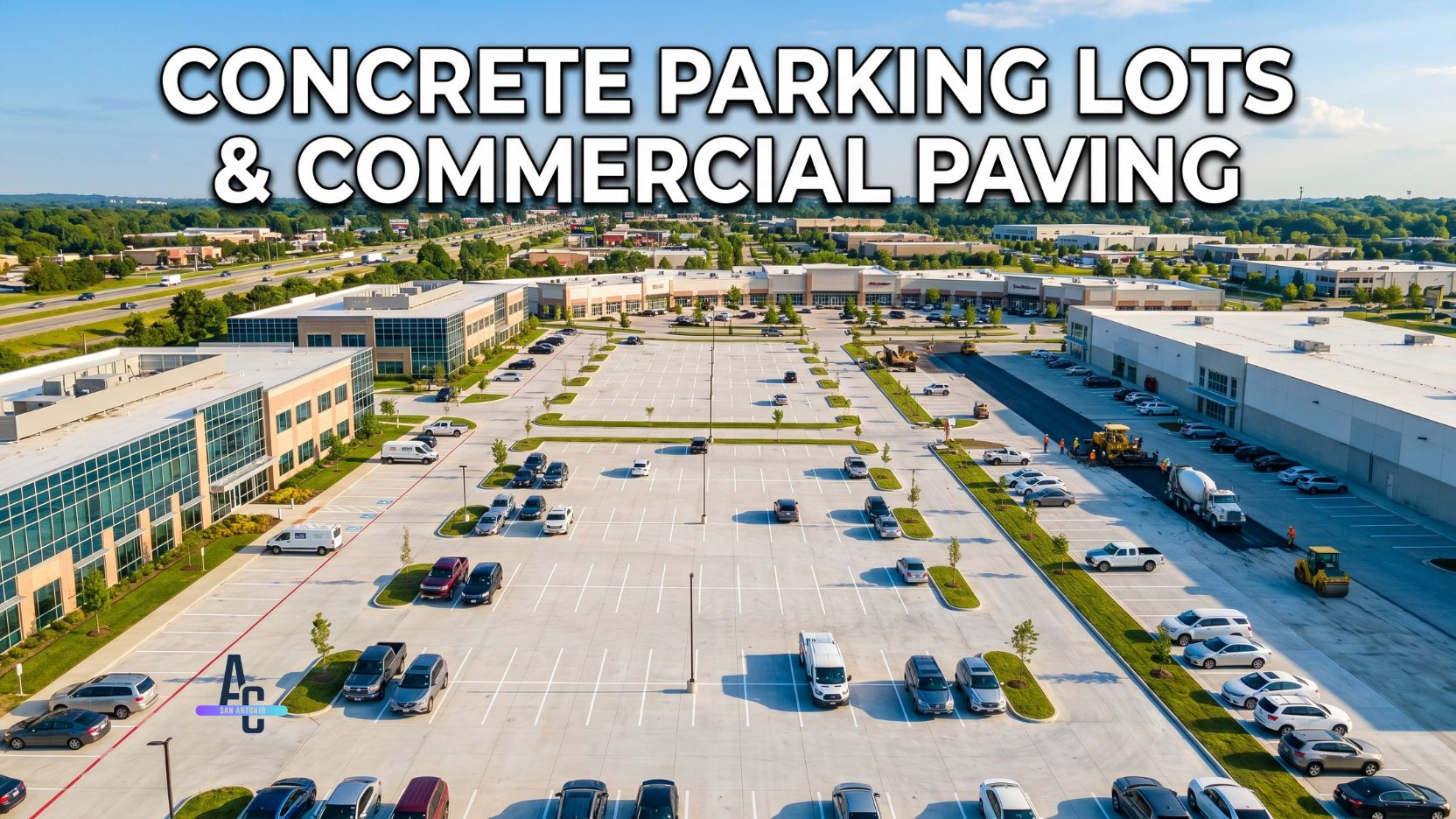
A concrete dumpster pad takes the heaviest, most repeated load on most commercial properties: a loaded front-loader truck setting down, lifting, and turning on the same small patch of ground every week. This guide covers how thick a concrete dumpster pad should be in San Antonio, what it costs, why the truck apron matters as much as the pad, when you need a permit, and what a good bid should list.
- What is a concrete dumpster pad?
- Why do dumpster pads fail so often?
- How thick should a concrete dumpster pad be?
- How much does a concrete dumpster pad cost in San Antonio?
- Does the truck approach need to be concrete too?
- How is a dumpster pad built on San Antonio clay?
- Is concrete or asphalt better for a dumpster pad?
- What does a restaurant dumpster pad need?
- Do I need a permit for a dumpster pad in San Antonio?
- What should a dumpster pad bid include?
- When should I call a pro about my dumpster pad?
- Where do we work?
- What else are homeowners asking?
A concrete dumpster pad in San Antonio should be at least 6 inches thick with 4,000 PSI concrete and rebar, and about 8 inches where front-loader trucks hit it. Expect roughly $7 to $13 per square foot. Our expansive clay soil makes the base critical, so call a pro once the old pad cracks or sinks.
What is a concrete dumpster pad?
A concrete dumpster pad is a reinforced slab that the trash container sits on, usually inside a screened enclosure, built to carry the weight of the waste truck that picks it up. It keeps the container level, gives the hauler a hard surface, and stops the ground or asphalt around it from breaking apart.
- Enclosure pad: the slab under the container and inside the screen walls.
- Apron or approach: the strip in front of the enclosure where the truck stops, lowers its forks, and lifts.
- Who needs one: retail centers, restaurants, offices, apartment communities, churches, schools, and shops with a front-load or roll-off container.
We pour dumpster pads, equipment pads, and the drive lanes that feed them as part of our commercial concrete services in San Antonio.
San Antonio numbers, 2026
Why do dumpster pads fail so often?
Dumpster pads fail because they are often poured at the same thickness as the parking lot, even though a front-loader truck puts far more weight on that one small spot. Repeated lifting at the same place cracks thin slabs and digs craters in asphalt.
- Concentrated load: our retail and restaurant concrete guide calls the trash enclosure pad and its approach lane the heaviest, most repetitive load on the whole property.
- Thin slab: pads poured at standard lot thickness are the ones that crater.
- Weak base: San Antonio clay swells when wet and shrinks when dry, so a soft or thin base lets the slab rock and break.
- Standing water: a flat or back-sloped pad holds wash water and runoff against the slab and the enclosure walls.
How thick should a concrete dumpster pad be?
A concrete dumpster pad should be at least 6 inches thick with 4,000 PSI concrete and rebar, and about 8 inches with heavy rebar where the truck sets down and lifts. That is thicker than the 5 to 6 inches we use for most commercial parking.
| Area | Typical spec | Source |
|---|---|---|
| Dumpster or trash pad | 6 in. minimum, 4,000 PSI, reinforced for truck lift loads | Commercial slab services guide |
| Trash enclosure pad and approach lane (front-loader trucks) | About 8 in. with heavy rebar | Retail and restaurant guide |
| Parking lot around it | 5 to 6 in. with a rebar grid | Retail and restaurant guide |
| Concrete mix | 4,000 PSI minimum for commercial work | Commercial concrete cost guide |
Ask your hauler what truck and container size will service the site. A heavier truck or a compactor is a reason to go thicker, not thinner.
How much does a concrete dumpster pad cost in San Antonio?
A standard 6-inch, 4,000 PSI concrete dumpster pad in San Antonio typically costs about $7 to $13 per square foot installed. Heavy-duty pads with extra reinforcement for truck and loading areas run about $14 to $18 per square foot.
| Item | Typical price (SA, 2026) | Source |
|---|---|---|
| Dumpster or trash pad, 6 in., 4,000 PSI | About $7 to $11 per sq. ft. | Commercial slab services guide |
| Dumpster or equipment pad, 6 in., 4,000 PSI, rebar, broom or exposed aggregate | About $8 to $13 per sq. ft. | Commercial concrete services guide |
| Heavy-duty with fiber (dumpster, truck, and loading areas) | About $14 to $18 per sq. ft. | Parking lot contractors guide |
| Mix upgrade from 3,000 to 4,500 PSI | Adds about $0.50 to $1.00 per sq. ft. | Commercial concrete cost guide |
Typical installed estimates from our own published San Antonio guides as of November 2026, not a quote. Tear-out of an old pad, enclosure walls, gates, and bollards are priced separately.
For example, a pad measuring 12 by 24 feet is 288 square feet. At $8 to $13 per square foot, that works out to about $2,304 to $3,744 before tear-out or enclosure work. That is simple arithmetic from the ranges above, so your written price comes after a free site visit.
Does the truck approach need to be concrete too?
Yes, in most cases. The apron in front of the enclosure is where the truck brakes, sets its forks, and lifts, so it takes the same heavy load as the pad and should be built to the same thicker, reinforced spec.
- Same spec as the pad: our retail guide upgrades both the trash enclosure pad and its approach lane to about 8 inches with heavy reinforcement.
- Long enough for the truck: the concrete should run far enough out that the front wheels stop on concrete, not on asphalt.
- Drive lanes that feed it: delivery and trash truck routes usually get 6 inches or more. See our concrete parking lot contractors guide.
How is a dumpster pad built on San Antonio clay?
A dumpster pad on San Antonio clay is built on a compacted crushed limestone base, reinforced with rebar, sloped to drain, and isolated from the building and nearby slabs. The base and drainage matter as much as the concrete.
- Site visit and layout: we check the truck path, the slope, the soil, and where water goes.
- Tear-out: remove the old pad or the broken asphalt and any soft soil under it.
- Base: place and compact crushed limestone. Our guides list 4 to 6 inches as standard for commercial work and 6 to 8 inches for heavier loads.
- Steel: set a rebar grid on chairs so it sits in the slab, not on the ground.
- Forms, slope, and joints: pitch the surface so wash water drains away from the enclosure, and isolate the pad from walls and adjacent slabs.
- Pour and finish: 4,000 PSI concrete with a broom or exposed aggregate finish for traction.
- Cure: keep the truck off until the concrete is strong enough. Our driveway installation page notes heavy vehicles wait about 28 days, so plan a temporary container spot with your hauler.
- The pad is cracked through, sinking, or rocking when the truck lifts
- The asphalt in front of the enclosure is cratered or rutted
- Water or grease pools on the pad or runs toward the building
- The enclosure walls or gate posts are leaning or cracking
Call (713) 504-2341 or request a free quote.
Is concrete or asphalt better for a dumpster pad?
Concrete is better for a dumpster pad. Asphalt costs less up front, but it softens and ruts in 100-degree heat and craters under the repeated point load of a front-loader truck.
Many San Antonio owners keep asphalt for light car parking and use concrete for the dumpster pad, the apron, and the drive lanes. Our concrete parking lot guide covers that mixed approach.
What does a restaurant dumpster pad need?
A restaurant dumpster pad needs to be sealed, sloped, and easy to wash down, because grease and food waste land on it every day. A pad that holds standing water gets slick and stains fast.
- Sealed surface: helps the slab resist grease and wash water.
- Positive slope: so washdown water drains away instead of pooling at the walls.
- Room for the grease container: plan the pad size around everything that sits in the enclosure.
See the restaurant section of our retail, restaurant, and office concrete guide.
Do I need a permit for a dumpster pad in San Antonio?
It depends on the site and the scope. Our commercial guides list dumpster and equipment pads as “varies; check with DSD,” and new pads are often bundled with a commercial site or building permit.
- New sitework: new commercial pads and parking areas usually go through a commercial permit application.
- Replacement: tearing out and replacing a commercial slab generally needs a permit, especially if it changes drainage or an accessible route.
- Ask first: call Development Services at 210-207-1111 before work starts. Our commercial permits and ADA guide explains the process.
What should a dumpster pad bid include?
A good dumpster pad bid lists the pad and apron size, slab thickness, PSI, rebar, base depth, slope, joints, tear-out, and cure time in writing. If a line is missing, ask before you sign.
| Bid line | What to look for |
|---|---|
| Size | Pad and apron dimensions in square feet |
| Thickness | 6 in. minimum, about 8 in. where the truck lifts |
| Concrete | 4,000 PSI minimum, in writing |
| Steel | Rebar size and spacing, set on chairs |
| Base | Crushed limestone depth and compaction |
| Drainage | Slope direction and how wash water leaves the pad |
| Tear-out | Removal and haul-off of the old pad or asphalt |
| Schedule | Pour date, cure time, and when the hauler can return |
Our guide on how to choose a commercial concrete contractor has more questions to ask.
When should I call a pro about my dumpster pad?
Call when the pad or the asphalt in front of it starts cracking, sinking, or holding water, or before you build a new enclosure. Fixing the pad early costs less than rebuilding the pad, the apron, and the enclosure walls later.
We give a free site visit and a written price before any work starts. Call (713) 504-2341 or request a free quote.
Need a dumpster pad that holds up to the truck?
Free site visit, a written price before any work starts, and a pad built for the truck that services it. Father-son owned in San Antonio.
Where do we work?
Affordable Concrete San Antonio works across San Antonio and nearby areas from our shop at 1247 W Thompson Pl, San Antonio, TX 78226.
We pour concrete dumpster pads, equipment pads, and drive lanes in San Antonio and these nearby areas: Helotes, Leon Valley, Shavano Park, Terrell Hills, Alamo Heights, Converse, Universal City, Schertz, Boerne, Cibolo, Fair Oaks Ranch, Bulverde, Spring Branch, New Braunfels, Pleasanton, Floresville, Castroville, Lytle, and Von Ormy. Not sure about your address? Call (713) 504-2341.
What else are homeowners asking?
These are the short answers people want before they book a quote.
How thick should a concrete dumpster pad be?
At least 6 inches with 4,000 PSI concrete and rebar, and about 8 inches with heavy rebar where a front-loader truck sets down and lifts.
How much does a concrete dumpster pad cost in San Antonio?
A standard 6-inch pad typically runs about $7 to $13 per square foot installed. Heavy-duty pads for truck and loading areas run about $14 to $18 per square foot.
Should the area in front of the dumpster be concrete?
Yes. The apron where the truck stops and lifts carries the same heavy load, so it should be built to the same thicker, reinforced spec as the pad.
Is asphalt OK for a dumpster pad?
Usually not. Asphalt softens in San Antonio heat and craters under the repeated load of a front-loader truck. Concrete lasts much longer there.
Do I need a permit for a dumpster pad in San Antonio?
It depends on the site and scope. New commercial pads are often part of a site or building permit, so call Development Services at 210-207-1111 before work starts.
How long before the trash truck can use a new pad?
Heavy vehicles should wait about 28 days while the concrete cures, so plan a temporary container spot with your hauler.
Sources used in this article:
- Affordable Concrete San Antonio, commercial concrete slab services guide, checked November 25, 2026, affordableconcretesanantonio.com
- Affordable Concrete San Antonio, commercial concrete services guide, checked November 25, 2026, affordableconcretesanantonio.com
- Affordable Concrete San Antonio, commercial concrete for retail centers, restaurants, and offices, checked November 25, 2026, affordableconcretesanantonio.com
- Affordable Concrete San Antonio, concrete parking lot contractors guide, checked November 25, 2026, affordableconcretesanantonio.com
- Affordable Concrete San Antonio, commercial concrete cost guide, checked November 25, 2026, affordableconcretesanantonio.com
- Affordable Concrete San Antonio, commercial concrete permits, codes, and ADA guide, checked November 25, 2026, affordableconcretesanantonio.com
- City of San Antonio, Development Services Department, sa.gov
This article is general information for San Antonio property owners. Prices are typical installed estimates as of November 2026, not a quote. The City of San Antonio is the final authority on permits, and your hauler sets its own access requirements.
What should I read next?
Start with our commercial concrete services page, or keep reading while you plan.