
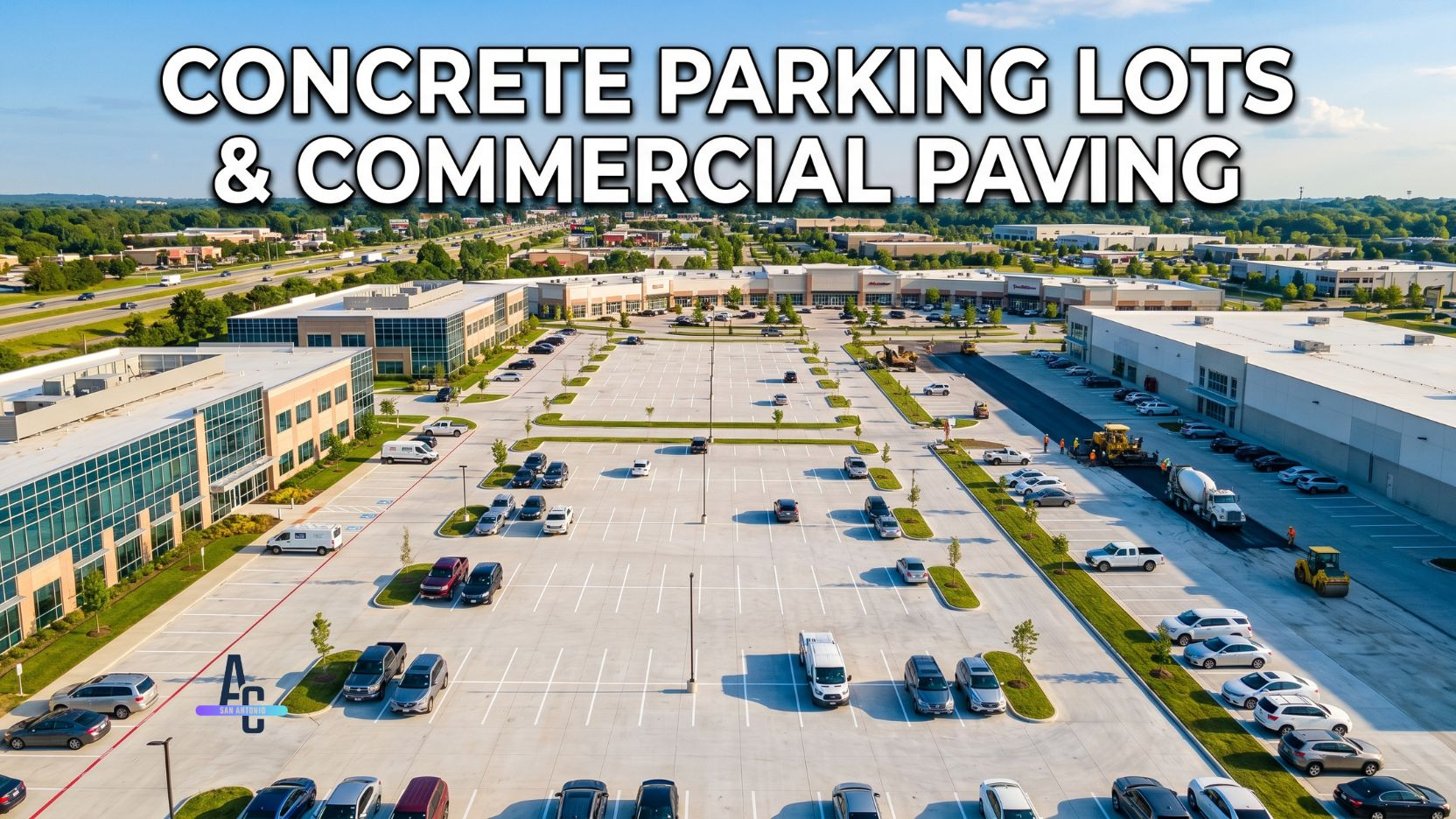
A concrete parking lot is one of the highest-value infrastructure investments a commercial property owner can make in San Antonio. Get the spec right and it will outlast asphalt by 15 or more years. Get it wrong and you are looking at expensive repairs within five years. This guide covers every decision design, thickness, drainage, cost, and what to ask before signing a contract.
Commercial property owners in San Antonio face a choice every time a parking lot reaches the end of its useful life: repave with asphalt again, or switch to concrete. The decision seems simple on the surface asphalt costs less upfront. But when you account for San Antonio’s intense summer heat, the city’s clay-heavy Vertisol soils, and the true cost of asphalt’s required maintenance and resurfacing cycles, concrete almost always wins the 30-year cost comparison by a wide margin.
This guide gives you the concrete parking lot specs used by experienced commercial contractors in San Antonio, the real cost numbers, and the design decisions that determine whether your lot looks good and holds up for decades or starts cracking and draining poorly within a few years.
More commercial concrete parking lots fail from poor drainage than from any structural deficiency. Water that pools on the surface accelerates joint deterioration, weakens the subbase over time, and creates liability hazards. In San Antonio, where summer storms can drop two inches of rain in under an hour, a lot designed without adequate slope and drainage infrastructure will have chronic standing water problems regardless of slab quality. Get the drainage design right before committing to any surface material.
Material Choice
Asphalt wins on initial cost. Concrete wins on total cost of ownership. In San Antonio’s climate, the gap between the two widens considerably because asphalt softens and ruts in sustained 100-degree heat. Commercial parking lots that handle heavy traffic delivery trucks, SUVs, bus drop-off zones will show asphalt deformation and edge cracking within five to seven years in Bexar County summers without aggressive maintenance.
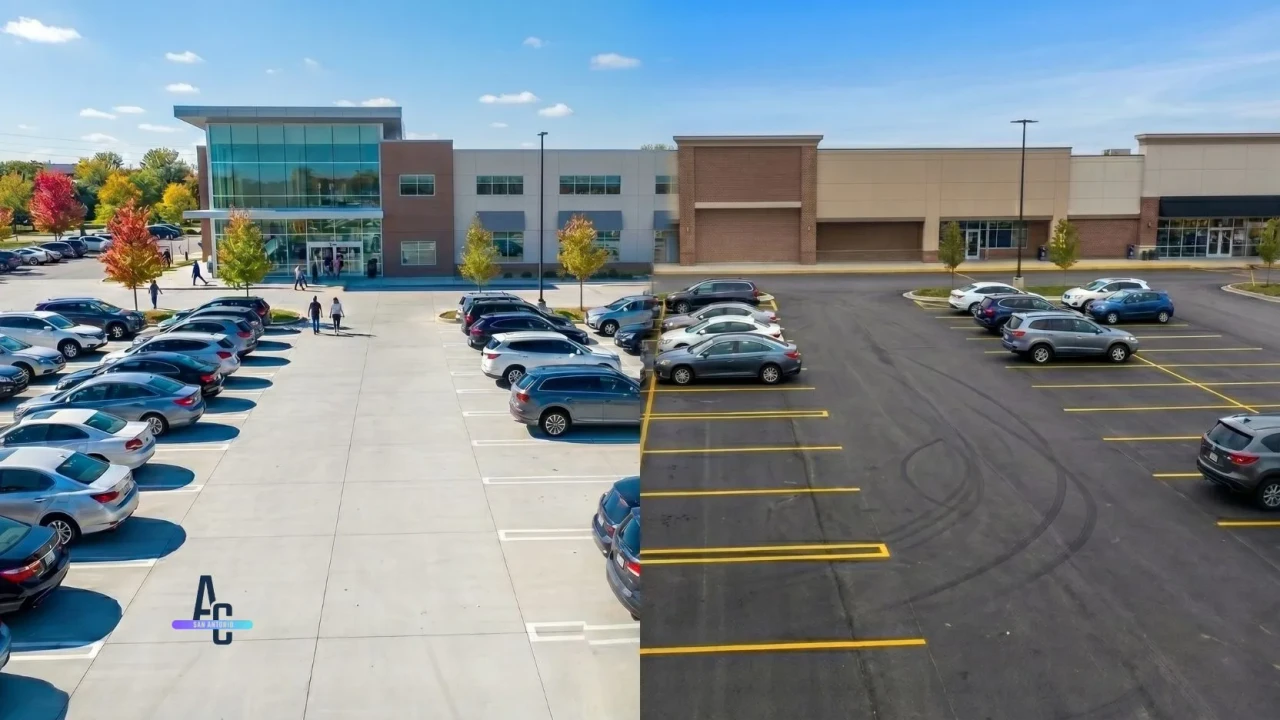
Concrete advantages in San Antonio: Does not soften in heat, requires no seal coating, no periodic resurfacing, reflects more light (reduces parking lot temperatures), and lasts 30 to 40 years with minimal maintenance. Tire stops, signage posts, and curbing all anchor more securely in concrete than in asphalt.
Where asphalt still makes sense: Projects with tight short-term budgets, temporary lots, and applications where the lot will be reconfigured or expanded within 10 years. Asphalt is also easier to patch incrementally, which matters when a property owner cannot close the entire lot for a full pour.
- 30-year total cost comparison completed not just upfront cost per sqft
- Traffic load assessed: standard passenger vehicles, delivery trucks, or semi-truck routes
- Lot reconfiguration plans reviewed concrete is permanent; asphalt is easier to modify
- Budget timeline confirmed: can financing support the higher concrete upfront cost for long-term savings
- City of San Antonio drainage and ADA compliance requirements reviewed for the specific lot
Structural Spec
Commercial parking lots fail structurally for three reasons: insufficient slab thickness for the actual loads, inadequate base preparation that allows subgrade settlement, and missing or incorrectly spaced control joints that cause random cracking. All three are preventable with proper specification. Here is what experienced San Antonio commercial contractors actually build to.
Ask every contractor quoting your lot to specify in writing: slab thickness, compressive strength (PSI), rebar size and spacing, base depth and material, and control joint spacing. Any contractor who gives you a single number (“we’ll pour a 6-inch slab”) without documenting reinforcement and base prep is giving you half a specification. The base and reinforcement are where corners get cut on low-bid jobs.
Slab thickness by use: Standard commercial parking for passenger vehicles requires a minimum 6-inch slab. Mixed-use lots that receive regular delivery truck access should be specified at 7 inches. Heavy-duty truck courts, loading dock aprons, and fleet maintenance areas should be 8 inches with heavier reinforcement. Thinner slabs may be quoted at lower cost but will fail prematurely under commercial loads in San Antonio’s expansive soils.
Concrete mix specification: Commercial parking lots in San Antonio should be poured using a minimum 4,000 PSI concrete mix. Some contractors will quote 3,000 or 3,500 PSI to lower material costs. The difference in delivered cost is modest a few cents per square foot but the durability difference over 30 years is significant. Specify 4,000 PSI in writing on every commercial parking project.
| Application | Slab Thickness | Rebar Spec | Base Depth | Min. PSI |
|---|---|---|---|---|
| Standard passenger vehicle lot | 6″ | #4 rebar at 18″ centers each way | 6″ compacted crushed limestone | 4,000 |
| Mixed-use lot (cars and delivery trucks) | 7″ | #4 rebar at 16″ centers each way | 6–8″ compacted base | 4,000 |
| Truck court / loading dock apron | 8″ | #5 rebar at 12–16″ centers each way | 8″ compacted base | 4,500 |
| Fire lane / emergency access | 6–7″ | #4 rebar at 18″ centers each way | 6″ compacted base | 4,000 |
| Pedestrian walkways within lot | 4″ | Wire mesh or #3 rebar | 4″ compacted base | 3,500 |
Base preparation in San Antonio: Bexar County sits on predominantly expansive clay soils that swell and shrink with moisture changes. This soil movement is harder on concrete slabs than almost any other subsurface condition. A proper commercial base consists of a minimum 6-inch layer of compacted crushed limestone (flex base) over prepared and compacted native subgrade. For lots in areas with known drainage issues or high clay content, 8 inches of base material is the appropriate spec. Subgrade soil may also require lime stabilization treatment to reduce plasticity before base placement on problem sites.
- Slab thickness confirmed in writing: 6″ minimum for standard commercial, 7–8″ for truck access
- Concrete compressive strength specified: 4,000 PSI minimum for all commercial parking
- Rebar size and spacing documented: #4 at 18″ centers each way for standard commercial
- Base depth and material specified: 6″ compacted crushed limestone minimum in San Antonio
- Subgrade preparation addressed: compaction testing required before base placement
- Control joint layout included in the project drawing with spacing no greater than 15 feet
Design & Drainage
A structurally sound concrete lot can still fail to serve its purpose if the drainage design is wrong. San Antonio sees intense, concentrated rainfall events throughout the year. A parking lot that holds standing water after a storm creates slip-and-fall liability, accelerates joint deterioration, and turns away customers and tenants. Drainage is not a cosmetic consideration it is a functional and legal one.
Surface slope requirements: The lot surface must be sloped a minimum of 1% (1/8 inch per foot) in every parking area to move water toward drainage inlets or lot edges. Most commercial lots are designed with a 1.5 to 2% cross slope, which is steep enough to drain quickly but shallow enough to remain comfortable for pedestrians and vehicles. Slopes exceeding 5% create runoff velocity problems and may violate ADA requirements for accessible routes.
Drainage infrastructure in San Antonio lots: Drainage inlets, catch basins, and channel drains should be located at the low points of every lot panel. On large lots, a perimeter curb-and-gutter system directs water to inlet locations at regular intervals. The City of San Antonio has stormwater runoff requirements that apply to commercial lots above a certain impervious cover threshold your project may require a stormwater management plan before permits are issued. An experienced commercial concrete contractor will coordinate with a civil engineer on larger projects to ensure the drainage design meets city requirements.
Request a drainage exhibit with your contractor’s bid on any lot larger than 10,000 square feet. This is a simple sketch or drawing showing where the lot slopes to, where inlets are located, and how water exits the property. Any contractor who cannot produce this has not designed your drainage they have guessed at it.
ADA compliance for commercial parking lots: The Americans with Disabilities Act requires accessible parking spaces, access aisles, and accessible routes from parking to building entrances. Specific requirements include: van-accessible spaces with 8-foot access aisles, slopes no greater than 1:48 (approximately 2%) in any direction within the accessible space and access aisle, firm and stable surfaces, and a marked accessible route to the building entrance. ADA violations on commercial lots expose property owners to federal complaints and significant remediation costs. Confirm ADA design compliance before construction begins.
| Total Parking Spaces | Required Accessible Spaces | Van-Accessible Minimum | Access Aisle Width |
|---|---|---|---|
| 1 to 25 | 1 | 1 | 8 feet (van) |
| 26 to 50 | 2 | 1 | 5 feet (standard) / 8 feet (van) |
| 51 to 75 | 3 | 1 | 5 feet (standard) / 8 feet (van) |
| 76 to 100 | 4 | 1 | 5 feet (standard) / 8 feet (van) |
| 101 to 150 | 5 | 1 | 5 feet (standard) / 8 feet (van) |
| 151 to 200 | 6 | 1 | 5 feet (standard) / 8 feet (van) |
| 201 and above | 2% of total spaces | 1 per 6 accessible spaces | 5 feet (standard) / 8 feet (van) |
Parking space dimensions and layout: Standard commercial parking stalls are 9 feet wide by 18 to 19 feet deep. Drive aisles for 90-degree parking are 24 feet wide minimum. Angled parking (60 degrees) can use 18-foot aisles but is less efficient for lot capacity. Fire lane widths in San Antonio are typically required to be 20 to 24 feet clear, with “No Parking Fire Lane” markings at specified intervals per San Antonio Fire Department requirements.
- Surface slope confirmed at 1–2% minimum across all lot panels with no low points that trap water
- Drainage inlets located at all low points; perimeter curb-and-gutter included on large lots
- City of San Antonio stormwater management requirements reviewed for the project size
- ADA accessible space count, dimensions, and slope verified against total lot capacity
- Van-accessible spaces with 8-foot access aisles included in the layout
- Drive aisle widths at 24 feet minimum for 90-degree parking; fire lane widths per SAFD requirements
- Striping scope included in original contract paint type and accessible markings specified
Maintenance
Concrete parking lots have a justified reputation for low maintenance requirements compared to asphalt. That reputation is earned but it assumes a baseline of proactive care. The concrete itself is nearly maintenance-free. The joints are not. Neglecting joint maintenance is the single most common cause of premature structural failure in commercial concrete lots that were otherwise well-built.
Joint sealing: Control joints are designed to allow movement in the slab without random cracking. Over time, the flexible sealant in these joints degrades from UV exposure, temperature cycling, and chemical contact (fuel and oil spills). Once the sealant fails, water and incompressible debris enter the joint. Water in the joint reaches the subbase, weakening it. Debris in the joint prevents the joint from functioning as designed, which transfers stress to the concrete and causes spalling at the joint edges. Joint sealant should be inspected annually and replaced on a 5 to 7-year schedule using a polyurethane or silicone joint sealant appropriate for traffic-bearing surfaces.
Crack repair: Hairline cracks in commercial concrete are not always a structural concern temperature-related surface cracking can occur even on properly reinforced slabs. Cracks wider than 1/4 inch, cracks with vertical displacement, and cracks that grow over time warrant a professional assessment. Small cracks should be cleaned and filled with a flexible concrete crack filler before they allow water infiltration that widens the crack further. Catching small cracks early extends the time before a more expensive structural repair is necessary.
Schedule a concrete lot inspection every two years on any commercial property you own or manage. Walk the lot with a contractor and log any cracks, joint failures, drainage issues, or surface spalling. The cost of a professional inspection is minimal compared to the cost of catching a problem two maintenance cycles too late. In San Antonio’s climate, lots that go uninspected for five or more years typically require panel replacement rather than simple maintenance.
Chemical and fuel contamination: Commercial lots frequently receive oil, fuel, and deicing chemical spills. Petroleum-based products penetrate concrete over time and can soften the surface if spills are not addressed. Clean fuel and oil spills promptly using an absorbent material followed by a pressure wash with a degreasing agent. If a lot section regularly receives fuel spills (near a dumpster pad, vehicle maintenance area, or fuel pump), specify a chemical-resistant concrete sealer in that area during construction.
- Joint sealant inspection scheduled annually; replacement every 5–7 years using polyurethane or silicone
- Biennial professional lot inspection budgeted inspect for cracks, joint failures, drainage, and surface spalling
- Crack fill and spall repair performed as defects are identified do not defer small repairs
- Surface sealing scheduled at 28–30 days after pour for decorative lots; evaluate annually for standard lots
- Fuel and chemical spill response protocol in place for commercial tenants or fleet operations
- Striping refresh budgeted every 5–8 years or when markings become faded and unclear
The following cost ranges reflect typical installed prices for commercial concrete paving in San Antonio and the surrounding Bexar County area as of 2026. All prices include base preparation, reinforcement, pour, finishing, and standard control joints. Striping is listed separately. Prices vary based on lot size, site conditions, and access.
| Project Type | Slab Spec | Typical Cost Range | Notes |
|---|---|---|---|
| Standard commercial parking lot (5,000+ sqft) | 6″ slab, #4 rebar, 6″ base | $5–7/sqft | Volume discount applies on larger lots |
| Small commercial lot or professional office (under 5,000 sqft) | 6″ slab, #4 rebar, 6″ base | $6–9/sqft | Mobilization costs higher on smaller jobs |
| Mixed-use lot with delivery truck access | 7″ slab, #4 rebar at 16″, 6–8″ base | $7–10/sqft | Heavier spec for mixed passenger and truck traffic |
| Truck court or loading dock apron | 8″ slab, #5 rebar, 8″ base | $9–14/sqft | Required for semi-truck or heavy equipment areas |
| Decorative retail or restaurant lot entrance | 6″ slab, stamped or exposed aggregate | $10–16/sqft | Decorative finish adds 40–60% over standard broom |
| Lot striping (new concrete, professional) | N/A | $0.25–0.50/sqft of lot area | Thermoplastic markings last significantly longer than paint |
| ADA-compliant ramp and accessible route addition | 4–6″ slab per application | $800–2,500 per ramp location | Varies by configuration and site conditions |
- Slab thickness confirmed in writing: 6″ minimum for passenger lots, 7–8″ for truck access
- Concrete compressive strength specified at 4,000 PSI minimum
- Rebar size and spacing documented: #4 at 18″ centers each way for standard commercial
- Base depth and material specified: 6″ compacted crushed limestone minimum in Bexar County
- Subgrade compaction testing included in the scope before base placement
- Control joint layout included in project drawings at maximum 15-foot spacing
- Surface slope confirmed at 1–2% toward drainage inlets or lot perimeter in all areas
- Drainage inlet locations identified at all low points in the lot layout
- City of San Antonio stormwater management requirements reviewed and addressed
- ADA accessible space count, dimensions, and surface slope verified
- Drive aisle widths at 24 feet minimum; fire lane widths confirmed with SAFD requirements
- Parking stall dimensions and layout drawn and reviewed before construction begins
- Certificate of insurance received: minimum $1M general liability for commercial work
- Quote itemizes base prep, reinforcement, pour, finishing, drainage, and striping separately
- References from completed commercial concrete projects in San Antonio available and verified
- Payment terms documented: deposit upfront, progress payment at defined milestones, balance on final completion
- Permit responsibility clarified in writing: contractor or owner handles City of San Antonio permits
- Curing method agreed: wet curing or liquid curing compound applied for minimum 3 days
- No vehicle traffic for 7 days after pour; pedestrian traffic restricted for 48 hours
- Striping scheduled at 28–30 days after pour when concrete has reached full cure
- Joint sealant inspection and resealing scheduled on a 5 to 7-year cycle
- Biennial professional lot inspection added to the property maintenance schedule
How much does a concrete parking lot cost in San Antonio?
How long does a concrete parking lot last compared to asphalt in San Antonio?
Do I need a permit for a commercial concrete parking lot in San Antonio?
Why is my concrete parking lot cracking after just a few years?
Can concrete parking lots handle heavy trucks and semi-trailers in San Antonio?
What ADA requirements apply to commercial parking lots in San Antonio?
Get a free commercial paving quote in San Antonio
Tell us about your project new parking lot, lot expansion, or existing lot repair. We will assess the site and provide a detailed written quote at no cost.