
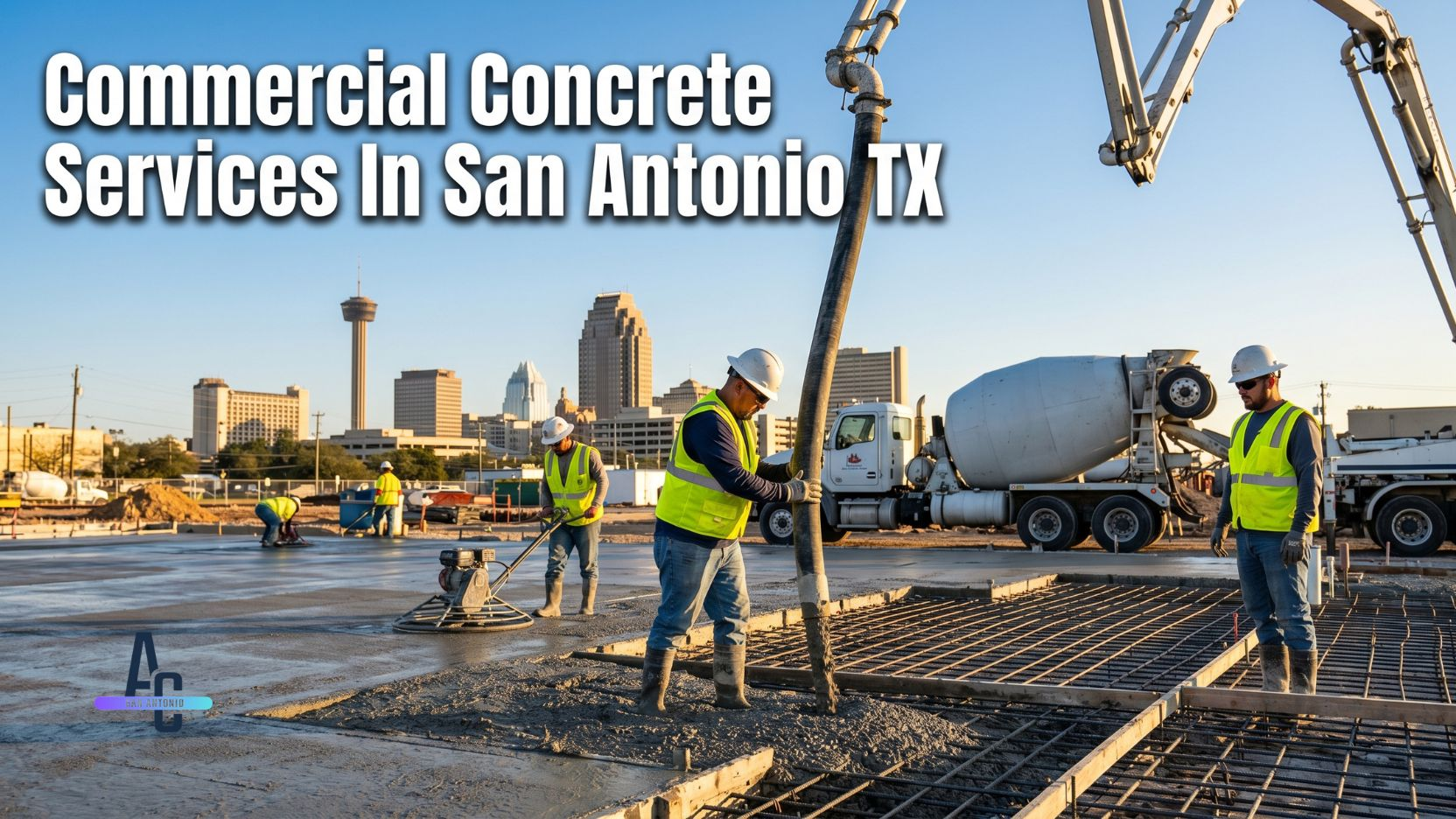
From large parking lots and structural foundations to commercial slabs and flatwork, San Antonio businesses need concrete that holds up under heavy traffic, Texas heat, and real daily use. This complete guide covers every major commercial concrete service, what each one costs, and how to hire the right contractor for the job.
Commercial concrete in San Antonio is a different discipline than residential work. The loads are heavier, the stakes are higher, the regulatory requirements are stricter, and the cost of a failure, whether that means a cracked parking lot, a foundation settlement, or a slab that can’t support the equipment above it, can easily run into six figures. Getting it right the first time is not optional for a business.
This guide covers the full range of commercial concrete services available in San Antonio: parking lots and commercial paving, structural foundations and footings, commercial slabs and flatwork, and the concrete specifications that separate a proper commercial job from a residential pour that gets upsized. Whether you are a property owner, a general contractor, or a business operator managing a build-out, this guide gives you the information to make smart decisions before the first truck arrives.
The number-one mistake businesses make when hiring a commercial concrete contractor is leading with budget rather than specifications. A parking lot poured at 4 inches instead of 6 inches, or a slab with 3,000 psi mix instead of 4,000 psi, will cost far less up front and far more in repairs over five years. Commercial specs exist for a reason. Any contractor who adjusts the specification to hit a price target is giving you a liability, not a deal. Get the full written spec first, then compare prices across contractors using identical specs. That is the only apples-to-apples comparison that protects your investment.
Commercial concrete work covers a broader range of applications than most property owners realize. The four core service categories below each have distinct specification requirements, permitting processes, and cost structures. Understanding which category your project falls into is the first step toward getting an accurate quote and a finished result that performs as expected.
Slabs & Flatwork
Commercial slabs cover the widest variety of applications in the San Antonio market: a warehouse floor that has to support forklift loads and pallet jacks, a retail slab-on-grade for a strip center build-out, exterior loading docks, covered walkways, and the miles of concrete sidewalks and ADA pathways that connect commercial buildings to public streets. Each has a distinct specification, and treating them all the same way is the leading cause of premature commercial slab failure.
The most underspecified element in San Antonio commercial flatwork is the subgrade. Contractors who skip proper subgrade preparation, which means at minimum 6 inches of compacted clean fill or crushed limestone over scarified native soil, are setting the slab up to fail in year three or four as the clay beneath swells and shrinks seasonally. Get the subgrade prep confirmed in writing before signing any contract.
- Slab thickness specified per use: 4 to 5 inches for light commercial, 6 to 8 inches for industrial or vehicle traffic
- Concrete mix strength confirmed: 4,000 psi minimum for commercial applications in San Antonio
- Reinforcement type specified: rebar grid (#4 at 18-inch centers) for vehicle areas, fiber or mesh for light interior slabs
- Subgrade prep included in scope: 6-inch compacted base minimum, subgrade tested and approved before pour
- Control joint layout provided: maximum 12 to 15 feet for commercial flatwork, cut within 24 hours of pour
- Vapor barrier specified for interior slabs where flooring will be installed
- ADA compliance confirmed for any sidewalks, ramps, or accessible routes
Parking Lots
San Antonio’s combination of intense summer heat, periodic heavy rainfall, and expansive clay soils is one of the most challenging environments for asphalt pavement in the country. Asphalt softens in sustained 100-plus-degree heat, ruts under heavy vehicle loads, and requires resurfacing every 5 to 7 years. Concrete under the same conditions lasts 20 to 40 years with minimal maintenance. For commercial property owners planning to hold an asset long-term, concrete parking lots consistently deliver a lower total cost of ownership despite the higher upfront price.
Commercial parking lot projects in San Antonio require coordination with the City of San Antonio Development Services Department for site plan approval, especially when the project involves changes to impervious cover, drainage, or driveway approach permits. A contractor experienced in local permitting can accelerate this process significantly. Projects on sites over one acre typically require a stormwater management plan as part of the permit package.
| Comparison factor | Concrete parking lot | Asphalt parking lot |
|---|---|---|
| Upfront cost (San Antonio) | $4–8/sqft installed | $2–4/sqft installed |
| Lifespan in TX heat | 25 to 40 years with basic maintenance | 10 to 15 years before major resurfacing |
| Maintenance cycle | Seal joints every 5 to 7 years; minimal ongoing cost | Seal coat every 2 to 3 years; resurface at 10 years |
| Performance in summer heat | Stable; no rutting or softening | Softens above 115 degrees F; ruts under heavy loads |
| ADA compliance | Easier to maintain level, stable surfaces long-term | Surface heave and rutting can create ADA compliance issues over time |
| Total 30-year cost | Lower in most commercial applications | Higher due to repeated resurfacing and sealing costs |
Phasing a large parking lot project: For commercial lots over 20,000 square feet, phased construction allows a business to remain fully operational during the project. A competent commercial concrete contractor can sequence the pour to keep traffic moving through the site at all times. Discuss phasing in the pre-construction meeting and confirm the sequence is written into the project schedule. Trying to figure it out during construction adds cost and delays.
- Site plan submitted and approved by City of San Antonio Development Services before work begins
- Slab thickness confirmed: 6-inch minimum for standard auto parking, 7 to 8 inches for truck or bus traffic
- Rebar schedule specified per structural or civil engineer if required by permit
- ADA stall count and dimensions confirmed against current ADA Standards (1 per 25 spaces minimum; van-accessible required)
- Drainage and slope plan reviewed: minimum 1 percent slope toward drains or pervious edges
- Striping plan included: stall lines, directional arrows, fire lane markings, ADA signage
- Driveway approach permit obtained from City of San Antonio if connecting to a public street
Foundations
Commercial foundation work in San Antonio operates under a different set of requirements than a residential slab. Every commercial foundation requires a building permit, geotechnical investigation, and stamped engineering drawings before a shovel goes in the ground. The structural engineer determines the foundation type, rebar schedule, concrete strength, and inspection requirements based on soil borings and the building’s load calculations. A concrete contractor’s job is to execute those drawings precisely, not to improvise in the field.
Bexar County sits on some of the most challenging soils in Texas for foundation construction. The highly plastic Vertisol clays in central and northwest San Antonio are among the most expansive in the country, with soil movements that can exert thousands of pounds of uplift force on a slab or footing. Before any commercial foundation work begins, a licensed geotechnical engineer must conduct soil borings, test the soil’s plasticity index, and determine the active zone depth. Skipping the geo report to save $3,000 to $6,000 is a decision that commonly results in $50,000 to $500,000 in foundation repair within 10 years. It is the most expensive shortcut in San Antonio commercial construction.
- Geotechnical investigation completed before design begins: soil borings, plasticity index, active zone depth
- Structural engineer of record engaged: stamped foundation drawings required for building permit
- Building permit obtained from City of San Antonio Development Services before any excavation
- Special inspections scheduled: required for commercial foundations under IBC concrete strength, rebar placement, placement observation
- Concrete mix design submitted and approved: 4,000 psi minimum, mix design stamped by engineer if required
- Rebar inspection completed before pour: city inspector or third-party special inspector to approve placement
- Concrete cylinders taken at pour: minimum 4 cylinders per pour event, tested at 7 and 28 days
Specifications
Commercial concrete specification is where most of the real decisions are made. The number on the bid is only meaningful if you know what it is buying. A commercial slab quote that does not specify concrete strength, reinforcement type and spacing, joint layout, subgrade preparation, and curing method is not a bid. It is a blank check for the contractor to do whatever is fastest and cheapest on the day of the pour.
| Specification element | Commercial standard (San Antonio) | Why it matters |
|---|---|---|
| Concrete mix strength | 4,000 psi (28-day compressive strength) minimum for all commercial work; 5,000 psi for heavy industrial | Higher strength resists abrasion, penetration, and cracking under load. The extra cost is roughly $8 to $15 per cubic yard, which is minimal relative to total project cost. |
| Water-to-cement ratio | 0.45 maximum for exterior slabs; 0.40 for parking and industrial | Excess water weakens the mix, increases shrinkage, and creates a porous surface that absorbs oil and chemicals. Contractors adding water at the job site to improve workability are reducing strength. |
| Reinforcement | #4 rebar at 18-inch centers each way for parking and vehicle areas; fiber reinforcement as supplement, not replacement, for rebar in structural applications | Rebar controls cracking after it occurs and maintains slab integrity under load. Fiber reinforcement reduces plastic shrinkage cracking during the pour but does not replace structural rebar for commercial loads. |
| Control joint spacing | Maximum 15 feet for interior slabs; 12 feet for exterior slabs in San Antonio climate | Control joints direct where cracking occurs. A slab without adequate joints will crack randomly. Random cracking in a commercial setting is both an aesthetic and a structural maintenance issue. |
| Base preparation | 6-inch compacted granular base (crushed limestone) minimum; subgrade compaction to 95 percent modified Proctor | The slab is only as good as what it sits on. In San Antonio’s clay soils, proper base and compaction are the primary defense against long-term slab settlement and cracking. |
| Curing | Minimum 7-day moist curing or approved liquid curing compound applied immediately after finishing; no vehicle traffic for 28 days | Curing is the process that develops concrete strength. In San Antonio’s summer heat, inadequate curing is the leading cause of surface dusting, scaling, and reduced long-term strength in commercial slabs. |
How to check that the correct mix arrived on site: Every ready-mix truck delivers a batch ticket with the mix design number, water-cement ratio, cement content, and slump. Ask the foreman for the batch ticket on every load. If the strength, slump, or water content does not match the specified mix design, that truck should be rejected before it is placed. This is standard practice on properly managed commercial projects and costs nothing to do. Skipping it means you have no documented evidence that the concrete poured matches what was specified and paid for.
Permits & Code
Commercial concrete projects in San Antonio operate under the International Building Code as adopted by the City of San Antonio, the ADA Standards for Accessible Design, and the requirements of the City’s Development Services Department. Non-compliance with any of these is not a paperwork problem. It is a liability that can result in stop-work orders, required demolition and reconstruction, certificate of occupancy holds, and ADA lawsuits from any individual who uses the property.
| Project type | Permit required | Issuing authority |
|---|---|---|
| New commercial foundation | Building permit + special inspections | City of San Antonio Development Services |
| New or expanded parking lot | Site development permit + impervious cover review | City of San Antonio Development Services |
| Driveway approach to public street | Right-of-way permit | City of San Antonio Public Works |
| ADA ramps and accessible routes | Building permit; compliance with 2010 ADA Standards | City of San Antonio + federal ADA requirements |
| Interior commercial slab (tenant improvement) | Building permit if structural; may be exempt for non-structural flatwork | City of San Antonio Development Services verify before starting |
| Concrete curb and gutter in ROW | Right-of-way encroachment permit | City of San Antonio Public Works |
- Correct permit type identified and applied for before any work begins
- Special inspector engaged for commercial foundation work as required by IBC Section 1705
- ADA path-of-travel requirements reviewed with architect or accessibility consultant before scope is finalized
- Impervious cover calculation provided to Development Services for parking and paving projects
- Right-of-way permit obtained for any work in the public street, sidewalk, or utility easement
- Certificate of occupancy requirements reviewed before pour unpermitted work can hold up CO indefinitely
Contractor Vetting
The commercial concrete contractor market in San Antonio ranges from experienced specialty firms who have managed complex tilt-wall and infrastructure projects to residential crews with a commercial-sounding name and a single truck. The stakes of hiring wrong on a commercial project are higher than on a residential job. A failed commercial parking lot, a foundation that settles, or an interior slab that cracks under forklift loads has business interruption costs in addition to the repair bill. Vetting the contractor before the contract is signed is the most important investment in any commercial concrete project.
| What to verify | What a qualified commercial contractor provides | Red flag response |
|---|---|---|
| Insurance coverage | $1M to $2M general liability minimum; workers compensation certificate; additional insured endorsement available on request | Cannot provide certificates; coverage below $1M; no workers compensation |
| Commercial project experience | Verifiable portfolio of completed commercial projects in San Antonio with references from property owners or general contractors | Residential portfolio only; references unavailable; photos are stock images |
| Quote detail | Written quote itemizing slab thickness, mix strength, reinforcement type and spacing, base prep depth, joint layout, curing method, and cleanup | Single line item quote: “concrete slab” with a price. No spec detail means no accountability to a specification. |
| Permit handling | Contractor pulls required permits in their name (or confirms the GC will do so); is familiar with City of San Antonio Development Services process | Asks you to pull your own permits; unfamiliar with local permit requirements; suggests permits are not needed when they are |
| Subgrade and base prep | Explicitly confirms subgrade compaction testing and crushed limestone base are included in the scope | Vague about base prep; no mention of compaction testing; willing to pour over existing subgrade without inspection |
| Payment terms | Deposit of 30 to 50 percent at contract signing; progress payments tied to milestones; final payment on substantial completion and your acceptance | Full payment required before work begins; no milestone-based payment structure for larger projects |
How to get comparable bids from multiple San Antonio contractors: Before soliciting bids, write a simple scope document that specifies slab thickness, concrete strength, reinforcement type and spacing, base preparation depth, joint spacing, finish type, and curing method. Send the identical scope to every contractor you are asking to bid. This is the only way to compare bids from different contractors on equal terms. If a contractor submits a bid that deviates from your spec without explaining the deviation in writing, that contractor is not bidding the same project as everyone else, and their lower price is not a savings.
- General liability insurance certificate received, verified, and shows minimum $1M coverage
- Workers compensation certificate received and current
- Minimum three local commercial references contacted and verified
- Bid itemizes full spec: thickness, mix strength, reinforcement, base prep, joints, curing, and cleanup
- Permit handling responsibility confirmed in writing before contract signing
- Payment schedule tied to project milestones, not time
- Subgrade compaction testing method and acceptance criteria confirmed
Use this table as your starting point for any commercial concrete project. Actual costs vary based on site conditions, access, project size, and current material pricing. Always get a written quote from a qualified San Antonio contractor before budgeting a specific number.
| Project type | Typical spec | Cost range (San Antonio 2026) | Permit required |
|---|---|---|---|
| Commercial parking lot | 6″ slab, 4,000 psi, rebar grid, broom finish | $4–8/sqft installed | Yes, site plan approval |
| Warehouse/industrial floor | 6–8″ slab, 4,000–5,000 psi, rebar, power trowel | $8–14/sqft installed | Yes, building permit |
| Retail slab-on-grade | 5″ slab, 4,000 psi, wire mesh or rebar | $6–10/sqft installed | Yes, building permit |
| Commercial foundation (grade beam) | Per engineer drawings; 4,000 psi min, engineered rebar | $12–22/sqft (foundation footprint) | Yes, building permit + special inspections |
| Loading dock slab | 6–8″ slab, 4,000 psi, sealed, rebar grid | $9–14/sqft installed | Often yes; verify with DSD |
| Commercial sidewalks (ADA) | 4″ slab, 4,000 psi, broom finish, ADA compliant slopes | $5–9/sqft installed | Right-of-way permit for public sidewalk |
| Curb and gutter | City of San Antonio standard curb type | $30–55/linear foot installed | Right-of-way or site permit |
| Dumpster pad / equipment pad | 6″ slab, 4,000 psi, rebar, broom or exposed aggregate | $8–13/sqft installed | Varies; check with DSD |
- Written scope of work confirms slab thickness, mix strength, reinforcement type, base prep, joint spacing, and curing method
- Geotechnical report completed for foundation work and large slab projects
- Structural engineer of record engaged for any foundation or structural slab
- Correct permit type identified and pre-application meeting with Development Services completed if required
- ADA path-of-travel obligations reviewed before scope is finalized
- Contractor insurance certificates received and verified
- Minimum three commercial references from recent San Antonio projects contacted
- Batch tickets collected from every concrete truck and compared against the specified mix design
- Special inspector on site for concrete placement on permitted foundation work
- Concrete test cylinders taken at required frequency (minimum 4 per pour event)
- Subgrade compaction testing documented before pour begins
- Rebar placement inspected and approved before concrete placement
- Control joints cut or formed within 24 hours of pour at specified spacing
- Curing compound applied or wet curing initiated immediately after finishing operations
- 28-day cylinder break results received and confirmed at or above specified strength
- Inspection approved and permit closed with City of San Antonio before final payment released
- ADA accessible elements verified for compliance before facility opens to the public
- First joint sealing scheduled within 90 days of cure completion for parking lots
- Warranty terms confirmed in writing with the concrete contractor
How much does a commercial concrete parking lot cost in San Antonio?
Do I need a permit for a commercial concrete parking lot or slab in San Antonio?
Is concrete or asphalt better for a commercial parking lot in San Antonio?
What concrete mix strength do commercial projects in San Antonio require?
How long does a commercial concrete project take in San Antonio?
What causes commercial concrete slabs to crack in San Antonio?
Get a free commercial concrete quote in San Antonio
Tell us about your project parking lot, foundation, warehouse slab, or site concrete. We will visit your site, review your specifications, and deliver a detailed written quote at no cost or obligation.