

Commercial pool decks face a higher standard than residential work in every category: code compliance, load ratings, ADA requirements, drainage design, and contractor qualifications. This guide covers every planning decision before a single form is set or a yard of concrete is poured.
Planning a commercial pool deck in San Antonio is a fundamentally different exercise from planning a residential one. The stakes are higher, the code requirements are more detailed, the liability exposure is greater, and the contractor qualifications you need to verify are more specific. A missed ADA requirement, an undersized expansion joint, or inadequate drainage design can result in costly repairs, regulatory fines, or personal injury claims against the property owner.
This guide walks through every planning decision in order: permits and code requirements, surface selection, drainage and expansion joint design, contractor vetting, and long-term maintenance. If you are managing a hotel, apartment complex, HOA, municipal recreation center, or any other commercial facility with a pool in San Antonio, this is the planning reference you need before talking to a single contractor.
Commercial pool deck failures almost always trace back to decisions made before the concrete was poured: a surface finish chosen for aesthetics without verifying slip resistance ratings, a drainage plan that ignored peak bather load, or a slab thickness specified for residential use on a commercial application. In San Antonio’s climate, with expansive clay soils and intense UV exposure, the structural and compliance decisions determine whether a deck lasts 5 years or 30. The finish comes last. Get the spec, the drainage, and the code compliance right first, then choose the surface that works within those constraints.
Permits & Code
Every commercial pool deck in San Antonio requires permits from the City of San Antonio Development Services Department before any site work begins. Unlike a residential patio, you cannot skip this step or retroactively permit a commercial concrete project. Unpermitted commercial work can trigger stop-work orders, mandatory demolition, and liability exposure if an injury occurs on an uninspected surface.
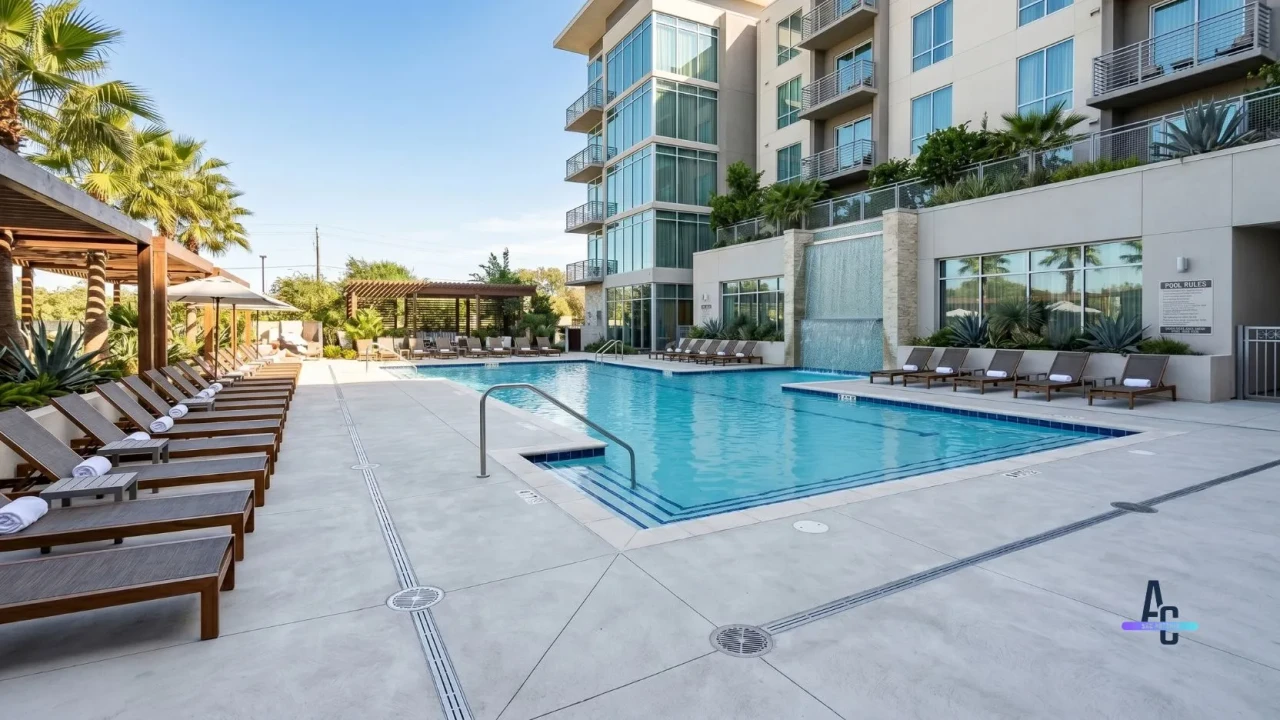
City of San Antonio permits: Commercial pool deck work falls under the Commercial Building Permit category. Your contractor must pull the permit before breaking ground. Verify that your contractor is licensed to pull commercial permits in Bexar County; not all residential concrete contractors hold this qualification.
Texas DSHS aquatic facility rules: The Texas Department of State Health Services (DSHS) regulates public swimming pools under 25 TAC Chapter 265. These rules govern deck surface materials, slip resistance ratings, drain placement, and minimum deck width around the pool perimeter.
| Regulatory body | What it governs | Where to verify |
|---|---|---|
| City of San Antonio DSD | Commercial building permits, structural inspections, zoning compliance | saplatforms.sanantonio.gov |
| Texas DSHS | Aquatic facility surface standards, drain design, deck clearances, bather capacity | dshs.texas.gov (25 TAC Ch. 265) |
| ADA / Title III | Accessible routes to and around pool deck, slope limits, surface continuity | ADA.gov pool accessibility guidelines |
| International Building Code (IBC) | Slab thickness, load ratings, reinforcement standards for commercial applications | Referenced in San Antonio’s commercial building code adoption |
| OSHA (if applicable) | Worker safety during construction; applies to contractors, not owners | osha.gov construction standards |
- Commercial building permit applied for with the City of San Antonio DSD before any site work
- Contractor holds a commercial contractor license valid in Bexar County and is authorized to pull commercial permits
- Stamped engineer’s drawing submitted with permit application: slab spec, reinforcement, drainage, and joint layout
- Texas DSHS aquatic facility rules reviewed: deck width minimums, slip resistance requirements, drain placement
- ADA accessible route requirements confirmed: path to pool deck meets slope and surface continuity standards
- Permit approval in hand before scheduling concrete delivery
Surface Selection
Surface selection on a commercial pool deck is not primarily an aesthetic decision. The governing factors are slip resistance ratings, surface temperature in San Antonio’s summer heat, durability under heavy and repetitive foot traffic, and maintenance cost over the life of the facility. Aesthetics matter, but they are the last filter, not the first.
Surface temperature matters more on commercial decks than residential ones: In San Antonio’s summer heat, a south-facing concrete pool deck can reach surface temperatures well above 140 degrees Fahrenheit. On a commercial property with children and barefoot guests, this is a liability concern and a comfort issue. Lighter aggregate colors and light integral color pigments reflect more heat than dark surfaces. Specify the lightest aggregate color acceptable within your design parameters and include this consideration in your surface selection documentation.
- Slip resistance rating confirmed: surface meets minimum wet coefficient of friction 0.6 per ASTM C1028
- If stamped concrete: anti-slip additive (aluminum oxide or silica sand) specified in sealer coat
- Surface temperature considered: lighter aggregate and integral color specified for south or west-facing decks
- Maintenance frequency budgeted: stamped surfaces require commercial-grade sealer reapplication every 1 to 2 years
- Surface selection documented in project spec and referenced in permit drawings
Drainage & Joints
Drainage and expansion joint design are the two most commonly underdone elements on commercial pool decks in San Antonio, and they are the two elements most likely to cause premature failure. Inadequate drainage leads to standing water, which accelerates surface deterioration and creates slip hazards. Inadequate expansion joints on San Antonio’s expansive clay soils lead to cracking that begins within the first three years and worsens with each seasonal cycle.
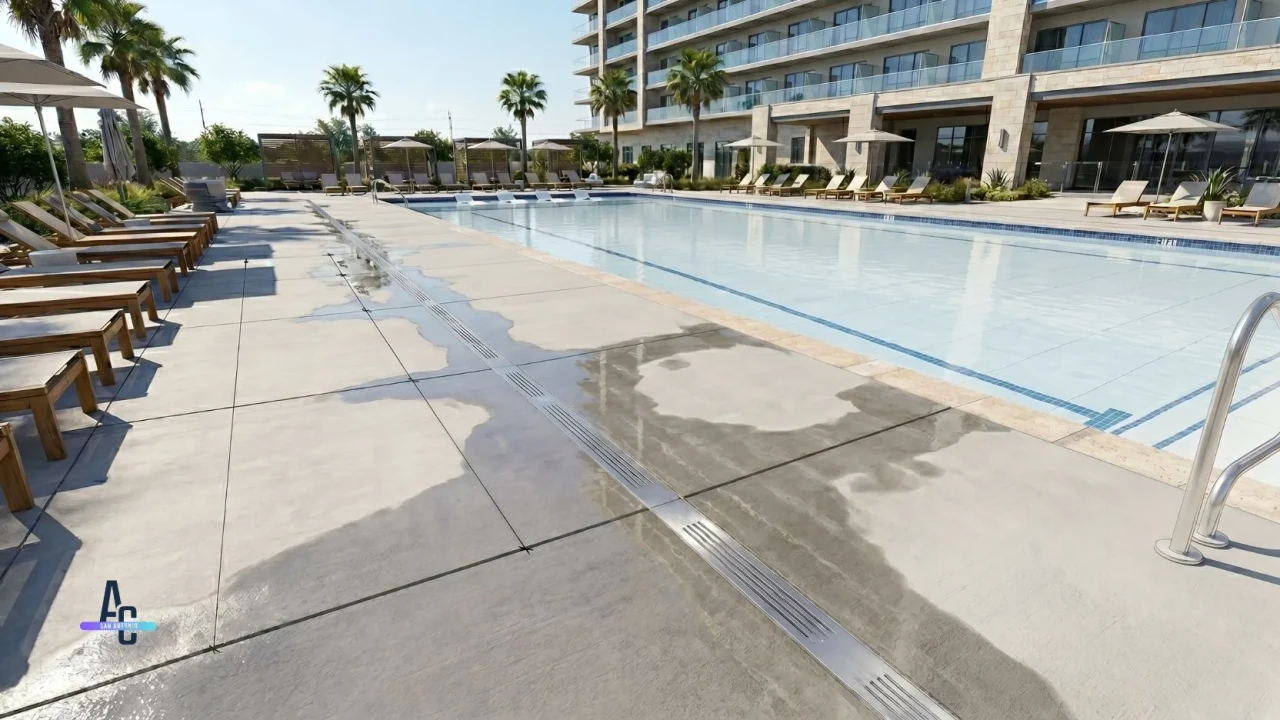
Slope requirements: Texas DSHS rules require a minimum positive slope of 1/8 inch per foot away from the pool edge across the full deck surface. This sounds minor, but it must be achieved uniformly across the entire slab, including around drain locations. Poor slope planning results in low spots that hold water after rain or splash-out events.
Drain placement: Commercial pool decks require deck drains positioned within 10 feet of the pool edge and spaced to ensure no portion of the deck surface is more than 15 feet from a drain. Drain sizing must account for peak bather splash-out and San Antonio’s intense rain events, which can deliver several inches of water per hour.
Expansion joints on commercial decks: Commercial pool decks require a complete expansion joint at the pool bond beam (the interface between the pool shell and the deck slab) and control joints spaced no more than 8 to 10 feet in each direction across the deck surface. In San Antonio’s Vertisol clay soils, which swell when wet and shrink when dry, this spacing is not conservative; it is the minimum that prevents visible cracking on a 5-plus year timeline. The joint material must be a pool-grade polyurethane sealant over closed-cell backer rod, not standard concrete caulk. For a detailed breakdown of expansion joint specifications and failure modes, refer to our pillar guide linked above.
The isolation joint at the bond beam is not optional on commercial projects: A continuous expansion joint between the pool shell and the deck slab allows the two structures to move independently. Without it, differential movement between the pool shell (which moves with water weight and temperature) and the deck slab (which moves with soil moisture and thermal cycling) creates stress that cracks the deck within the first two to three years. This joint must be filled with pool-grade polyurethane sealant and inspected annually. Specify it explicitly in your contractor scope and verify it is included in the permit drawings before the pour.
- Deck slope confirmed at 1/8″ per foot minimum across all deck surfaces, away from pool edge
- Drain locations shown on engineered drawings: within 10 ft of pool edge, maximum 15 ft between drains
- Drain sizing accounts for peak storm event intensity, not just routine splash-out
- Isolation joint at pool bond beam specified: closed-cell backer rod with pool-grade polyurethane sealant
- Control joint spacing confirmed: 8 to 10 ft on center in both directions across deck area
- Joint filler material specified as pool-grade polyurethane, not standard concrete caulk
Contractor Vetting
Commercial pool deck work requires a different contractor qualification standard than residential concrete. The license requirements, insurance minimums, and technical expertise needed are significantly higher. A residential concrete contractor with a strong track record of residential patios is not automatically qualified for a commercial aquatic facility project. Verifying the right credentials before you sign a contract protects your facility, your guests, and your liability exposure.
| What to verify | Commercial minimum requirement | Red flag response |
|---|---|---|
| Texas contractor license | Texas licensed general contractor or concrete specialty contractor; verify at tdlr.texas.gov | Cannot provide license number or claims exemption from licensing on commercial work |
| General liability insurance | $2M per occurrence minimum for commercial aquatic facility work; request certificate naming your property as additional insured | Policy below $2M; reluctance to provide certificate; no additional insured endorsement available |
| Workers’ compensation | Active workers’ comp policy required; no-coverage notice is a significant risk on a commercial project | No workers’ comp; uses subcontractors who carry their own coverage without verification |
| Commercial pool deck experience | Completed at least 3 commercial aquatic facility projects in Texas; references available from facility managers | Experience limited to residential pool decks; cannot provide commercial facility references |
| Permit-pulling authority | Licensed to pull commercial permits with the City of San Antonio DSD; has done so on prior projects | Expects owner to pull permit; claims permits are not required; no prior COSA commercial permits |
| Written bid specification | Bid itemizes slab thickness, base depth, reinforcement schedule, joint layout, drainage design, finish type, and sealer specification | Bid lists only square footage and a total price; no structural specification detail |
| Payment terms | Standard commercial terms: 10 to 30 percent deposit, draw schedule tied to milestones, balance on final inspection | Full payment required before mobilization; no milestone-based payment structure |
- Texas contractor license verified at tdlr.texas.gov before bid invitation
- Certificate of general liability insurance received: $2M per occurrence minimum, property named as additional insured
- Workers’ compensation certificate received and verified as active
- Three commercial aquatic facility references provided; at least two contacted before award
- Contractor has pulled commercial permits with City of San Antonio DSD on prior projects
- Written bid itemizes slab thickness, reinforcement, base depth, drainage design, joint layout, finish, and sealer
- Payment terms structured as milestone-based draws, not full payment upfront
ADA & Maintenance
ADA compliance for commercial pool decks is governed by the 2010 ADA Standards for Accessible Design, which specify accessible route requirements to and around the pool deck, surface slope limits on accessible routes, and pool entry requirements. These are not optional standards for public accommodations; a non-compliant commercial pool deck creates immediate liability exposure under Title III of the ADA.
Long-term maintenance on a commercial pool deck is more intensive than on a residential surface, primarily because of foot traffic volume and the requirement to maintain code-compliant slip resistance throughout the facility’s life. A surface that tested at the required coefficient of friction at installation can fall below the minimum threshold as the finish wears. Scheduled inspections and proactive resealing keep the surface compliant and reduce liability risk.
Build a maintenance log from day one: Document the pour date, the sealer product and batch applied, the first inspection date, and every subsequent maintenance action with dates and photos. This log serves three purposes on a commercial property: it demonstrates due diligence in an injury claim, it provides the baseline data needed to identify deterioration trends early, and it gives your maintenance contractor the product history needed to apply compatible materials during resealing. A one-page log in your facility management system is all it takes.
- Accessible route to and around pool deck confirmed: maximum 5% running slope, 2% cross slope
- 60″ clear turning space provided at all pool entry points
- At least one accessible pool entry method (lift or ramp) specified and installed
- Annual deck inspection scheduled and documented in facility maintenance plan
- Sealer reapplication budgeted: every 1 to 2 years for stamped and stained surfaces under commercial use
- Expansion joint refilling scheduled every 3 to 5 years with pool-grade polyurethane sealant
- Maintenance log established at project completion: pour date, sealer products, inspection records
Use this table as your starting reference point for any commercial aquatic facility project. Each row reflects the spec requirements and typical cost range for that facility type in the San Antonio market in 2026.
| Facility type | Recommended surface | Min. slab spec | Typical cost range (SA, 2026) |
|---|---|---|---|
| Hotel or resort pool deck | Stamped with integral color and anti-slip sealer, or exposed aggregate | 5″ slab, rebar grid, 6″ crushed limestone base | $18–22/sqft installed |
| Apartment or HOA community pool | Exposed aggregate or salt finish; broom acceptable for budget projects | 5″ slab, rebar grid, 6″ crushed limestone base | $14–18/sqft installed |
| Municipal recreation center pool | Broom finish (heavy-duty commercial spec) or exposed aggregate | 6″ slab, rebar grid, 6″ base | $12–16/sqft installed |
| School or university aquatic facility | Broom finish or exposed aggregate; ADA-compliant throughout | 6″ slab, rebar grid, 6″ base | $12–15/sqft installed |
| Fitness club or gym pool deck | Exposed aggregate or stamped with anti-slip sealer | 5″ slab, rebar, 6″ base | $15–20/sqft installed |
| Water park splash pad surround | Broom or exposed aggregate; continuous slip resistance testing required | 6″ slab, rebar grid, 6″ base; engineered drainage plan required | $14–18/sqft installed |
- City of San Antonio commercial building permit applied for before any site work
- Texas DSHS aquatic facility standards reviewed: deck width, slip resistance, drain spacing
- ADA accessible route requirements confirmed and incorporated into project drawings
- Stamped engineer’s drawings prepared and submitted with permit application
- Slab thickness: 5″ minimum for most commercial applications, 6″ for high-load or municipal use
- Reinforcement: rebar grid (#4 at 12″ centers minimum) specified in engineering drawings
- Base: 6″ compacted crushed limestone base specified and verified during construction
- Expansion joints: 8 to 10 ft on center across full deck; isolation joint at pool bond beam
- Joint filler: pool-grade polyurethane sealant over closed-cell backer rod
- Surface finish selected and confirmed to meet 0.6 wet coefficient of friction per ASTM C1028
- If stamped or stained: anti-slip additive specified in sealer coat
- Deck slope: 1/8″ per foot minimum across all surfaces, away from pool edge
- Drain locations on engineered drawings: within 10 ft of pool edge, no point more than 15 ft from drain
- Drain sizing reviewed for peak storm event, not just routine splash-out
- Texas contractor license verified at tdlr.texas.gov
- General liability insurance certificate received: $2M minimum, property named as additional insured
- Workers’ compensation certificate received and verified as active
- Three commercial aquatic facility references provided and at least two contacted
- Contractor has prior COSA commercial permit history
- ADA-compliant pool entry method (lift or ramp) installed and verified
- Annual inspection schedule established and documented in facility maintenance plan
- Sealer reapplication budgeted: every 1 to 2 years under commercial foot traffic
- Expansion joint refilling scheduled: every 3 to 5 years with pool-grade sealant
- Maintenance log started at project completion with pour date, products used, and inspection records
How much does a commercial pool deck cost in San Antonio?
Do I need a permit for a commercial pool deck in San Antonio?
What is the best concrete surface for a commercial pool deck in San Antonio?
What ADA requirements apply to commercial pool decks?
How often does a commercial pool deck need to be resealed in San Antonio?
Get a free commercial pool deck quote in San Antonio
Tell us about your facility and project scope. We will visit the site, review your permit requirements, and provide a fully itemized written quote at no cost.