

A pool deck slip-and-fall at a hotel or apartment property is not just a liability exposure. It is a failure of the concrete surface that was supposed to protect your guests and residents. This guide covers every safety decision: surface finish, drainage slope, signage, ADA compliance, inspection schedules, and the repair triggers that San Antonio property managers cannot afford to ignore.
Hotel and apartment pool decks in San Antonio carry a level of legal and operational responsibility that residential pool decks simply do not. When a guest or resident slips on a wet concrete surface, the question that follows in a courtroom is not whether the surface was wet. The question is whether the property did everything it was required to do to make that surface safe. Finish choice, drainage slope, inspection frequency, repair response time, and signage all become evidence.
This guide is written for property managers, facility directors, and ownership groups who need to understand exactly what a safe commercial pool deck looks like in 2026 in San Antonio, what Texas regulations require, and what the concrete decisions made at construction determine about liability exposure for the life of the property.
Property managers often treat pool deck safety as an ongoing operational problem: more signage, more cleaning, more spot repairs. Those things matter, but they are all responses to a surface that was not specified correctly at the time of construction or resurfacing. A pool deck poured with the correct non-slip finish, the correct drainage slope, and the correct sealant can be maintained safely at a fraction of the cost and effort of managing a surface that was never right. The single most cost-effective safety investment for any San Antonio hotel or apartment pool is a surface spec review before the next resurfacing project, not after the next incident.
Surface Finish
The concrete finish applied to a pool deck at the time of construction or resurfacing determines the baseline coefficient of friction (COF) that the surface will deliver underfoot when wet. No amount of operational management corrects a surface that was finished too smoothly. A polished or broomed-too-fine finish on a commercial pool deck is not a management problem. It is a construction defect that the property will carry until the surface is replaced or overlaid.
The ANSI A1264.2 standard, which governs slip resistance in commercial environments, calls for a minimum COF of 0.6 on wet walking surfaces in pool areas. Texas courts have looked to this standard in premises liability cases. The following finishes are the options that meet or exceed it reliably in San Antonio’s outdoor pool environment.
- Pool deck finish confirmed as one of the compliant types: exposed aggregate, medium or coarse broom, salt finish, or stamped with non-slip additive in sealer
- COF tested on existing surfaces before assuming original finish is still performing smooth finishes wear further over time
- Smooth trowel, polished concrete, and fine broom finishes identified and scheduled for resurfacing or overlay
- Non-slip aggregate additive included in every sealer coat application documented in writing with brand and date
- Overlay option evaluated for structurally sound decks that need surface compliance without full demolition
Drainage
Standing water on a pool deck is not just an inconvenience. It is a documented slip hazard, an accelerant for algae growth on the concrete surface, and in Texas, a situation that a jury will consider evidence of negligence if someone is injured on the property. The concrete slab must be sloped to move water away from the pool coping and toward drain locations at a minimum of 1/8 inch per foot. On any commercial property, this is a design requirement, not a preference.
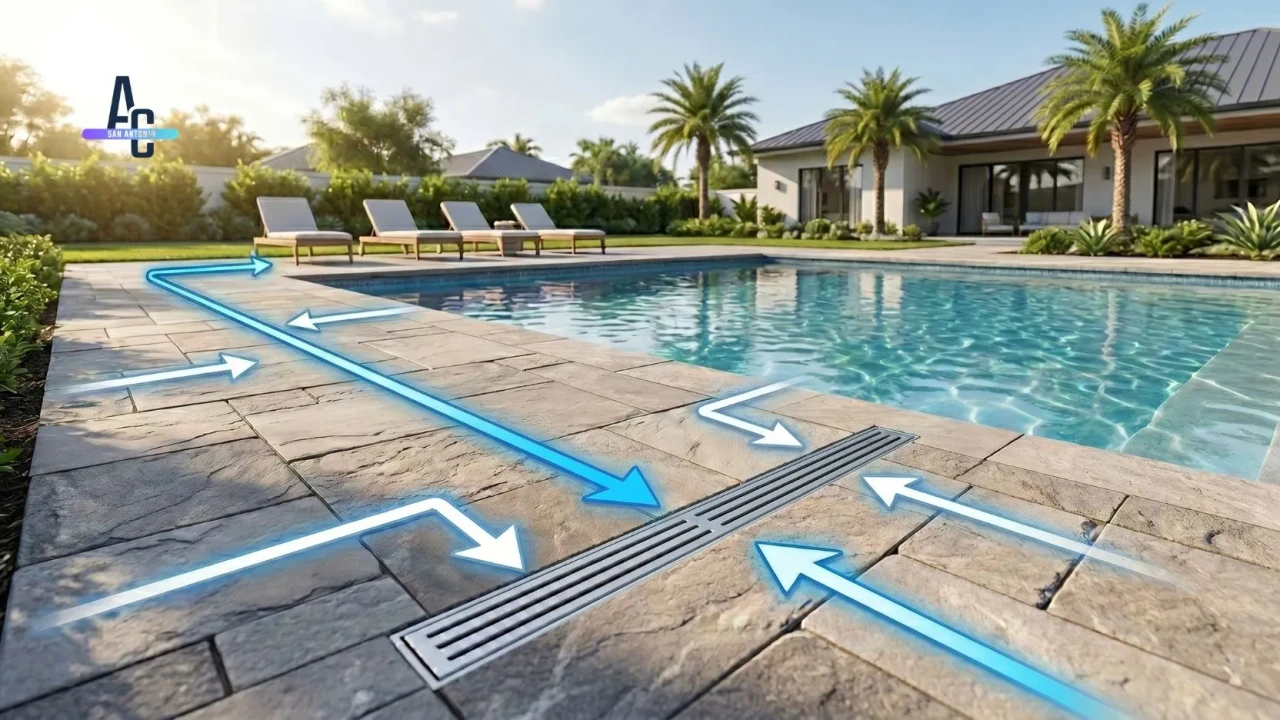
Most pool deck drainage failures in San Antonio are not drain failures. They are slope failures. The drain is present and functional, but the concrete between the pool edge and the drain is not pitched consistently enough to move water all the way there. Water collects in low spots, dries slowly, and creates algae and staining patterns that signal a slope problem. In San Antonio’s heat, these low spots become slippery before they become visible.
Drain grates are a frequently overlooked source of slip hazards on commercial pool decks. A grate with a smooth or decorative top surface can be the most slippery point on an otherwise correctly finished deck. All drain grates on commercial pool decks should be specified with a slip-resistant top surface rated for wet pedestrian environments. Stainless steel grates with a raised pattern or serrated bar top are the standard for commercial pool applications in San Antonio.
How to identify slope problems on an existing pool deck without a survey: After a heavy hosing or a rain event, photograph the deck from pool level. Any area where water is visible standing more than 30 minutes after wetting is a slope failure zone. Mark these areas with chalk or tape and have a concrete professional evaluate whether grinding, overlay, or section replacement is the right fix. In San Antonio’s heat, do not assume the water will evaporate before it becomes a problem. Algae growth in a standing water zone begins within 48 to 72 hours.
- Deck slope confirmed at 1/8 inch per foot minimum from pool coping to all drain locations no flat or reverse-slope zones
- Standing water test completed after every significant rain event any zone that holds water past 30 minutes flagged for correction
- Drain grates confirmed as slip-resistant rated for wet pedestrian environments smooth or decorative top grates replaced
- Drain sizing confirmed adequate for peak San Antonio storm load on the full deck surface area not just normal splash volume
- Drain body-to-slab joint inspected and sealed annually gap at this joint allows water to undermine the base in San Antonio clay soils
ADA Compliance
The Americans with Disabilities Act applies to hotel pools as public accommodations and to apartment pools serving more than a defined number of units. The Texas Accessibility Standards (TAS), administered through the Texas Department of Licensing and Regulation, adopt and in some cases exceed the federal ADA requirements for new construction and alterations. Any pool deck resurfacing, reconstruction, or significant alteration at a San Antonio hotel or apartment property triggers a TAS review for the altered area.
| ADA / TAS requirement | What it means for pool deck concrete | Common compliance failure |
|---|---|---|
| Accessible route to pool | A continuous path from accessible parking or the accessible building entrance to the pool deck with no step changes in elevation and a maximum 1:20 slope (1:12 for ramps with handrails) | A single step up from the sidewalk or parking area to the pool deck grade common in older properties and a frequent ADA violation |
| Pool entry accessibility | At least one accessible means of entry into the pool either a pool lift or a sloped entry required for public swimming pools under ADA | Pool lift present but not positioned on a stable, level concrete surface the concrete pad under a pool lift must be flat and structurally reinforced to support the equipment and a user |
| Surface cross-slope | Accessible routes on the pool deck must not exceed 1:48 (about 1/4 inch per foot) in cross-slope perpendicular to the direction of travel | Drainage slope exceeds the maximum accessible cross-slope a conflict between drainage requirements and ADA surface requirements that must be resolved in the design phase, not the field |
| Surface stability and firmness | The accessible route must be stable, firm, and slip-resistant the same non-slip surface standards that apply to safety generally also satisfy this ADA requirement | Loose aggregate, damaged concrete joints, or spalled surfaces on the accessible route each of these creates both an ADA violation and a slip hazard |
| Changes in level | Vertical changes in level on the accessible route up to 1/4 inch are allowed without treatment; 1/4 to 1/2 inch must be beveled; anything over 1/2 inch requires a ramp | Control joints that have opened or displaced, creating a vertical lip at a joint in the accessible path |
| Signage | Pool rules and safety signage must be accessible lettering contrast, mounting height, and Braille requirements apply under TAS for certain signs | Signs posted at a height accessible to a standing person only, or without sufficient contrast for low-vision guests |
The drainage slope vs. ADA cross-slope conflict is real and solvable: The minimum drainage slope of 1/8 inch per foot and the maximum ADA cross-slope of 1/4 inch per foot can coexist if the deck is designed so that the drainage slope runs parallel to the direction of accessible travel, not perpendicular to it. On a deck where accessible travel runs along the length of the pool, slope the concrete away from the pool (toward an outer drain) in the direction perpendicular to travel. A concrete contractor experienced with commercial pool decks in San Antonio will understand this constraint. One who does not is a risk you cannot afford on a commercial property.
- Accessible route from parking or building entrance to pool deck confirmed no step changes in elevation, maximum slope 1:20 on route and 1:12 on ramps with handrails
- Pool lift or sloped entry present and positioned on a level, structurally reinforced concrete pad
- Cross-slope on accessible route confirmed at 1:48 maximum drainage slope designed parallel to direction of accessible travel, not perpendicular
- Control joints and expansion joints on accessible route inspected for vertical displacement exceeding 1/4 inch any displacement over 1/2 inch requires correction before the pool opens
- TAS-registered accessibility consultant engaged before any resurfacing or alteration project to assess path-of-travel compliance requirements
Inspections
For a hotel or apartment pool in San Antonio, a pool deck inspection is not a housekeeping task. It is a formal safety function that, when documented correctly, establishes the property’s due diligence record. If an incident occurs and the property cannot produce a documented inspection history showing what was found, what was repaired, and when, that absence of documentation becomes evidence of negligence in Texas premises liability law.
The quarterly inspection is the one most commercial properties in San Antonio skip or perform informally. A formal quarterly inspection should produce a written record that includes the date, the name of the person conducting the inspection, a checklist of specific items reviewed, any defects found, and the response taken for each defect. This document should be retained for at least three years and stored somewhere other than the property itself in case of a legal hold.
| Defect type | Response required | Acceptable timeline |
|---|---|---|
| Crack wider than 1/4 inch with no vertical displacement | Fill with flexible polyurethane sealant; monitor for expansion | Within 14 days of identification |
| Crack with any vertical displacement (one side higher than the other) | Grind high side flush and fill, or section replacement if base failure is suspected close affected area until repaired | Before the pool reopens the following day |
| Spalling or delamination of surface layer | Area isolation until repaired; patch or overlay depending on extent | Before the pool reopens the following day if on a walkway or pool-edge area |
| Standing water zone that does not drain in 30 minutes | Cone off zone; assess slope and drain function; correct drainage or grind high spots | Within 7 days of identification; cone remains until corrected |
| Drain grate damaged, missing, or flush failure | Replace grate immediately; a missing or damaged grate is a trip and entrapment hazard | Same day pool deck adjacent to missing grate should be coned off until replacement is in place |
| Sealer visibly worn, peeling, or no longer beading water | Schedule professional reseal with non-slip additive; document date and application | Within 30 days of identification; apply interim non-slip treatment if the surface fails a wet COF test |
| Control joint filler cracked, missing, or extruded | Remove old filler and refill with fresh polyurethane joint sealant | Within 30 days; accelerate if joint is on an accessible route or pool edge zone |
- Daily visual sweeps for debris, standing water, and displaced safety equipment brief written or digital log maintained
- Weekly deck walk covering crack formation, joint condition, and drain function findings logged with date and name
- Quarterly formal written inspection covering COF, drainage, joints, ADA route, and signage retained for minimum 3 years
- Annual professional assessment of sealer condition and surface spec compliance scheduled before pool season opens
- Post-storm inspection protocol established and followed after any significant rain event
- Every documented defect has a corresponding repair record or a written interim safety action no open defects without a documented response
Maintenance
A concrete pool deck sealer serves two functions for a commercial property in San Antonio: it protects the concrete from water intrusion, pool chemical absorption, and staining, and it carries the non-slip additive that keeps the surface COF above the required 0.6 when wet. When the sealer wears, both functions fail simultaneously. The surface becomes more porous and more slippery at the same time.
San Antonio’s outdoor conditions are harder on pool deck sealers than in most U.S. cities. Intense UV exposure from May through September degrades sealers faster than manufacturer timelines assume. Pool chemicals and splash water create a chemical environment that breaks down standard sealers from the surface. High foot traffic on a commercial deck compounds both problems.
1–2 yrs
2–3 yrs
Best time to reseal a commercial pool deck in San Antonio: October through March. Sealer application requires surface temperature between 50 and 90 degrees Fahrenheit for proper curing. San Antonio summer surface temperatures routinely reach 130 to 150 degrees Fahrenheit in direct sun, which is well above the upper limit for most sealers and causes bubbling, peeling, and adhesion failure. Plan reseal projects for fall and winter and schedule accordingly. Properties that try to reseal in July to get ahead of a busy summer often create the exact surface failure they were trying to prevent.
- Reseal schedule established based on traffic level: annually for high-traffic hotel or large apartment pools; every 2 to 3 years for smaller commercial properties
- Non-slip aggregate additive specified in writing for every reseal coat not assumed to be included
- Wet COF test completed after each reseal before the pool reopens to guests or residents
- Reseal projects scheduled for October through March summer surface temperatures in San Antonio prevent proper sealer curing
- Sealer brand, application date, additive type, and contractor name documented and retained as part of the property maintenance record
- Overlay resurfacing evaluated for any surface where reseal alone cannot restore COF to 0.6 wet minimum
Operations
A correctly finished, well-drained, ADA-compliant pool deck is the foundation of a safe commercial pool area. Signage and operational controls are the layer on top of that foundation. In Texas, pool signage requirements are established through the Texas Department of State Health Services (DSHS) and enforced through local health authorities. San Antonio properties operating public pools are subject to Bexar County or City of San Antonio pool regulations depending on jurisdiction.
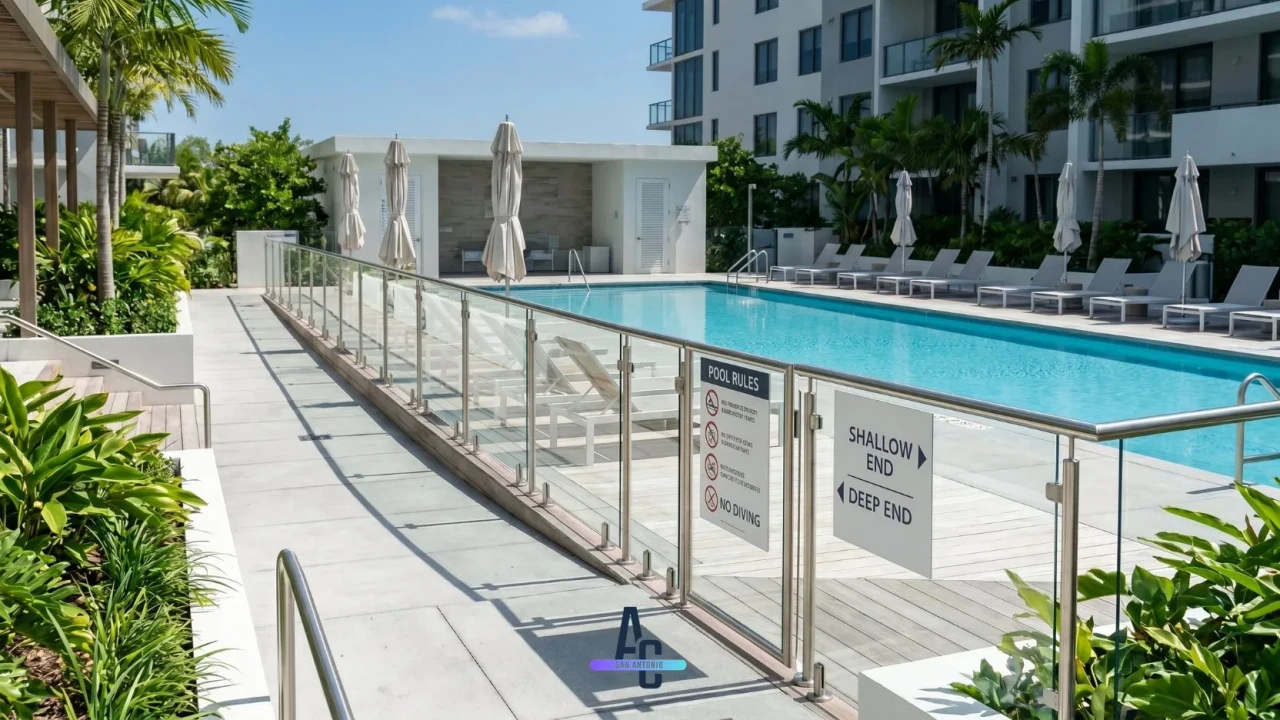
Texas Health and Safety Code Chapter 341 establishes the baseline requirements for public swimming pools, which include commercial apartment and hotel pools. Required signage elements for most Texas public pools include pool rules, depth markings at the pool edge, no-diving markers where applicable, and emergency contact information prominently posted.
Signage placement matters as much as signage content on a pool deck. A no-running or wet surface warning sign posted only at the gate does not adequately warn a guest who enters from a different access point or who has already walked past it. Multiple sign placements throughout the deck, particularly near high-risk zones like pool entry points, steps, and slope transitions, are a stronger risk management posture and a more defensible one in the event of a claim.
The two operational controls that reduce pool deck incident rates most effectively in San Antonio: First, non-slip mat placement at pool entry and exit points. The zone where guests step from the pool ladder or steps onto the deck surface is the highest-risk area on any pool deck, regardless of the underlying concrete finish. A correctly specified non-slip mat at each pool entry point reduces incidents at that zone significantly. Second, a pool deck surface cleaning schedule that removes algae and organic buildup before they become visible. By the time a dark spot is visible on the concrete, the surface underneath has already lost significant COF. Weekly cleaning with a diluted sodium hypochlorite solution keeps the surface at its designed performance level between professional cleaning visits.
- Pool rules signage posted in plain view of the deck and meeting Texas DSHS public pool requirements
- Depth markers present on deck and pool wall at each end and at every slope transition
- No-running and wet surface warning signs posted at multiple deck locations, not just at the entry gate
- Emergency contact information posted prominently and kept current verify contact numbers at the start of each pool season
- Non-slip mats placed at each pool ladder and step entry point and inspected weekly for condition and placement
- Weekly deck cleaning schedule established using a dilute sodium hypochlorite solution or equivalent algae-control product
- Current local pool permit posted and visible as required by Bexar County or City of San Antonio jurisdiction
Use this table as a fast reference when assessing a specific property type. Requirements vary between hotel pools, apartment community pools, and HOA facilities in terms of inspection frequency, regulatory oversight, and ADA applicability.
| Property type | Regulatory authority | ADA applicability | Recommended inspection frequency | Reseal interval |
|---|---|---|---|---|
| Hotel or motel pool | Texas DSHS + City of San Antonio / Bexar County Health | Full ADA Title III applies as a public accommodation | Daily visual, weekly formal, quarterly written, annual professional | Every 12 to 18 months |
| Apartment complex pool (50+ units) | Texas DSHS + local health authority | ADA applies under Fair Housing Act for pools available to all residents | Daily visual, weekly formal, quarterly written, annual professional | Every 18 to 24 months |
| Apartment complex pool (under 50 units) | Local health authority varies | Fair Housing Act accessibility provisions may still apply confirm with TAS consultant | Weekly visual, quarterly written, annual professional | Every 2 to 3 years |
| HOA community pool | Texas DSHS + local health authority | ADA applies to the extent it is a public accommodation consult counsel | Weekly visual, quarterly written, annual professional | Every 2 to 3 years |
| Condo association pool | Local health authority | Fair Housing Act applies; ADA public accommodation rules may apply depending on access | Weekly visual, quarterly written, annual professional | Every 2 to 3 years |
- Pool deck finish confirmed as a compliant non-slip type: exposed aggregate, medium or coarse broom, salt finish, or stamped with non-slip additive in sealer
- Wet COF confirmed at 0.6 minimum across the full deck surface including high-traffic zones at pool entry points
- Sealer condition assessed: peeling, worn, or non-beading areas scheduled for reseal before pool opens
- Non-slip additive included in most recent sealer application and documented in maintenance records
- Deck slope confirmed at 1/8 inch per foot minimum toward all drain locations with no standing water zones
- Drain grates confirmed as slip-resistant rated for wet pedestrian environments and free of damage or displacement
- Drain body-to-slab joint sealed and intact at all drain locations
- Post-storm drainage test completed within 24 hours of any significant rain event
- Accessible route from parking or building entrance to pool deck confirmed with no step changes in elevation
- Pool lift or sloped entry present, functional, and positioned on a level reinforced concrete pad
- Cross-slope on accessible route confirmed at 1:48 maximum
- Control joints on accessible route inspected for vertical displacement exceeding 1/4 inch
- TAS compliance reviewed before any resurfacing or alteration project is approved
- Quarterly inspection completed and written record filed with date, inspector name, findings, and repair responses
- All documented defects have a corresponding repair record or documented interim safety action
- Pool rules, depth markers, no-running signs, and emergency contact information posted per Texas DSHS requirements
- Current pool permit posted and valid for the operating season
- Non-slip mats in place at all pool entry and exit points and inspected for condition
What concrete finish is required for a hotel or apartment pool deck in San Antonio?
Does ADA apply to apartment pool decks in San Antonio?
How often should a commercial pool deck in San Antonio be resealed?
What should a hotel or apartment manager do immediately after a pool deck slip-and-fall incident?
Can we resurface our existing pool deck instead of replacing it?
Get a free commercial pool deck assessment in San Antonio
Tell us about your hotel or apartment pool deck. We will visit the property, assess the surface condition, slope, and drainage, and give you a detailed written quote for any repair, resurfacing, or reseal work needed.