
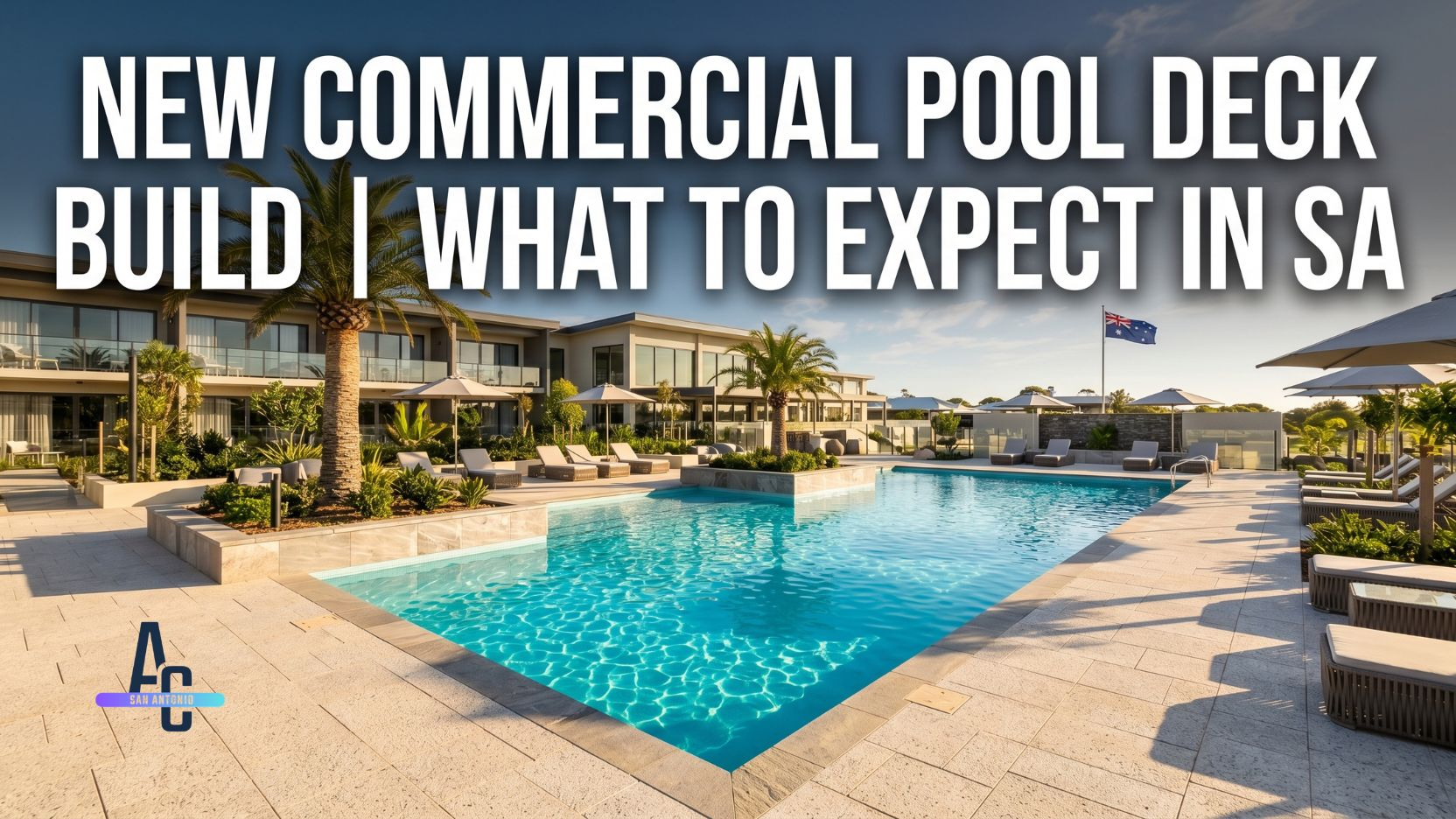
A commercial pool deck build in San Antonio is a different animal than a residential pour. Stricter codes, ADA requirements, heavier load specs, and a multi-phase approval process all come into play before a single yard of concrete is ordered. This guide walks you through every stage so your project runs on schedule and on budget.
If you manage a hotel, apartment complex, HOA, or recreational facility in San Antonio, you already know that a commercial pool deck is not a weekend project. The scope alone sets it apart from residential work: larger footprints, heavier foot traffic, ADA compliance requirements, City of San Antonio permitting, and pool barrier code all need to be addressed before any concrete touches the ground.
What most property managers do not realize is that the planning phase is where most projects run into trouble. A poorly sequenced job that pulls permits after design decisions are locked in, or a concrete spec that does not account for commercial drainage requirements, can delay a project by weeks and add thousands to the final cost. This guide lays out the full process in the order it actually happens, with the specific decisions and numbers that apply to commercial pool decks in Bexar County.
The most common cause of delays on commercial pool deck projects in San Antonio is a mismatch between what the designer specified and what the City’s Development Services Department will approve. Drainage grades, barrier setbacks, ADA route widths, and expansion joint placement all need to be locked in before the concrete contractor prices the job. Starting with a contractor who knows San Antonio’s commercial concrete code and who has pulled these permits before eliminates the back-and-forth that kills timelines.
Phase 1
Every commercial pool deck build in San Antonio starts with a site assessment. This is not a courtesy walk-around. It is a technical evaluation that determines the concrete specification, base preparation requirements, drainage design, and the footprint boundaries that will be submitted for permitting. Skipping this step or rushing through it is the number one reason commercial projects go over budget.
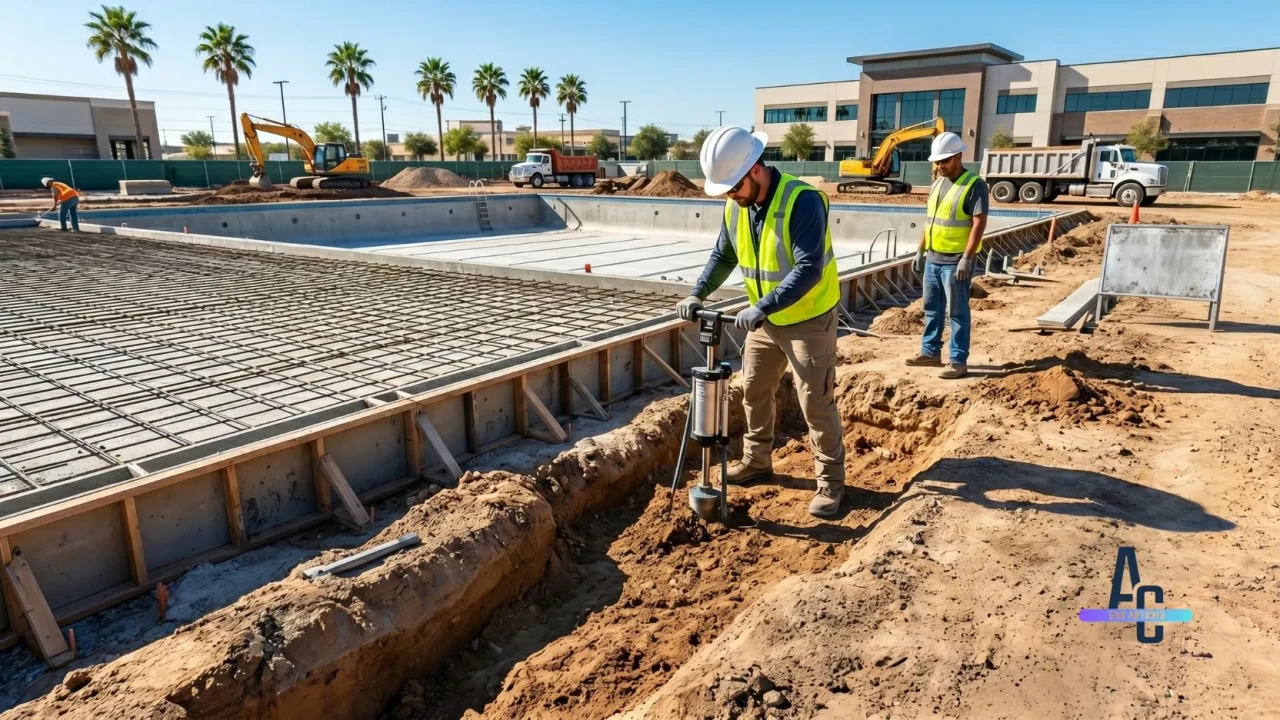
In Bexar County, expansive clay soils are the norm. For a residential patio, this means careful base preparation. For a commercial pool deck with heavy, concentrated foot traffic year-round, it means a full geotechnical review is strongly recommended. Soil movement in San Antonio’s clay-heavy ground can crack a slab that was poured to residential spec within two to three seasons of heavy use.
The concrete specification that comes out of this assessment will determine whether the project passes its City inspection on the first visit. For commercial pool decks in San Antonio, the standard spec is a 5-inch slab minimum with a rebar grid (number 4 bar at 12 inches on center both ways), poured over a 6-inch compacted crushed limestone base. Expansion joints are required at 10-foot intervals and wherever the deck meets the pool coping, any raised feature, or a building foundation.
- Soil evaluation completed: clay content, bearing capacity, and compaction requirements confirmed
- Drainage plan designed: drain locations, slope grades, and runoff path documented
- Pool barrier setback distances measured and recorded for permit submission
- ADA-accessible route from entry to pool identified and dimensioned
- Slab spec confirmed in writing: thickness, reinforcement type and spacing, base depth, and expansion joint plan
Phase 2
Commercial pool deck construction in San Antonio requires permits through the City of San Antonio Development Services Department. The specific permits required depend on the scope of work, but most new commercial pool deck builds will require at minimum a commercial building permit covering the concrete flatwork, a pool barrier inspection, and a drainage review. If the project includes any electrical (lighting, outlets), plumbing (deck drains connecting to the sanitary or storm system), or a covered structure, additional trade permits apply.
| Permit or review required | Who reviews it | Typical timeline |
|---|---|---|
| Commercial building permit (flatwork) | City of San Antonio Development Services | 2–4 weeks after complete application submission |
| Pool barrier compliance | Development Services / Building Inspection | Reviewed with building permit; site inspection required |
| ADA compliance review | Development Services | Part of building permit plan review |
| Drainage and grading plan | San Antonio River Authority (SARA) if near waterway; otherwise Development Services | 2–3 weeks for standard review |
| Electrical permit (if applicable) | Development Services Electrical Division | 1–2 weeks; separate inspection required |
| Final inspection and certificate of occupancy | Building Inspection Division | Scheduled after all work complete; typically within 1 week of request |
Use a contractor who has pulled commercial concrete permits in San Antonio before. The City’s plan review checklist for commercial pool decks is specific drainage grades, barrier setback dimensions, ADA route widths, and expansion joint locations all need to be shown on the submitted drawings. An experienced local contractor will know exactly what the reviewer looks for and will get the application right the first time. Incomplete or incorrect applications go to the back of the queue on resubmission, adding two to four weeks to your timeline.
ADA requirements for commercial pool decks fall under the 2010 ADA Standards for Accessible Design. At minimum, this requires at least one accessible route connecting the accessible parking area to the pool entrance, a surface that is firm, stable, and slip-resistant, and turning space at any dead-end accessible route. For pool decks specifically, ADA also governs pool lift placement and the accessible route to each pool entry point. These requirements need to be reflected in the design drawings submitted with the permit application.
- Commercial building permit application submitted with complete drawings: slab spec, drainage grades, barrier layout, ADA route
- Pool barrier compliance documentation included: barrier height, gate hardware spec, and setback distances from water edge
- Drainage plan stamped by engineer if required by scope or proximity to waterway
- Trade permits identified and applied for: electrical, plumbing (deck drains), and any covered structure
- Inspection schedule confirmed with contractor: rough slab, barrier, and final inspection dates on calendar
Phase 3
Site preparation for a commercial pool deck is the most labor-intensive phase of the project, and the one that most directly determines how long the finished slab holds up. On a well-run commercial job in San Antonio, site prep typically takes two to three days before the pour. Cutting corners here is what creates cracked, settled, or sunken commercial pool decks three to five years after installation.
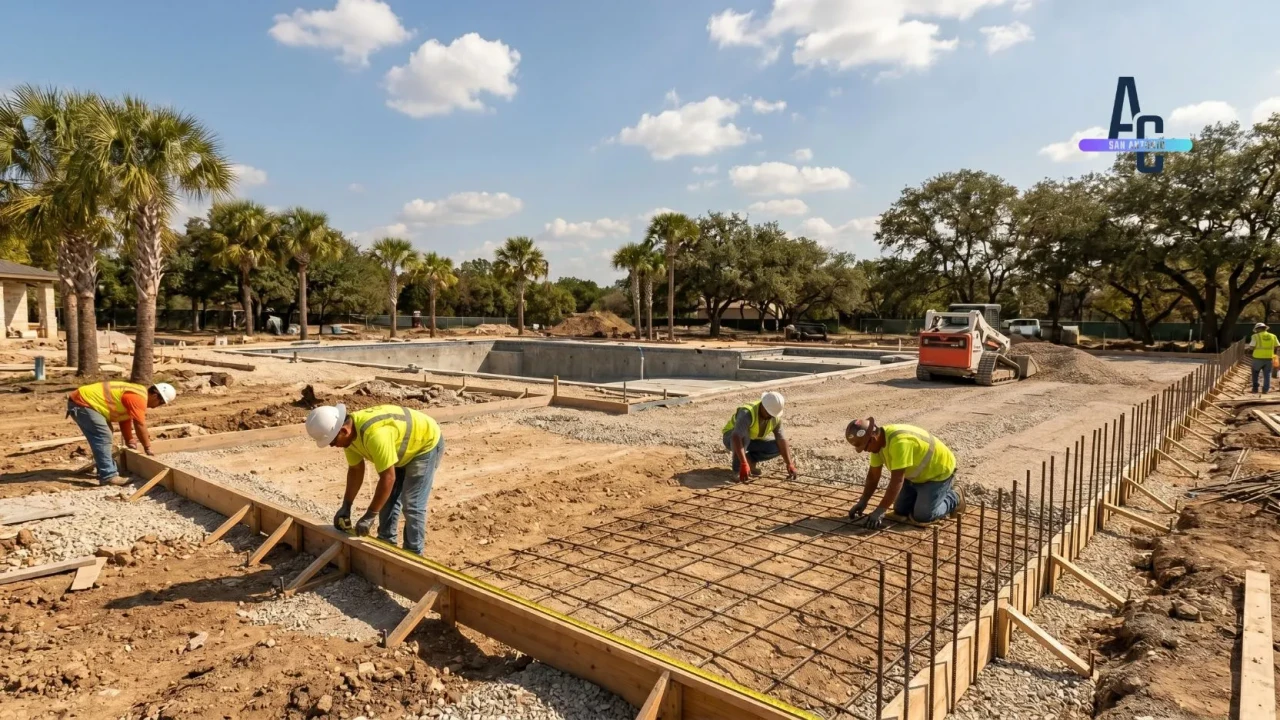
Excavation removes existing material to the correct depth for the base and slab combined. For a commercial pool deck in San Antonio with a 5-inch slab and 6-inch base, that means excavating to 11 inches below the finished surface grade. The excavated area is then graded to the designed drainage slope before the base material goes in.
Rebar for a commercial pool deck should be elevated on plastic or concrete chairs so that it sits at mid-slab depth not resting on the base. Rebar that sits on the ground provides little structural benefit and corrodes faster because of its proximity to moisture in the base material. For a 5-inch commercial slab, the rebar chairs should hold the grid at 2.5 inches above the base surface.
- Excavation depth verified: slab thickness plus base depth below finished grade
- Native subgrade compacted before base material is placed
- Crushed limestone base placed in two 3-inch lifts, each compacted to 95% standard Proctor density
- Forms set to correct grade and verified for drainage slope before rebar placement
- Rebar grid placed on chairs at mid-slab height not resting on base material
- All drain sleeves, conduit, and utility penetrations set and secured in forms before pour day
- Expansion joint locations marked and isolation material or foam backer placed at pool coping, building walls, and column bases
Phase 4
A commercial pool deck pour in San Antonio typically requires multiple concrete trucks sequenced to arrive at intervals that allow the crew to keep up with placement and finishing. For a large commercial deck 3,000 square feet or more this can mean four to eight trucks over the course of a morning. The crew size needs to match the pour volume. An understaffed crew on a large commercial pour will struggle to finish sections properly before the concrete reaches initial set, particularly in San Antonio’s summer heat.
Surface finish for commercial pool decks must meet two requirements that residential work does not always prioritize: slip resistance when wet and durability under commercial-grade cleaning chemicals. The most common finishes used on commercial pool decks in San Antonio are exposed aggregate, medium broom finish, and brushed texture. Smooth trowel finishes are not permitted on exterior commercial pool decks under any conditions they are a slip hazard when wet and a liability exposure.
Exposed aggregate is the most durable and lowest-maintenance finish for high-traffic commercial pool decks in San Antonio. The natural texture provides excellent wet slip resistance without a surface coating that needs periodic reapplication. A sealed exposed aggregate deck also resists the chlorine and UV damage that degrades stamped and stained surfaces faster in a pool environment. For commercial properties focused on reducing long-term maintenance costs, this is typically the correct finish choice.
- Concrete mix design confirmed: 4,000 psi minimum, water-to-cement ratio at or below 0.45
- Truck delivery sequenced correctly: intervals match crew’s placement and finishing pace
- No water added at the truck by the driver to improve workability
- Rebar placement verified before first truck discharges: chairs in place, grid at correct depth
- Expansion joints cut or tooled at all planned intervals as each section is poured
- Non-slip surface finish applied: exposed aggregate, medium broom, or brushed texture not smooth trowel
- Curing compound applied immediately after finishing, or wet curing protocol initiated before crew leaves site
Phase 5
After the concrete cures, the project moves into final inspections before the deck can be opened to the public. For commercial pool decks in San Antonio, the City’s final inspection covers the concrete flatwork, pool barrier compliance, ADA route verification, and drainage. All of these need to pass before the certificate of occupancy is issued and the pool area can be used. Scheduling the inspection early — as soon as the 28-day cure period is complete keeps the project on timeline.
Sealing a commercial pool deck is not optional. In San Antonio’s combination of intense UV exposure, seasonal temperature swings, and constant chlorine exposure near the pool edge, an unsealed commercial slab will show surface scaling and color degradation within two to three seasons. A penetrating concrete sealer not a surface film sealer is the correct product for commercial pool decks. Penetrating sealers bond with the concrete matrix rather than sitting on the surface, which means they do not peel, bubble, or create a slip hazard when wet the way some topical coatings can.
- 28-day cure period complete before scheduling final City inspection
- Pool barrier inspection passed: barrier height, gate self-closing hardware, and setback distances verified
- ADA route inspection passed: surface firmness, slope, and turning space confirmed at all required locations
- Drainage inspection passed: no standing water on deck surface after hose test
- Penetrating sealer applied after inspection sign-off not before, as sealer can interfere with some inspection tests
- Certificate of occupancy received and filed with property records
- All permit documentation, inspection records, and concrete mix design receipts filed for future reference
Commercial pool deck costs in San Antonio vary based on deck size, finish selection, and site conditions. The table below breaks down typical cost ranges by line item so you can evaluate contractor quotes accurately and spot where bids are cutting corners.
| Line item | Typical cost range | Notes |
|---|---|---|
| Excavation and haul-off | $1.50–3.00/sqft | Varies with depth and access; clay soil costs more to haul due to weight |
| Crushed limestone base (6″) | $1.00–2.00/sqft | Material plus compaction; do not accept quotes that omit this line |
| Forming and rebar placement | $1.50–2.50/sqft | Commercial rebar grid at #4 bar is more labor-intensive than residential wire mesh |
| Concrete (5″ slab, 4,000 psi) | $5.00–7.00/sqft | Material plus placement; based on ready-mix pricing in Bexar County |
| Surface finish broom or brushed | Included in concrete line | Standard commercial finish; no upcharge over plain pour |
| Surface finish exposed aggregate | $2.00–3.50/sqft upcharge | Additional labor for surface washing and aggregate reveal process |
| Expansion joints (tooled or saw-cut) | $0.50–1.00/linear ft | Saw-cut joints on commercial work are standard; tooled joints available on smaller pours |
| Penetrating sealer (first application) | $0.50–1.00/sqft | Applied after 28-day cure; silane-siloxane penetrating sealer recommended for pool environments |
| Permitting fees | $800–2,500 per project | Varies with project valuation and number of trade permits required |
| Total installed cost (broom finish) | $14–18/sqft | All-in including base, pour, finish, joints, and sealer; excludes electrical and plumbing |
| Total installed cost (exposed aggregate) | $17–22/sqft | All-in with premium finish; most common spec for new commercial pool decks in SA |
- Site assessment completed: soil evaluation, drainage survey, and ADA route planning done before design is finalized
- Slab specification confirmed in writing: 5″ minimum thickness, number 4 rebar at 12″ on center, 6″ compacted limestone base
- Drainage grades designed into the slab: minimum 1/8″ per foot slope toward drains confirmed on drawings
- Expansion joint plan documented: 10-foot maximum spacing, isolation joints at coping, building walls, and all penetrations
- Commercial building permit applied for with complete drawings slab spec, drainage grades, barrier layout, ADA route
- Pool barrier compliance addressed: barrier height, self-closing and self-latching gate hardware, and setback distances from pool edge
- ADA compliance addressed in design: accessible route, surface requirements, and pool lift placement documented
- All trade permits applied for: electrical (lighting), plumbing (deck drains), and any covered structure
- Contractor has pulled commercial concrete permits in San Antonio verify with City records if uncertain
- Certificate of insurance on file: $2M general liability minimum for commercial work; workers compensation confirmed
- Quote itemizes every line item: excavation, base, rebar, concrete, finish, joints, sealer, and permitting fees
- Concrete mix design included in quote: 4,000 psi minimum, w/c ratio at or below 0.45 specified
- References from completed commercial pool deck projects in Bexar County available on request
- Curing process confirmed in writing: liquid compound or wet curing for minimum 3 days after pour
- No commercial foot traffic, furniture placement, or equipment staging for minimum 7 days
- Final City inspection scheduled for day 28 or later after pour
- Penetrating sealer applied after inspection sign-off; resealing scheduled for every 3 years
- All permits, inspection records, and concrete mix design documentation filed with property records
How long does a commercial pool deck build take from start to finish in San Antonio?
Do I need a permit for a commercial pool deck in San Antonio?
What is the best concrete finish for a commercial pool deck in San Antonio?
How do I evaluate competing bids for a commercial pool deck project?
How often does a commercial pool deck need to be resealed in San Antonio?
Get a free commercial pool deck quote in San Antonio
Tell us about your property and project scope. We will visit the site, evaluate soil and drainage conditions, and deliver a detailed written quote that covers every line item — no surprises at invoice.