
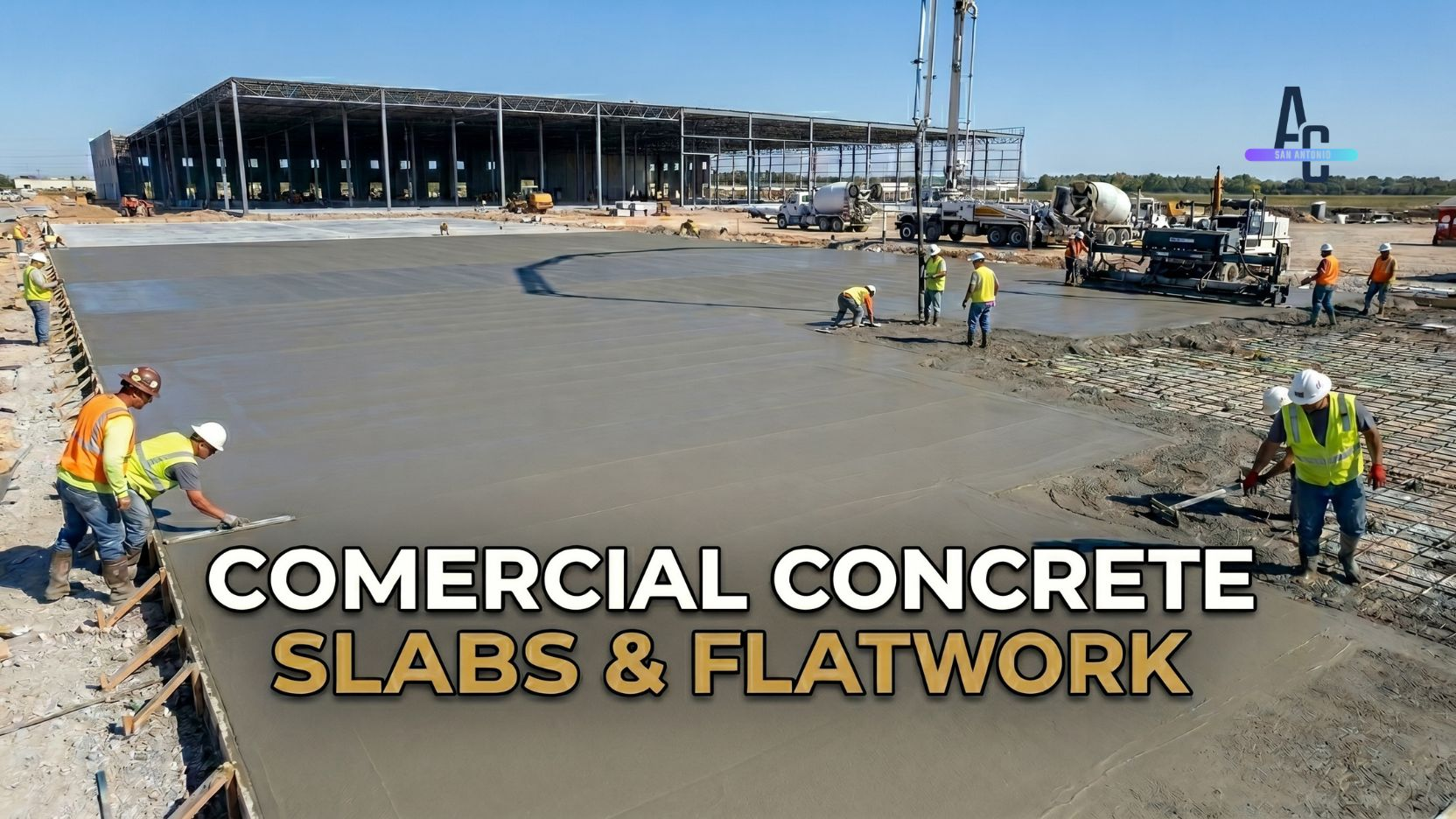
A commercial slab is not a scaled-up residential patio. The load requirements, subgrade preparation, reinforcement specs, and finishing tolerances are in a different category entirely. This guide covers everything a San Antonio business owner or property manager needs to know before signing a flatwork contract.
Commercial flatwork in San Antonio covers a wide range of projects: warehouse floors, retail storefronts, restaurant pads, drive-through lanes, loading docks, sidewalks, and equipment pads. What ties them together is that they all carry loads that residential concrete was never designed to handle and they all fail when a contractor applies residential thinking to a commercial job.
The difference between a commercial slab that lasts 30 years and one that starts cracking in year three almost always comes down to decisions made before the pour: subgrade compaction, slab thickness, concrete mix design, reinforcement, joint spacing, and surface finish. This guide walks through each of those decisions with the specific numbers that apply to San Antonio’s soil conditions and commercial use cases.
Every commercial concrete failure we see in San Antonio traces back to the same root cause: a contractor who skipped or rushed subgrade preparation. Bexar County’s expansive clay soils move significantly with moisture changes. A slab poured over improperly compacted fill or unstabilized clay will crack, heave, and settle regardless of how good the concrete mix is. Proper subgrade compaction, lime stabilization where soils require it, and a well-graded crushed limestone base course are not optional line items. They are the foundation of every flatwork project that meets spec.
Slab Design
Commercial slabs carry loads that residential concrete is not engineered for. A 5,000-pound forklift distributes its load through four small contact patches on hard tires, creating point loads that can be 10 to 20 times higher than the loads a passenger vehicle places on a driveway. Undersizing the slab thickness for the anticipated use is the most common and most expensive mistake in commercial flatwork.
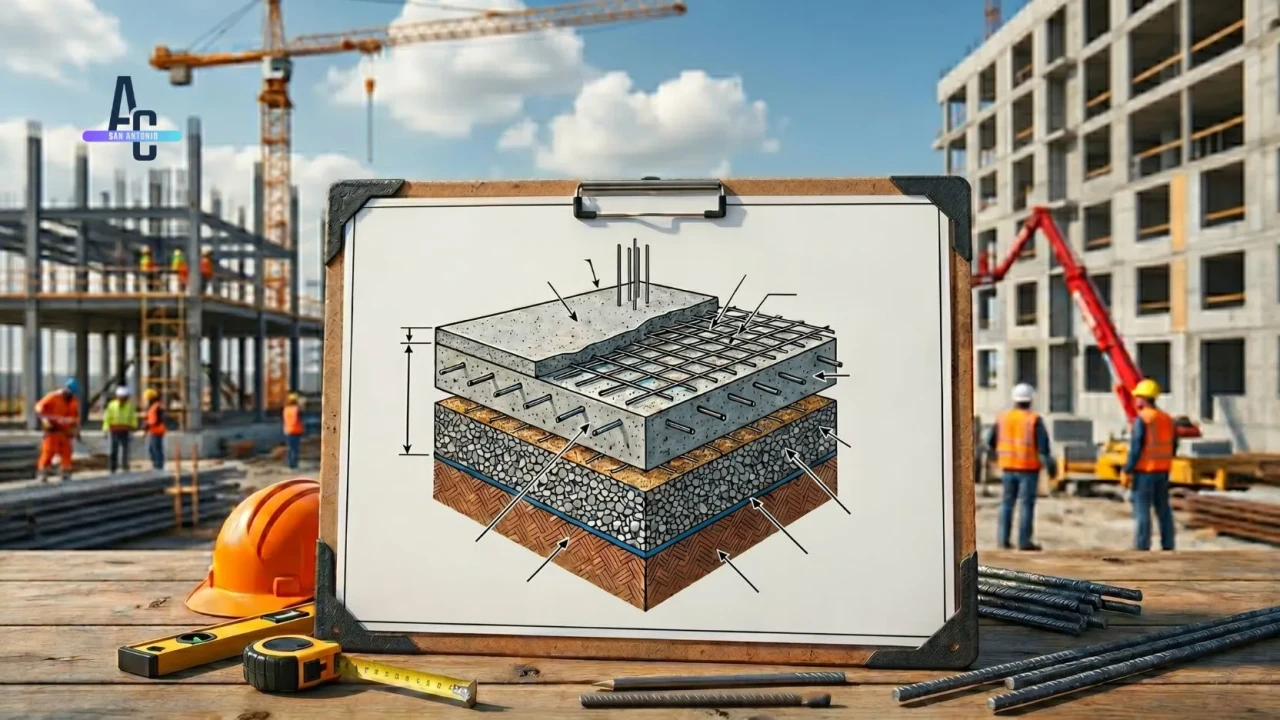
Light commercial (retail storefronts, offices, restaurant pads): 4 to 5 inch slab on a 4 inch compacted crushed limestone base. Adequate for foot traffic and light delivery hand trucks. Wire mesh reinforcement at minimum; rebar grid recommended for any slab over 500 square feet.
Standard commercial (warehouses, distribution centers, light forklift traffic): 6 inch slab on a 6 inch compacted base. This is the industry minimum for any facility where forklifts operate. Rebar (#4 at 18 inch centers both ways) or fiber-reinforced mix required. Expansion joints every 12 to 15 feet.
- Slab thickness specified based on maximum anticipated load, not minimum code compliance
- Subgrade compaction test (Proctor test) required or specified in the contract
- Lime stabilization assessed and included if Vertisol clay soils are present
- Base course depth specified: minimum 4 inches for light commercial, 6 inches for warehouses
- Concrete design strength confirmed: minimum 4,000 psi for all commercial flatwork
Reinforcement
Concrete is strong in compression and weak in tension. Reinforcement handles the tensile forces that cause cracking under load and soil movement. For commercial flatwork, the reinforcement choice depends on the slab thickness, the expected load type, and whether the primary concern is crack prevention or crack control after the fact.
| Reinforcement Type | Best For | Limitations | Typical Spec |
|---|---|---|---|
| Rebar Grid (#4) | Standard warehouse floors, loading docks, drive-through lanes | Higher labor cost; must be placed at correct height in the pour | #4 bars at 18″ centers both ways, placed at mid-depth |
| Rebar Grid (#5) | Heavy forklift traffic, truck docks, industrial equipment pads | Significantly increases material and labor cost; requires engineered design | #5 bars at 12–18″ centers both ways |
| Welded Wire Mesh (WWM) | Light commercial, retail slabs, sidewalks, equipment pads under 10,000 lbs | Often bunched at the bottom of the pour in practice; provides less tensile capacity than rebar | 6×6 W2.9/W2.9 or heavier; must be held at proper elevation |
| Synthetic Fiber (Polypropylene) | Secondary reinforcement for shrinkage crack control on any slab | Does not replace structural rebar; controls plastic shrinkage cracks only | Added to the mix at 1.5 lbs per cubic yard |
| Steel Fiber | Jointless slabs, high-cycle forklift floors, freezer floors | Significantly higher material cost; requires specialized finishing techniques | 25–50 lbs per cubic yard depending on design |
For any San Antonio commercial slab that will carry forklift traffic, we recommend specifying that rebar chairs or supports are required in the contract. The most common reinforcement failure is wire mesh or rebar that sinks to the bottom of the pour because workers stepped on it during placement. Reinforcement at the bottom of a slab does almost nothing for tensile resistance. It needs to be at mid-depth or slightly above to do its job. Chairs cost almost nothing and eliminate this failure mode entirely.
- Reinforcement type and spacing specified in the written contract, not left to the crew’s discretion
- Rebar chairs or support devices specified for any rebar or wire mesh installation
- Placement height confirmed: reinforcement at mid-depth for most applications
- Fiber reinforcement added to mix for shrinkage crack control on any slab over 2,000 sqft
- Dowels specified at all slab joints to prevent differential vertical movement
Joint Design
Concrete shrinks as it cures and expands and contracts with temperature changes. On a commercial slab, those forces are significant. The role of joint design is to predetermine where the slab relieves those stresses so that cracks happen in controlled locations rather than randomly across the surface. A commercial slab without a proper joint plan will crack on its own schedule, which is almost always the worst possible place.
Control joints (saw cuts): Cut to one-quarter of the slab depth within 4 to 24 hours of the pour. They create a weakened plane where the slab will crack in a straight line rather than at random. For a 6 inch slab, cuts should be 1.5 inches deep. For commercial flatwork in San Antonio, saw cut spacing should not exceed 15 times the slab thickness in feet meaning a 6 inch slab needs cuts every 7.5 feet or less in San Antonio’s clay soil conditions. Many contractors use a 10 to 12 foot grid as standard practice here.
Expansion joints (isolation joints): Full-depth joints that separate the slab from columns, walls, drains, and adjacent slabs. They allow independent movement without transferring stress. Expansion joints must be placed wherever the slab meets a fixed structure or a different pour. Using foam backer rod and polyurethane sealant in these joints keeps them water-tight and flexible.
Dowel bars at construction joints are frequently omitted on lower-bid commercial projects and it is one of the most expensive oversights in flatwork. When two slab sections meet at a construction joint without load-transfer dowels, one side can settle independently from the other, creating a vertical lip at the joint. In a forklift environment, that lip becomes a recurring impact point that eventually blows out the joint edge entirely. Specifying smooth dowel bars at all construction joints adds minimal cost and eliminates a common failure mode that otherwise requires full joint repair within a few years of use.
- Saw cut spacing specified: 10 to 15 times the slab thickness in feet, adjusted for San Antonio clay conditions
- Saw cut depth confirmed: one-quarter of slab thickness minimum
- Timing plan for saw cuts documented: accounts for pour time, temperature, and mix design
- Expansion joints at all columns, walls, drains, and adjacent structure contact points
- Smooth dowel bars specified at all construction joints where two pours meet
- Joint sealant specified: polyurethane or epoxy sealant applied after full cure
Surface Finish
Commercial surface finish choices are driven primarily by function, not aesthetics. A warehouse floor finish is selected for flatness tolerance, forklift tire wear, and dust resistance. A retail storefront finish is chosen for appearance, slip resistance, and ease of maintenance. Getting the finish wrong costs money every day in maintenance, wear, or operational problems.
| Finish Type | Best Applications | Floor Flatness | Maintenance |
|---|---|---|---|
| Broom Finish (Medium) | Exterior commercial pads, drive-throughs, loading aprons, sidewalks | F-number not typically specified; functional slope for drainage | Low sweep and occasional pressure wash |
| Float Finish (Power Trowel) | Warehouse floors, distribution centers, retail back-of-house areas | FF25/FL20 standard; FF50/FL30 for narrow-aisle forklifts | Low can be sealed or coated for dust control |
| Hard Trowel Finish | Interior commercial floors where high surface density and shine are required | FF35/FL25 or better achievable with experienced crew | Low dense surface resists wear; periodic sealing recommended |
| Exposed Aggregate (Light Broom) | Retail storefronts, restaurant patios, commercial entries where aesthetics matter | Decorative flatness is secondary to appearance | Moderate sealing every 3–5 years recommended |
| Polished Concrete | Retail showrooms, office lobbies, restaurants high-end commercial interior | Existing slab tolerance becomes visible; requires flat slab as base | Moderate periodic resealing and diamond-grinding maintenance |
For warehouse and industrial applications, the floor flatness specification (the F-number system) is the critical quality metric not the surface appearance. A narrow-aisle forklift operating at speed requires an FF50 or higher floor. A standard counterbalanced forklift operates acceptably on an FF25 floor. Specifying the F-number in the contract is the only way to hold a contractor accountable for delivering a floor that works for your material handling equipment. A slab that looks flat to the eye can still fall far short of the flatness tolerance a modern warehouse operation requires.
- Finish type specified based on use case: broom for exterior, float or hard trowel for interior industrial
- Floor flatness F-number specified for any floor with forklift or material handling equipment
- Densifier or surface hardener specified for warehouse and industrial floor applications
- Curing compound or wet cure method specified immediately after finishing
- First sealing or coating scheduled after full 28-day cure for any sealed floor system
Project Planning
Commercial flatwork in San Antonio involves more moving parts than residential concrete. Ready-mix truck scheduling, subgrade inspection timing, saw cut crews, curing schedules, and site access coordination all have to align. A project that is poorly planned before the pour often results in a substandard slab, because decisions get made in real time under pressure rather than in advance with proper specifications.
Scheduling around San Antonio’s climate: Summer heat is the biggest concrete quality risk in San Antonio. Ambient temperatures above 95 degrees Fahrenheit accelerate concrete set time significantly, reducing the working window for finishing and increasing the risk of plastic shrinkage cracking. Large commercial pours in summer months should be scheduled for early morning starts, with concrete ordered from a plant that can add ice or chilled water to the mix if necessary. Sunshades and evaporation retarder should be on site for any exposed pour during peak summer.
Permitting: Commercial concrete projects in San Antonio generally require a City of San Antonio Development Services permit. For projects within city right-of-way including sidewalks, curb cuts, and drive approach aprons a separate Right-of-Way permit is required. Projects on TxDOT-adjacent property require additional state permits. Confirm permit requirements before scheduling any demolition or subgrade work, as permit processing timelines affect your project schedule.
| Project Type | Typical Permit Required | Lead Time (Estimate) | Notes |
|---|---|---|---|
| Warehouse / industrial slab (on private property) | City of SA Building Permit | 2–4 weeks | Structural drawings may be required for slabs over a certain area or thickness |
| Retail pad / commercial site work | City of SA Site Development Permit | 3–6 weeks | Often part of broader site plan review |
| Sidewalk or drive approach (public ROW) | City of SA Right-of-Way Permit | 1–3 weeks | ADA compliance required for all public-facing pedestrian surfaces |
| Equipment pad or utility slab | Building Permit (typically) | 1–3 weeks | Mechanical or electrical connections to the pad may trigger separate permits |
What to look for in a commercial concrete contractor: A commercial flatwork contractor in San Antonio should provide a written proposal that itemizes subgrade preparation, base course material and depth, concrete mix design and strength, reinforcement type and placement, joint plan and saw cut schedule, finishing spec (including F-number if applicable), curing method, and cleanup. Any proposal that combines these into a single line-item price or references only a square-foot rate without detailed spec backup is not a commercial-grade proposal. Get three itemized bids and compare them line by line.
Ask every commercial concrete bidder for a copy of the mix design they plan to use, including the water-to-cement ratio. High water-to-cement ratios (above 0.50) are the leading cause of weak, dusty, permeable commercial floors. The water content gets adjusted on the job site to make the mix easier to place, and unless the property owner specifies a maximum water-to-cement ratio in the contract, it often gets watered down. A 4,000 psi mix at the plant can easily arrive at the pour site as an effective 3,000 psi mix if water is added. Specifying a maximum of 0.45 water-to-cement ratio in the contract costs nothing and protects your floor’s long-term strength.
- Permit type identified and applied for before any subgrade or demolition work begins
- Pour scheduled for early morning start in any month from May through October
- Evaporation retarder and sunshade on site for summer pours over 2,000 sqft
- Ready-mix plant and truck count confirmed to allow pour to be completed in a single continuous session
- Contractor proposal itemizes subgrade, base, mix design, reinforcement, joint plan, finish, and curing separately
- Water-to-cement ratio maximum of 0.45 specified in the written contract
- Certificate of insurance verified: minimum $1M general liability for commercial work
- Existing soil type identified Vertisol clay soils require lime stabilization before base placement
- Subgrade compaction specified to 95% Standard Proctor at optimum moisture content
- Base course material specified: crushed limestone, minimum 4″ for light commercial, 6″ for warehouse use
- Base compaction testing (nuclear densometer or sand cone) included in project scope
- Minimum 4,000 psi compressive strength at 28 days specified in the contract
- Maximum water-to-cement ratio of 0.45 specified to protect against job-site watering-down
- Fiber reinforcement (polypropylene, 1.5 lbs/cy) specified for shrinkage crack control
- Pour schedule confirmed: continuous pour without cold joints for each slab panel
- Truck count and plant confirmed to complete each panel without stopping
- Rebar size, spacing, and placement height specified not left to crew discretion on pour day
- Rebar chairs or supports required by contract to maintain correct placement depth
- Saw cut schedule documented: timing plan accounts for temperature and mix set time
- Saw cut depth confirmed at one-quarter slab thickness minimum
- Dowel bars at all construction joints specified
- Expansion joints at all fixed structures and adjacent pour boundaries
- Curing method specified: wet cure or liquid curing compound applied immediately after finishing
- Minimum 7-day cure before any vehicle or equipment traffic 28 days before forklift or heavy load
- Densifier or surface hardener specified for any warehouse or industrial floor application
- Joint sealant application scheduled after full 28-day cure
- Certificate of insurance verified: $1M+ general liability minimum for commercial work
- Proposal itemizes each scope element separately no single-line square-foot-only bids
- F-number flatness specification included for any floor with material handling equipment
- Permit responsibility and timeline confirmed in writing before work begins
- Payment terms confirmed: partial payment on mobilization, balance upon satisfactory completion
How much does commercial concrete flatwork cost per square foot in San Antonio?
How thick should a commercial concrete slab be in San Antonio?
Do I need a permit for a commercial concrete slab in San Antonio?
Why is my commercial concrete floor cracking so soon after installation?
How long before we can operate forklifts on a new commercial slab?
Get a free commercial concrete quote in San Antonio
Tell us about your commercial flatwork project warehouse floor, retail pad, loading dock, or equipment slab. We will visit your site, assess the subgrade conditions, and provide a detailed written proposal at no cost.