
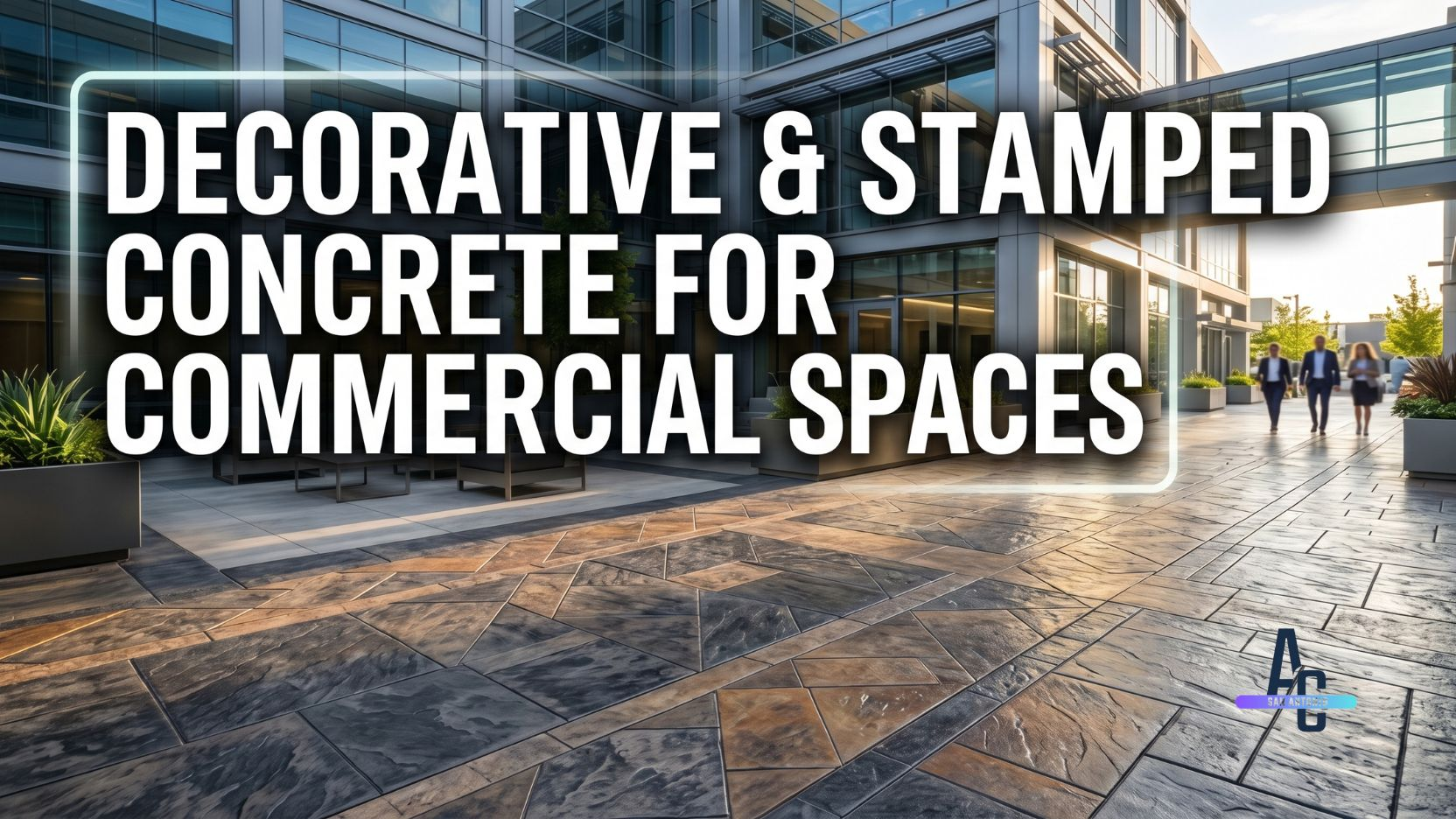
Stamped and decorative concrete is one of the highest-return upgrades a San Antonio commercial property can make. This guide covers every decision: finish selection, commercial-grade specs, ADA compliance, cost expectations, and what separates a contractor who can handle commercial work from one who cannot.
Most San Antonio business owners think of decorative concrete as a residential product. That is a mistake that costs them money every year. A stamped concrete entryway, a stained interior floor, or an exposed aggregate plaza surface does everything plain gray concrete does structurally and it communicates something to every customer, tenant, and visitor who walks across it. First impressions at a commercial property start at the ground level, literally.
This guide covers decorative and stamped concrete specifically for commercial applications in San Antonio: the finishes that hold up to heavy foot traffic, the specs that meet commercial building requirements, the ADA obligations that apply to any business open to the public, and the cost numbers you should expect from a contractor who actually does this work at a commercial scale.
Commercial concrete is regulated differently than residential. ADA slope requirements, load ratings for service vehicles, slip-resistance standards for public walkways, and local permitting in San Antonio all apply before you choose a finish. A contractor who leads with pattern books before asking about your traffic loads and code requirements is not a commercial contractor. They are a residential contractor taking on a job they are not fully prepared for. Get the structural and compliance specs right first. The decorative finish is the final layer of that decision.
Finish Selection
Commercial spaces demand more from a concrete finish than a backyard patio does. A retail entryway may see 500 pedestrian crossings a day. A restaurant patio endures spilled food and beverages, chair and table scraping, pressure washing, and direct Texas sun year-round. A hotel driveway carries delivery trucks and valet vehicles. Each of these scenarios eliminates certain finishes and favors others.
The 2026 trend for San Antonio commercial concrete: Branded color integration is the most requested commercial upgrade we are seeing this year. Property owners are specifying integral colors that match their brand palette: terracotta for Tex-Mex restaurants, charcoal and warm gray for modern office buildings, and cream and buff for hospitality properties. Combined with a logo or pattern stamp at the main entry, it turns a utilitarian surface into a brand touchpoint. Ask your contractor about integral pigment options before the mix is designed. Color cannot be added after the pour.
- Finish chosen for the correct commercial application. Slip resistance confirmed for any outdoor or wet-area surface
- Traffic load evaluated: foot traffic only, or mixed vehicle and pedestrian use (affects finish durability requirements)
- For stamped: pattern, color, and release agent confirmed in writing before pour day , no verbal agreements on commercial jobs
- For polished: non-slip additive specified if the floor will be exposed to water or cleaning solutions
- For overlays: existing slab assessed for structural soundness. Overlays fail on unsound substrates regardless of installation quality
- Sealing schedule confirmed: commercial-grade penetrating sealer, not residential surface coating
Structural Spec
The most common mistake in commercial decorative concrete projects is applying a residential structural spec to a commercial use case. A 4-inch slab with wire mesh that performs perfectly as a backyard patio will fail within a few years under the load cycles of a restaurant courtyard, a retail entry, or a property that receives any service vehicle traffic. Commercial applications need commercial specs.
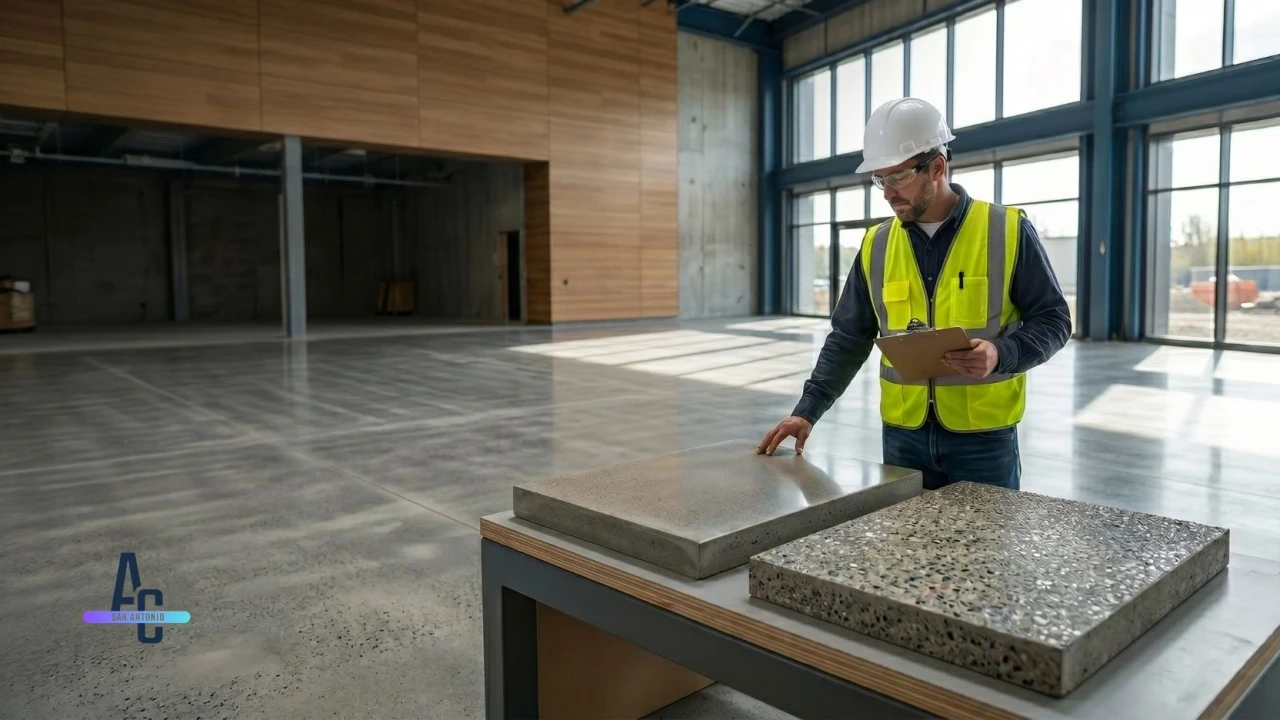
Slab thickness: 5 to 6 inches for standard commercial foot traffic areas. 6 to 8 inches for areas that receive delivery trucks, forklifts, or any vehicle over 10,000 lbs. Decorative finishes do not change the structural thickness requirement. The finish goes on top of a correctly engineered slab.
Reinforcement: Rebar at #4 or #5 bars on 12-inch centers is standard for commercial slabs in San Antonio. Wire mesh alone is not adequate for commercial loading. Post-tensioned slabs are used for very large commercial pours where joint spacing needs to be maximized.
- Slab thickness confirmed in writing: 5″ minimum for commercial foot traffic, 6″ or more for vehicle access
- Reinforcement type specified: rebar (#4 or #5 at 12″ centers). Wire mesh alone is not adequate for commercial loading
- Sub-base depth and compaction included in the scope: 4–6″ compacted crushed limestone, San Antonio standard
- Control joint spacing confirmed: maximum 15 feet on center for interior slabs, every 10–12 feet for exterior commercial
- Concrete mix design specified: minimum 4,000 PSI compressive strength for commercial applications (3,000 PSI is residential standard)
- Fiber reinforcement additive confirmed: polypropylene fibers in the mix reduce surface cracking on large commercial pours
ADA Compliance
Any business open to the public in San Antonio must meet ADA requirements on all exterior concrete surfaces that form part of an accessible route. This is not optional and it is not a matter of interpretation. The slope of a walkway, the texture of a surface, the width of a path, and the design of any ramp are all regulated. A decorative finish does not exempt a surface from these requirements , in fact, certain decorative finishes can create ADA compliance problems if they are not properly specified.
| ADA requirement | Standard | Common commercial concrete issue |
|---|---|---|
| Cross slope (walkways) | Maximum 2% (1:50) perpendicular to direction of travel | Decorative finishes applied without checking grade. The contractor focuses on pattern, not slope verification |
| Running slope (walkways) | Maximum 5% (1:20) along direction of travel; steeper than 5% requires ramp spec | Existing grade not evaluated before decorative overlay is poured. The surface fails ADA running slope after installation |
| Ramp slope | Maximum 8.33% (1:12); landings required at top and bottom, minimum 60″ x 60″ | Stamped decorative ramps poured at incorrect slope. Cosmetically appealing but not compliant |
| Surface texture | Stable, firm, and slip-resistant. No surface that becomes slippery when wet | Polished or smooth-trowel decorative finish specified for outdoor use without non-slip additive |
| Walkway width | Minimum 36″ clear width; 60″ preferred for two-way passage | Decorative border or planting strip reduces effective walkway width below minimum |
| Surface discontinuities | Maximum 1/2″ vertical change; 1/4″ to 1/2″ must be beveled at 1:2 slope | Stamped pattern edges or overlay transitions create lips that exceed the vertical change limit |
Ask your contractor directly: “Will you confirm ADA slope compliance with a digital level at every point on this walkway before we pour?” A contractor experienced in commercial work will say yes without hesitation. One who has primarily done residential patios may not even own the equipment to verify cross slopes at 2%. The question tells you more than any license check.
- Grade survey completed before design: existing slopes measured and confirmed against ADA maximums
- Cross slope verified at 2% or less on all pedestrian surfaces. Confirm with a digital level, not visual estimate
- Running slope verified: surfaces over 5% slope require full ramp specification with landings
- Ramp design confirmed: 1:12 maximum slope, 60″ x 60″ landings at top and bottom, 36″ minimum width
- Finish texture appropriate for ADA: no polished, smooth-trowel, or glazed surface on exterior without non-slip additive
- Surface transitions reviewed: no lips or vertical changes over 1/2″ at overlay edges, saw cuts, or pattern stamp borders
Property Type Guide
Not every commercial property has the same priorities. A fast-casual restaurant in Stone Oak needs a finish that survives spilled drinks, high chair scraping, and pressure washing three times a week. A medical office in the South Texas Medical Center needs surfaces that project cleanliness and meet strict accessibility standards. A boutique hotel on the River Walk needs a look that photographs well and impresses guests on arrival. The right finish for each of these is different.
| Property type | Best finish choice | Key specification priority | Cost range (San Antonio) |
|---|---|---|---|
| Restaurant / food service patio | Stamped with integral color and penetrating sealer; exposed aggregate for heavy-use zones | Chemical resistance to food acids and cleaning agents; non-slip in wet conditions | $15–22/sqft |
| Retail storefront / entry | Stamped or stained interior; exposed aggregate or broom exterior approach | ADA compliance on approach; visual brand alignment at entry threshold | $12–20/sqft |
| Hotel / hospitality property | Stamped with multiple pattern zones; polished lobby interior; decorative pool surround | Appearance premium; maintenance schedule that does not disrupt guest operations | $16–22/sqft |
| Office building / campus | Exposed aggregate plaza; stained or polished interior lobby; banded broom parking lot | Low ongoing maintenance; professional appearance consistent with brand identity | $10–18/sqft |
| Medical / dental office | Polished interior with densifier; broom or exposed aggregate exterior; no exposed aggregate in clinical areas | ADA compliance critical; cleanability; no texture that traps contaminants in clinical areas | $12–18/sqft |
| Mixed-use retail / residential | Exposed aggregate common areas; stamped retail entries; broom residential walkways | Consistent design language across zones; separation of commercial and residential ADA routes | $10–20/sqft |
| Industrial / warehouse with showroom | Polished showroom floor; plain commercial slab for warehouse area | Heavy load rating in warehouse zone; premium appearance limited to customer-facing areas for cost control | $8–16/sqft |
For restaurant and hospitality properties on the San Antonio River Walk or in the Pearl District: the City of San Antonio has design guidelines for properties within the River Walk improvement district that may restrict certain decorative concrete patterns, colors, or materials visible from the public right-of-way. Confirm with the City’s Development Services Department before specifying any finish for an exterior surface in these districts. Your contractor should know this. If they do not, that is a problem.
Maintenance
Decorative concrete at a commercial property is a larger investment than plain gray concrete. It also requires a maintenance commitment that plain concrete does not. The property owners who get 25-plus years from a stamped commercial surface are the ones who seal on schedule, clean correctly, and address cracks and joint failures early. The ones who let a commercial decorative surface go unmaintained for five years typically end up spending more on restoration than the original install cost.
San Antonio’s climate creates specific maintenance considerations that are different from other Texas markets. The UV intensity in Central and South Texas bleaches surface sealers faster than in North Texas or coastal markets. A sealer that lasts four years in Dallas may need to be reapplied in two and a half years in San Antonio. Your contractor should specify a UV-stable, commercial-grade sealer. Do not use a residential product applied at commercial scale. The resealing interval should reflect the local climate, not a generic national recommendation.
A worn stamped or stained commercial surface is not automatically a demolition and repour situation. If the structural slab is sound (no base failure, no displacement cracks, no heaving), a commercial microtopping or overlay system can restore the appearance at roughly 30 to 50 percent of the cost of a full repour. The key question is whether the deterioration is cosmetic or structural. Faded sealer and surface wear are cosmetic. Cracked slabs with vertical displacement, slab heaving from root intrusion, or base failure are structural. Get a professional assessment before committing to either path.
- First sealer applied at 28 to 30 days after pour. Confirm the sealer is UV-stable, commercial-grade penetrating type
- Resealing scheduled every 2–3 years for stamped and stained surfaces in San Antonio climate
- Quarterly pressure washing for restaurant, retail, and high-traffic exterior surfaces
- Food spills, oil, and grease degreased immediately. Do not allow acids to sit on sealed surfaces
- Expansion joint sealant inspected annually and refilled before cracks reach the slab edge
- Hairline cracks filled at first inspection , do not wait for seasonal reopening to address early surface cracking
Use this table as your starting spec reference for any commercial decorative concrete project. Every number in this table reflects San Antonio conditions: Bexar County soils, Texas UV exposure, and local code requirements.
| Application | Recommended finish | Min. slab thickness | PSI requirement | Cost range |
|---|---|---|---|---|
| Restaurant patio (outdoor) | Stamped with integral color; penetrating commercial sealer | 5″ | 4,000 PSI | $15–22/sqft |
| Retail storefront entry | Stamped or exposed aggregate; ADA-compliant slope | 5″ | 4,000 PSI | $12–20/sqft |
| Hotel / hospitality entry drive | Stamped decorative; 6″ where valet vehicles access | 5–6″ | 4,500 PSI | $16–22/sqft |
| Office lobby (interior) | Polished with densifier; non-slip coefficient confirmed | 5″ | 4,000 PSI | $10–16/sqft |
| Commercial plaza / walkway | Exposed aggregate or broom with decorative banding | 5″ | 4,000 PSI | $10–16/sqft |
| Service drive / loading approach | Plain broom with control joints; heavy-duty spec | 7–8″ | 4,500 PSI | $8–12/sqft |
| Retail interior floor | Acid stain or microtopping over existing slab | Existing slab; overlay 1/4–3/8″ | Substrate 3,500 PSI min | $6–12/sqft (overlay) |
- Slab thickness confirmed in writing: 5″ minimum for foot traffic, 6–8″ for any vehicle access area
- Concrete mix strength specified: minimum 4,000 PSI for commercial (not residential 3,000 PSI)
- Reinforcement confirmed: rebar #4 or #5 at 12″ centers. Wire mesh alone is not adequate
- Sub-base included in scope: compacted crushed limestone, minimum 4–6″ depth, 95% compaction
- Control joint spacing confirmed: 10–15 feet on center, specified in writing
- Fiber reinforcement additive included for large-format commercial pours
- Grade survey completed. Existing slopes measured and confirmed against ADA maximums before design
- Cross slope verified at 2% maximum on all pedestrian surfaces
- Ramp design confirmed: 1:12 slope maximum, proper landings at top and bottom
- Finish texture confirmed as ADA-compliant: slip-resistant in wet conditions, no polished finish outdoors without additive
- City of San Antonio permitting confirmed. Commercial concrete on public-adjacent surfaces typically requires permits
- Finish type selected and confirmed appropriate for the commercial traffic and use case
- Pattern, color, and sealer type confirmed in writing , verbal agreements are not enforceable on commercial projects
- Sample or mockup approved by property owner before full installation begins
- Brand color integration reviewed: integral pigment versus surface staining decided and documented
- Sealing schedule confirmed: UV-stable commercial-grade penetrating sealer, not residential product
- Certificate of insurance received: $2M general liability minimum for commercial work
- Commercial concrete experience verified: residential-only contractors are not appropriate for commercial specs
- References from completed commercial projects in San Antonio available on request
- Payment terms confirmed: 30–50% deposit, balance on completion and inspection. No full payment before work begins
- Quote itemizes sub-base, reinforcement, pour, decorative finish, and sealing as separate line items
How much does stamped concrete cost for a commercial property in San Antonio?
Can decorative concrete be installed on an existing commercial slab?
Does stamped concrete hold up to San Antonio heat and UV exposure at a commercial property?
Do I need a permit for commercial decorative concrete in San Antonio?
What is the difference between a residential and commercial concrete contractor in San Antonio?
Get a free commercial concrete quote in San Antonio
Tell us about your commercial project: restaurant patio, retail entry, office plaza, or interior floor. We will visit your property, assess the site, and give you a detailed written quote at no cost.