
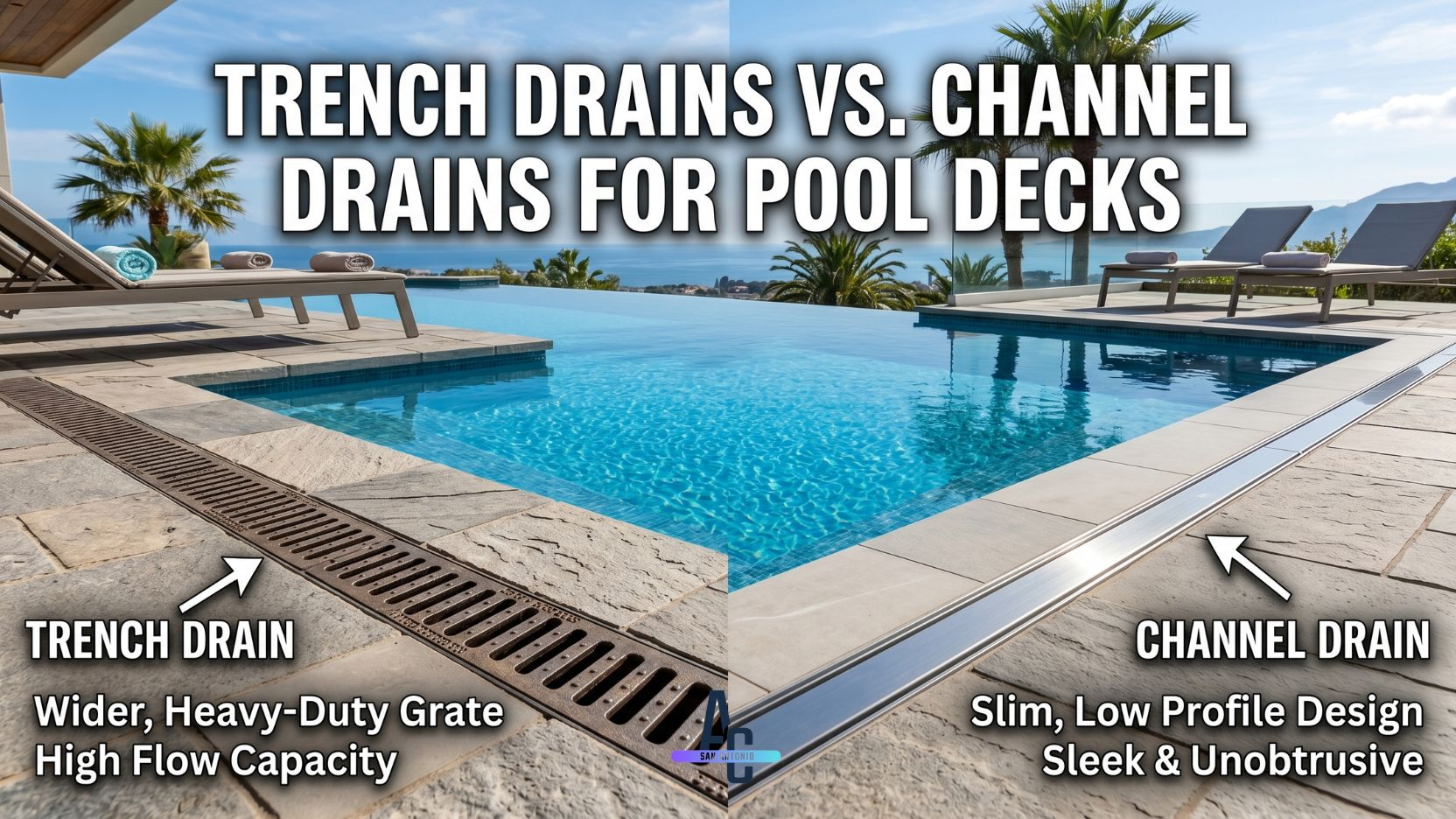
Pool deck drainage is one of the most misunderstood details in outdoor concrete work. Get it wrong and you end up with standing water, slip hazards, and staining within the first season. This guide breaks down every difference between trench drains and channel drains, how each one performs in San Antonio’s climate, and which system belongs on your pool deck.
If you search “trench drain vs. channel drain,” most of what you find treats them as two completely different products. In practice, the two terms are often used interchangeably, and the real decisions have nothing to do with the name on the box. What actually matters is the grate width, the body depth, the load rating, and where in the pool deck the drain is positioned relative to the concrete slope.
This guide cuts through the naming confusion and focuses on what pool deck owners in San Antonio need to know: how each drain type performs in high heat, what the installation requires, what they cost, and which one belongs on your specific project.
No drain system compensates for a poorly sloped slab. Before you spend a dollar on trench drains or channel drains, the concrete itself must slope correctly: a minimum of 1/8 inch per foot away from the pool coping and toward the drain locations. In San Antonio’s summer heat, where a pool deck can be in direct sun for 10 or more hours a day, standing water does not just evaporate harmlessly. It breeds algae on the surface, accelerates staining, creates slip hazards, and degrades any sealer you’ve applied. The drain is the exit point. The slope is the road that gets the water there.
Terminology
Here is the honest answer most guides will not give you: trench drain and channel drain refer to the same basic product category. Both describe a linear drain system with a body set into a trench cut or formed in the concrete, topped with a grate that sits flush with the finished surface. The terms are used interchangeably by contractors, suppliers, and manufacturers across the industry.
The practical differences that actually affect your pool deck project are not about what the system is called. They are about the specific specs of the product you choose:
Where the terminology does make a useful distinction is in scale. When a contractor says “trench drain,” they usually mean a wider, deeper system built for higher-volume water flow the kind you would find at a commercial pool facility, a hotel deck, or any area that handles significant runoff from a large surface area. When they say “channel drain,” they usually mean a narrower, shallower system sized for residential use. But this is convention, not a product specification. Always ask for the grate width, body depth, and load rating by number not by the name used to describe the category.
The question that actually matters when comparing drainage quotes: Ask every contractor to specify the grate width and body depth in writing. A quote that just says “install trench drain” is meaningless without dimensions. A 3-inch-wide, 4-inch-deep drain and a 6-inch-wide, 8-inch-deep drain are sold under the same name and will perform completely differently on a large pool deck in a San Antonio rainstorm. Get the dimensions in writing before approving any scope.
- Grate width specified in inches in writing not just “trench drain” or “channel drain” as a description
- Body depth specified in inches this determines flow capacity more than any other single factor
- Grate material confirmed: stainless steel or cast iron recommended for pool deck exposure
- Load rating confirmed: pedestrian-rated minimum for residential; vehicle-rated if near parking or service areas
- Outlet type and pipe connection diameter specified: 4-inch minimum for most residential pool decks
Performance
San Antonio gets an average of about 32 inches of rainfall per year, much of it delivered in short, intense storms rather than slow, steady rain. A pool deck that sits fine for six months can see two inches of rain in ninety minutes during a July storm event. The drainage system needs to handle that peak load, not just average conditions.
- Best fit for smaller residential pools with a deck area under 500 square feet
- Cleaner, less visible appearance when set flush with stained or stamped concrete
- Lower flow capacity can overflow in heavy storm events on larger decks
- Grate slots are smaller, which means finer debris (leaves, sand) can clog them faster
- Easier for homeowners to clean and maintain without tools
- Lower cost: typical installed price runs $25–40 per linear foot in San Antonio
- Better fit for larger decks (500+ sqft), commercial pools, and hotel or apartment facilities
- Higher flow capacity handles heavy San Antonio summer storms without backing up
- More visible from the deck surface some homeowners consider this a drawback aesthetically
- Wider grate openings pass more debris but also allow larger objects to be cleaned out more easily
- Heavy cast iron or stainless grates can double as a design feature when specified correctly
- Higher cost: typical installed price runs $40–60 per linear foot in San Antonio
Slip resistance is a separate consideration that affects grate selection regardless of width. Pool deck grates should always have a slip-resistant pattern on the upper surface. Smooth or polished grates common on lower-cost decorative options become dangerously slippery when wet, which on a pool deck means essentially always. Look for grates rated for wet pedestrian environments specifically, not general-purpose drainage grates repurposed for outdoor use.
- Drain sizing calculated based on total deck surface area draining into each catch point not just linear feet of drain installed
- Outlet pipe diameter sized for peak storm load: 4 inches minimum for most residential pools, 6 inches for large or commercial decks
- Grate surface confirmed as slip-resistant rated for wet pedestrian environments smooth decorative grates not acceptable for pool deck use
- Flow capacity verified for San Antonio storm events system should handle at least 1 inch per hour of rainfall across the draining surface
Installation
The most common and most expensive pool deck drainage mistake in San Antonio is treating the drain as something you can add after the concrete is already down. You cannot cut a trench drain into a finished slab and produce a result that drains correctly, looks professional, and holds up over time. The drain body must be set before the pour, positioned at the correct elevation so the grate lands flush with the finished surface, and connected to the outlet piping before the concrete is placed around it.
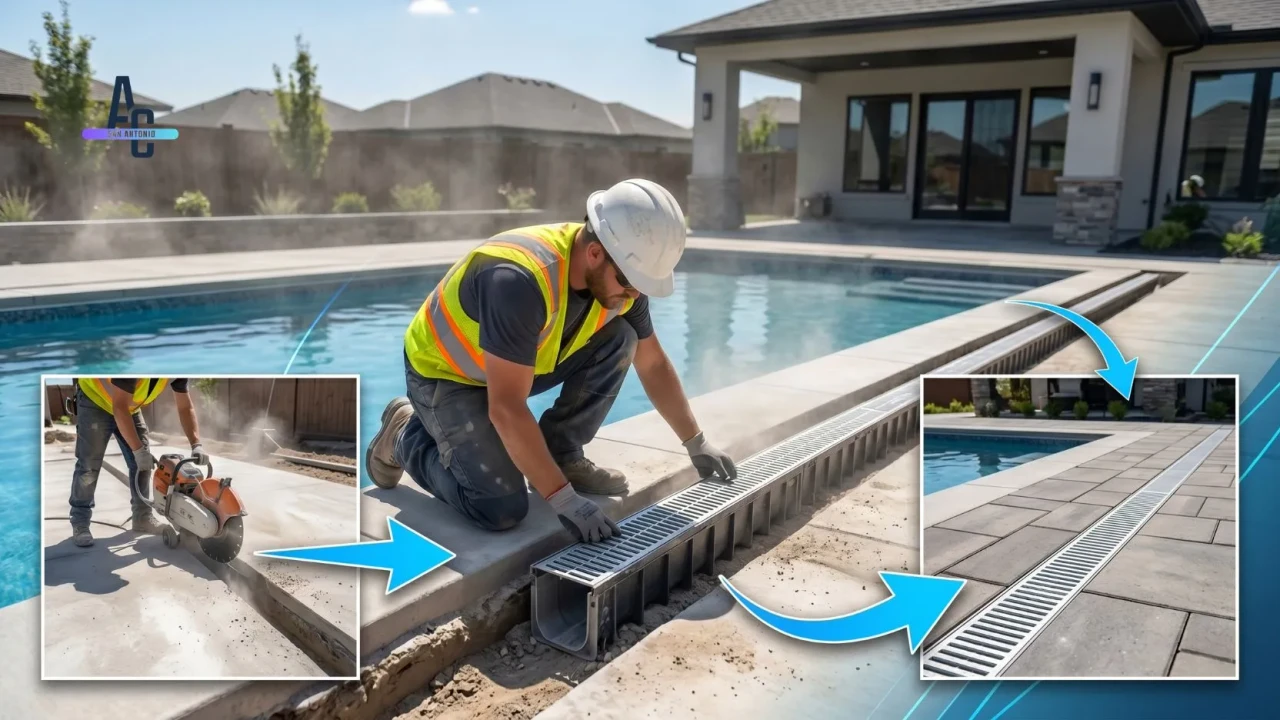
The correct installation sequence for a pool deck with linear drainage in San Antonio starts well before the concrete truck arrives.
San Antonio’s expansive clay soils add a complication that contractors from other markets sometimes underestimate. The ground under a pool deck in Bexar County can shift significantly between wet and dry seasons enough to affect a drain body that was set at perfect elevation during the pour. Proper base compaction using crushed limestone (not native clay fill) is the only reliable way to prevent the drain from shifting relative to the slab after installation. A drain that sits a quarter inch above a settled slab is a trip hazard; one that sits a quarter inch below is a standing-water trap.
Adding drainage to an existing pool deck in San Antonio: If you are working with an existing slab that has no linear drain, the realistic options are cutting a trench, removing the concrete in that zone, setting the drain, and patching or installing a surface drain (a point drain with a flat grate) rather than a linear system. Surface drains are less effective for large deck areas but are a legitimate option when full demolition is not in the budget. Never let a contractor convince you that a simple saw-cut and epoxy-set drain body is a durable solution in San Antonio. The clay soil movement will work it loose within a year or two.
- Drain body set before concrete pour not cut in after the fact
- Outlet piping connected and pitched correctly (1/8 inch per foot minimum toward daylight or storm connection) before pour
- Finished grate elevation confirmed flush with planned slab surface before concrete is placed
- Base prepared with compacted crushed limestone not native clay fill, which will shift and affect drain elevation over time
- Concrete slope built into forms: 1/8 inch per foot minimum toward drain locations from all points on the deck
- Concrete placed tight against drain body with no gap or cold joint that could allow water to undermine the slab edge
Decision Guide
The right drainage system is determined by four factors: the size of the pool deck, the expected foot traffic and load, whether you are building new or retrofitting, and whether the property is subject to commercial or HOA regulations. Here is how those factors map to the right product choice.
| Pool deck type | Recommended drain system | Key specification | Notes for San Antonio |
|---|---|---|---|
| Residential, small (under 400 sqft) | Narrow channel drain, 3–4″ width | 4″ outlet pipe, pedestrian load rating | Stainless grate preferred over plastic UV and pool chemicals degrade plastic faster here |
| Residential, large (400–800 sqft) | Narrow or wide channel, 4–6″ width | 4–6″ outlet pipe, sizing calculated for peak storm load | Run hydraulic calculation before specifying many large residential decks are undersized at 3″ drain width |
| HOA community pool | Wide channel, 6″ minimum width | 6″ outlet pipe minimum, ADA-compliant grate | Texas Health and Safety Code Chapter 341 applies; check with local health authority for current requirements |
| Hotel or apartment pool | Wide trench/channel, 6–12″ width | Heavy-duty load rating, 6″ pipe minimum | Commercial property requires permits and inspections through City of San Antonio factor into project timeline |
| Retrofit to existing deck | Surface (point) drain or saw-cut linear | Depends on existing slab condition and slope | Always assess existing slab slope before choosing a retrofit drain if slope is wrong, drain placement alone will not solve standing water |
| Deck adjacent to parking or service area | Heavy-duty channel, vehicle load rating | Cast iron or heavy stainless grate; 6″ pipe | Standard pedestrian grates fail under vehicle loads specify load rating in writing if any service vehicles access the area |
Maintenance
A properly installed pool deck drain requires minimal maintenance, but it is not zero maintenance. In San Antonio’s climate, three things work against drainage systems over time: pool chemicals that accelerate corrosion on lower-grade metals, organic debris (oak leaves are a particular issue in older neighborhoods) that clogs grate slots, and the UV exposure that degrades plastic grate bodies and outlet connections faster than in cooler climates.
The joint between the concrete slab and the drain body is the most common failure point on pool deck drainage systems in San Antonio. Expansive clay soils shift the slab slightly over seasons; the drain body, set in the ground, shifts at a different rate. Over time, a gap opens at the edge. Water gets in, undermines the base, and accelerates the problem. Resealing that joint every two to three years with a polyurethane or epoxy joint sealant is the single most important maintenance task for keeping a pool deck drain working correctly long-term.
Best grate material for San Antonio pool decks: Stainless steel (316 grade) is the most durable option for pool deck grates where chlorine or salt water is present. Galvanized steel holds up well in non-chemical environments but corrodes faster around pools. Cast iron is extremely durable and load-resistant but heavy and more expensive. Plastic grates are the lowest cost option but degrade noticeably in San Antonio’s UV exposure within three to five years and should be avoided on any deck that is expected to maintain its appearance long-term. Specify 316 stainless as the default unless budget is the overriding concern.
- Grate removed and drain body flushed monthly during pool season do not wait for standing water to signal a blockage
- Grate inspected twice per year for corrosion, cracking, or slot deformation that reduces slip resistance
- Outlet pipe rodded or flushed annually to clear organic buildup and verify no root intrusion
- Concrete-to-drain-body joint inspected and resealed every 2–3 years with polyurethane or epoxy joint sealant
- Grate elevation checked relative to surrounding slab at each inspection any rise or depression indicates soil movement requiring professional assessment
- Plastic grates replaced proactively at 3–5 years before UV degradation creates surface cracking that reduces slip resistance
Use this table as your fast reference when comparing quotes or evaluating options for a pool deck drainage project in San Antonio. The column headers reflect the spec details that matter not the product name used by the contractor or supplier.
| Specification | Narrow channel (3–4″) | Wide channel / trench (6–12″) | Surface point drain |
|---|---|---|---|
| Best application | Residential pools under 500 sqft deck | Large residential, commercial, HOA | Retrofit or small accent area |
| Flow capacity | Moderate adequate for smaller decks in typical storms | High handles peak San Antonio storm events on large surfaces | Low point collection only, not suitable for large areas |
| Appearance | Minimal visual presence, easy to integrate with stained or stamped finish | More visible can be a design feature with the right grate choice | Compact and low-profile |
| Installed cost (San Antonio) | $25–40 per linear foot | $40–60 per linear foot | $300–600 per drain unit |
| Recommended grate material | 316 stainless steel or galvanized | 316 stainless or cast iron | 316 stainless steel |
| Load rating required | Pedestrian for pool areas; vehicle-rated if adjacent to parking | Pedestrian or heavy-duty depending on application | Pedestrian standard |
| Must be set before concrete pour? | Yes cannot be correctly retrofitted into a finished slab | Yes cannot be correctly retrofitted into a finished slab | No can be set in a cored hole in existing concrete |
- Total pool deck surface area calculated and used to size the drain system not just estimated by a contractor eyeballing the site
- Concrete slope confirmed at minimum 1/8 inch per foot from pool coping and all high points toward drain locations
- Drain width and body depth sized for peak San Antonio storm load: at least 1 inch per hour across the draining surface
- Outlet pipe sized appropriately: 4-inch minimum for residential, 6-inch for large or commercial decks
- Grate material confirmed: 316 stainless steel or cast iron recommended for pool chemical and UV exposure in San Antonio
- Grate surface confirmed as slip-resistant rated for wet pedestrian environments smooth decorative surfaces not acceptable
- Load rating confirmed in writing: pedestrian-rated standard for pool areas; vehicle-rated if any drive access is possible
- Plastic components limited or avoided: UV degradation in San Antonio typically requires replacement within 3–5 years
- Drain body confirmed to be set before concrete pour not retrofitted after the slab is placed
- Base prepared with compacted crushed limestone not native clay fill
- Drain elevation set to land grate flush with finished slab surface at correct slope
- Outlet piping connected and pitched before concrete is poured around drain body
- Grate cleaning scheduled monthly during pool season not left until backup is visible
- Outlet pipe flush or rod scheduled annually
- Concrete-to-drain-body joint resealing scheduled every 2–3 years
- Grate elevation monitoring included in annual pool deck inspection routine
Is there actually a difference between a trench drain and a channel drain?
Can I add a trench drain to my existing pool deck without replacing the whole slab?
What grate material should I specify for a pool deck in San Antonio?
How much does it cost to install a trench or channel drain on a pool deck in San Antonio?
Does my pool deck drainage need to meet any code or permit requirements in San Antonio?
Get a free pool deck drainage quote in San Antonio
Tell us about your pool deck project new construction, retrofit drain, or commercial facility. We will visit your property, assess the existing slope and conditions, and give you a detailed written quote at no cost.