
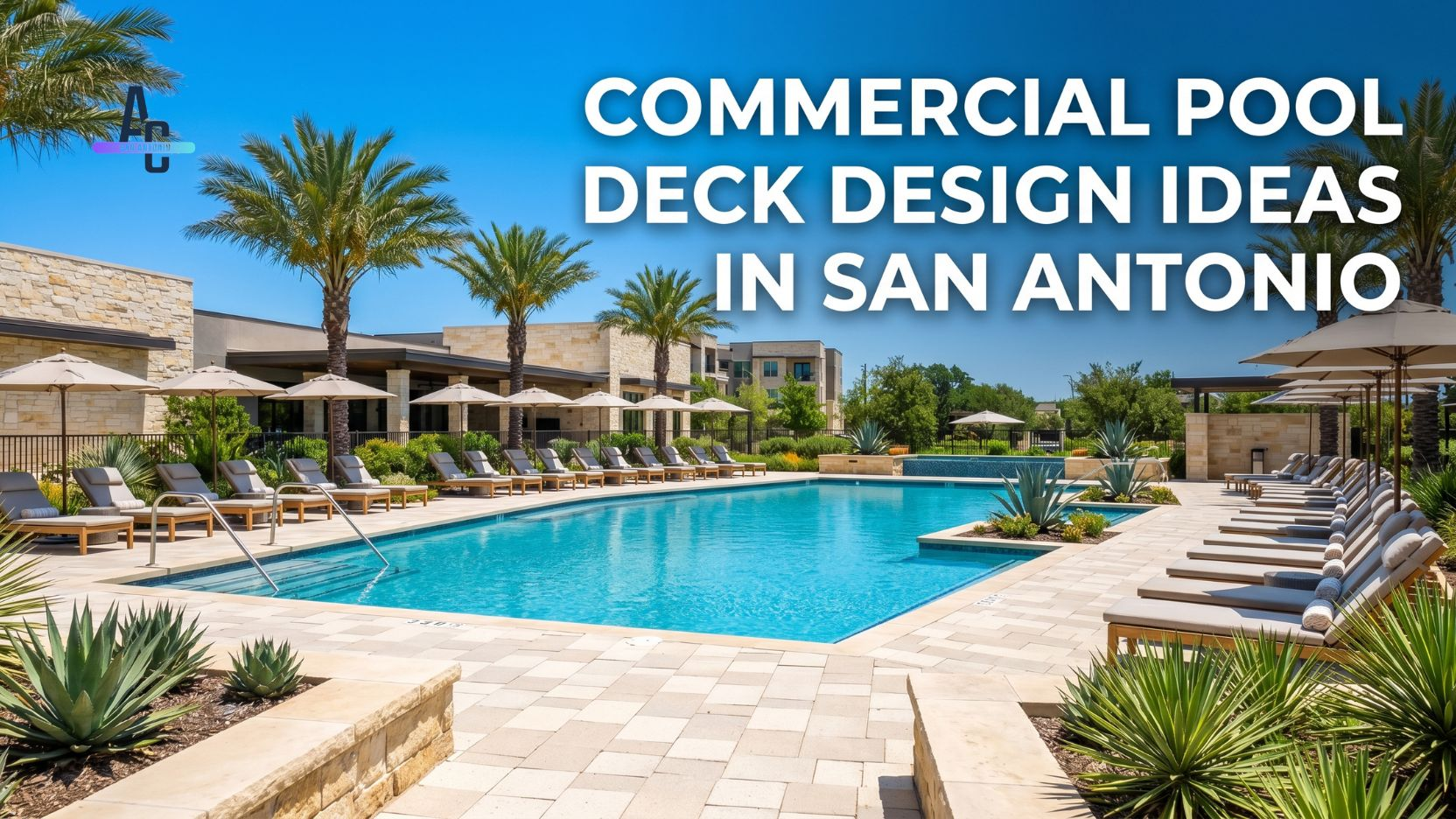
A commercial pool deck does more than surround water. It handles foot traffic from dozens or hundreds of guests every day, must meet ADA and health code requirements, and needs to hold up against San Antonio’s heat, UV exposure, and clay soil movement for decades. This guide covers every design choice that separates a pool deck that lasts from one that requires constant repairs.
Commercial pool decks in San Antonio carry a different set of demands than residential ones. A backyard pool deck serves one family. A hotel pool deck, apartment complex pool area, or HOA amenity center serves hundreds of people throughout the day, often in direct Texas sun, in wet conditions, and with heavily loaded maintenance equipment crossing the surface regularly. The design decisions that work perfectly for a 400-square-foot residential patio will not hold up on a 3,000-square-foot commercial deck without the right spec upgrades.
This guide covers the six decisions that define a successful commercial pool deck design in San Antonio: finish selection, drainage planning, ADA compliance and slip resistance, expansion joint strategy, the right materials for high-traffic zones, and how to evaluate a commercial concrete contractor who has done this work before.
Property managers and facility owners often approach commercial pool deck projects with a finish in mind first. The better starting point is drainage slope, slip resistance classification, expansion joint layout, and load-bearing capacity. San Antonio’s expansive clay soils, intense UV exposure, and occasional freeze events mean that structural decisions made before the pour will determine whether you are resealing a beautiful deck at year 10 or paying for emergency repairs at year 4. Get the spec right first. Then choose the finish that fits your facility’s image and budget.
Finish Options
The finish you choose for a commercial pool deck affects slip resistance, maintenance requirements, guest experience, and how the surface holds up after years of wet foot traffic and UV exposure. Not every finish that works on a residential patio is appropriate for a commercial setting. Here are the options that perform well in San Antonio’s climate and high-traffic conditions.
The most popular commercial pool deck finish combination in San Antonio for 2026: Exposed aggregate for the main deck field combined with stamped concrete borders around the pool edge and at transitions to covered seating areas. This approach gives you the low-maintenance, inherent slip resistance of aggregate over the largest traffic areas while delivering a visually polished look at the focal points guests notice most. The cost premium over an all-broom-finish deck is typically 20 to 30 percent, but the finished appearance is significantly more attractive for marketing and property photography.
- Finish choice confirmed appropriate for commercial foot traffic volume and facility type
- Slip resistance rating verified: wet DCOF (Dynamic Coefficient of Friction) of 0.42 or higher for commercial pool areas
- Surface temperature impact considered for barefoot guest comfort in San Antonio summers
- Maintenance schedule matched to facility operations: can the deck be closed for resealing every 2 years?
- Non-slip additive specified in sealer mix if a stamped or smooth finish is selected
Drainage
Standing water on a commercial pool deck is not an aesthetic problem. It is a safety and liability problem. Any pool deck that allows water to pool creates slip hazards, accelerates concrete deterioration in San Antonio’s clay-soil environment, and provides conditions for algae and mold growth that create both health concerns and guest complaints. Drainage is the most important structural design decision in a commercial pool deck project.
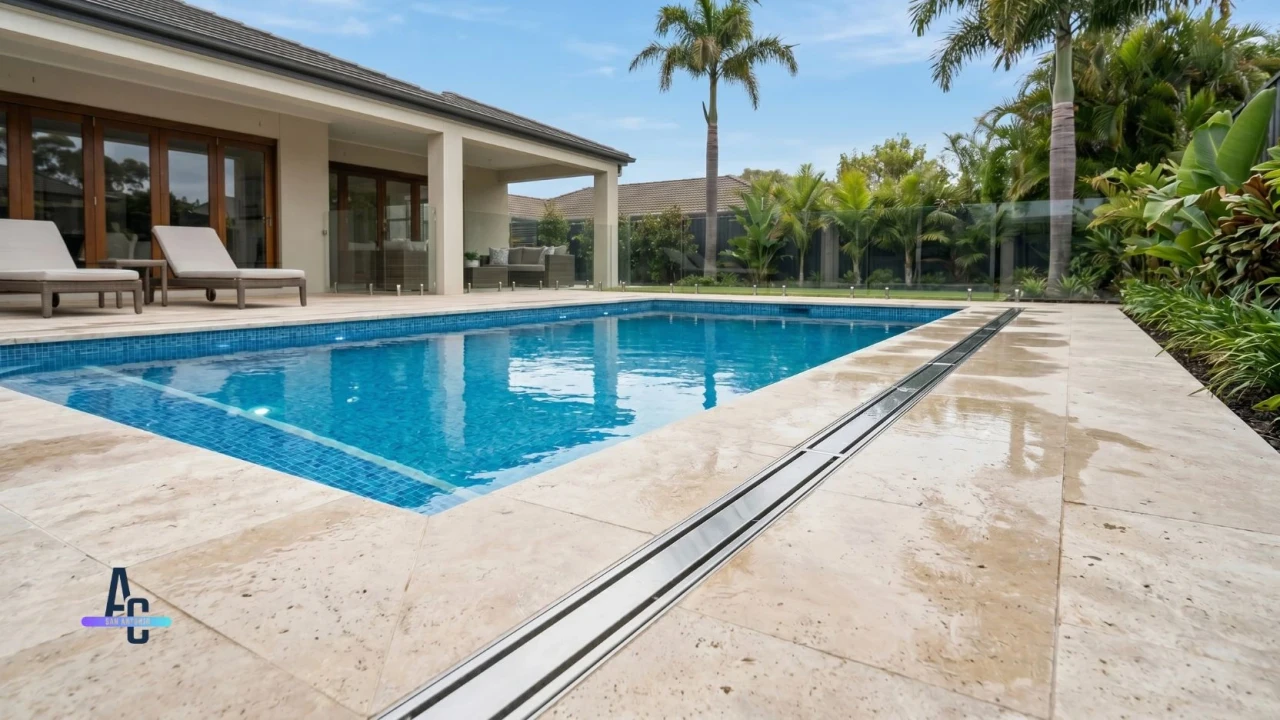
Commercial pool decks must slope a minimum of 1/8 inch per foot away from the pool edge and toward drains. Many engineers specify 1/4 inch per foot on large commercial decks to improve drainage speed. The slope direction should direct water away from the pool (to prevent runoff from deck chemicals contaminating the pool water) and toward drains positioned to collect flow efficiently.
On large commercial pool decks, linear trench drains along the pool perimeter or at the base of splash features are more effective than point drains alone. They intercept the concentrated flow of water that comes off pool edges and splash pad features before it has the chance to spread across the deck. Trench drain grates must be ADA compliant with openings no wider than 1/2 inch in the direction of travel.
- Minimum 1/8″ per foot slope confirmed in construction drawings 1/4″ per foot preferred for large decks
- Drain placement verified: no low spots on the deck where water can collect
- Trench drains specified at pool edges, splash zones, and slide landings
- All drain grates specified as ADA compliant with openings no wider than 1/2″ in the direction of travel
- Drainage plan reviewed and approved before forming begins slope cannot be corrected after the pour
Code & Safety
Every commercial pool deck in Texas is subject to ADA accessibility requirements, Texas Department of State Health Services pool facility standards, and local San Antonio building codes. Getting these wrong is not just a design problem. It is a code violation that can shut down a facility, expose ownership to liability, and require expensive after-the-fact retrofitting. Address these requirements in the design phase, not after the concrete is poured.
| Requirement | Standard or minimum | Concrete design implication |
|---|---|---|
| Accessible route to pool | ADA 2010 Standards: 36″ minimum clear width, maximum 1:20 slope for accessible routes, 1:12 for ramps | Deck layout must include a continuous accessible path from entry to pool lift or ramp with no abrupt level changes above 1/2″ |
| Slip resistance (wet DCOF) | ANSI A137.1: minimum 0.42 wet DCOF for floors subject to foot traffic in wet areas | Exposed aggregate, coarse broom, and approved textured overlays meet this threshold; polished or smooth trowel finishes do not |
| Pool entry accessibility | ADA requires at least one accessible pool entry: either a pool lift or sloped entry ramp at large pools | Deck must be designed and poured to accommodate pool lift base anchor points or sloped entry ramp approach |
| Drain grate openings | ADA: maximum 1/2″ opening in the direction of pedestrian travel for surface drain grates | Specify compliant grates during design; standard round drain grates often fail this requirement |
| Level changes at transitions | ADA: changes in level from 1/4″ to 1/2″ must be beveled; anything above 1/2″ requires a ramp | Control joint placement and coping edge detailing must be designed to avoid non-compliant level changes at deck transitions |
| Texas pool facility standards | Texas DSHS pool rules require slip-resistant deck surfaces and specific deck width minimums (typically 4 feet minimum around commercial pools) | Deck width and finish must satisfy DSHS requirements in addition to ADA and local building code |
Include your civil engineer and accessibility consultant before the pour, not after: The most common and costly commercial pool deck compliance mistakes happen when accessibility requirements are treated as a finishing detail rather than a design constraint. Pool lift anchor points, ramp approach grades, and drain grate specifications all affect where forming begins. Having a qualified reviewer sign off on the design before any concrete is placed is a fraction of the cost of remediation after the slab is in place.
- Accessible route confirmed: 36″ minimum clear width from facility entry to pool, no abrupt level changes above 1/2″
- Slip-resistant finish specified with wet DCOF of 0.42 or higher
- Pool lift or sloped entry ramp included, with anchor or approach area formed and poured accordingly
- Drain grates specified as ADA-compliant: maximum 1/2″ opening in direction of travel
- Texas DSHS commercial pool facility deck width requirements verified and incorporated into the layout
- Design reviewed by a qualified accessibility professional before construction begins
Joints & Structure
Expansion joints on a commercial pool deck are not the same as on a residential patio. The slab areas are larger, the load is heavier, and the consequences of cracking are more serious because a cracked commercial deck creates trip hazards, ADA compliance failures, and visible deterioration that affects facility reputation. The joint strategy must be planned before forming begins and must address isolation joints at the pool shell, control joints across the deck field, and expansion joints at all structural transitions.
The isolation joint between the pool shell and the surrounding deck is particularly critical on commercial projects. The pool shell and the deck slab are subject to different thermal expansion rates and different soil movement forces. If the deck slab is poured tight against the pool shell without a proper isolation joint, differential movement will crack both structures. This joint must be filled with a compressible foam backer rod and sealed with a pool-compatible sealant that can accommodate movement without failing.
For a complete breakdown of expansion joint types, placement, and maintenance requirements specific to San Antonio pool decks, see our pillar guide linked at the top of this article.
- Isolation joint confirmed at pool shell perimeter: full-depth separation with backer rod and pool-grade sealant
- Control joint spacing specified at 8 to 10 feet maximum across the deck field
- Expansion joints specified at all building walls, columns, and structural transitions
- Polyurethane or polysulfide sealant specified not standard silicone
- Joint inspection schedule included in the facility maintenance plan: annual inspection recommended
Structure
A commercial pool deck is not a residential patio with a larger footprint. The structural spec must account for maintenance vehicle loads, concentrated foot traffic, pool equipment access, and San Antonio’s expansive clay soil conditions. Using residential-grade specifications on a commercial project will produce a deck that looks fine at year two and requires significant repairs by year five.
Ask your contractor for a mix design submittal before the pour: On commercial projects, request the concrete mix design in writing before work begins. The submittal should specify the design strength (PSI), water-cement ratio, aggregate size, and any admixtures being used. This is standard practice on commercial construction projects and any experienced commercial concrete contractor will be able to provide it. If they cannot, that is a meaningful red flag about their experience level with commercial work.
- Slab thickness specified at 5″ minimum for the main deck field; 6″ in vehicle or equipment access zones
- Rebar reinforcement confirmed: #4 bar at 12″ to 18″ centers minimum not wire mesh
- Compacted crushed limestone base at 6″ to 8″ depth, compacted in lifts
- Concrete mix design submittal received: 4,000 PSI minimum, low water-cement ratio
- Rebar placement verified at mid-slab height before pour begins not resting on the base
Contractor
Commercial pool deck work is a specialization. The same contractor who builds beautiful residential driveways and patios may not have experience with the drainage engineering, ADA compliance documentation, mix design submittals, and coordination with pool contractors and engineers that a commercial project requires. The consequences of choosing the wrong contractor on a commercial project are far more expensive than on a residential one.
| What to verify | What a qualified commercial contractor provides | Red flag response |
|---|---|---|
| Commercial experience | Portfolio of completed commercial pool decks hotels, apartments, HOAs with references from property management contacts | Residential portfolio only; cannot provide commercial references or project photos |
| Insurance coverage | $2M+ general liability and workers’ compensation; certificate of insurance issued to the property owner as additional insured | Coverage below $2M; unable to name property owner as additional insured; no workers’ comp |
| Mix design documentation | Written concrete mix design submittal specifying PSI, water-cement ratio, and admixtures before the pour | “We’ll use good concrete” with no documentation or specification of the mix design |
| ADA knowledge | Demonstrates familiarity with ADA accessible route requirements, drain grate specifications, and slope tolerances for commercial pool decks | Unfamiliar with ADA requirements; suggests those are “the architect’s problem” without contractor involvement |
| Expansion joint plan | Written joint layout included in the proposal, specifying control joint spacing, isolation joint at pool shell, and sealant specification | No joint plan in the proposal; “we’ll cut joints after” without specification of spacing or sealant type |
| Project management | Named superintendent or project manager for the job; clear communication process for RFIs and field decisions | Owner handles everything personally with no designated site superintendent for a large commercial project |
- Verified commercial pool deck portfolio with a minimum of three completed comparable projects
- Certificate of insurance received: $2M+ general liability, workers’ compensation, property owner named as additional insured
- Proposal includes written structural spec: slab thickness, reinforcement type and spacing, base depth, concrete PSI
- Joint layout plan included in the proposal: control joint spacing, isolation joint at pool shell, sealant specification
- Contractor demonstrates working knowledge of ADA accessible route requirements and Texas DSHS pool facility standards
- Payment terms confirm deposit upfront and balance due on completion after inspection not full payment before work
The following cost ranges reflect installed commercial pool deck pricing in San Antonio for projects of 1,500 square feet and above. Smaller project areas will typically run 10 to 20 percent higher per square foot due to mobilization and setup costs. All ranges assume proper commercial specification: 5″ slab, rebar reinforcement, compacted base, and expansion joint system.
| Finish type | Cost range (installed) | Best for | Maintenance frequency |
|---|---|---|---|
| Broom finish (standard) | $8–12/sqft | Recreational centers, public aquatic facilities, budget-conscious commercial properties | Seal every 3–5 years; annual inspection |
| Exposed aggregate | $12–16/sqft | Hotels, apartment complexes, HOA amenity areas the most versatile commercial finish | Seal every 3–4 years; low maintenance overall |
| Salt finish | $10–14/sqft | Mid-range commercial properties seeking a natural aesthetic at moderate cost | Seal every 3 years; check surface condition annually |
| Stamped concrete | $16–22/sqft | Upscale hotels, resort-style apartments, high-end HOA amenity centers | Reseal every 2 years minimum; non-slip additive required |
| Spray-applied overlay (Kool Deck) | $14–20/sqft | Resort-style facilities where barefoot guest comfort is a priority | Recoat every 5–7 years; inspect for delamination annually |
| Integral color with exposed aggregate | $14–18/sqft | Properties seeking branded color schemes with low-maintenance surface texture | Seal every 3–4 years; color is permanent |
- Slab thickness confirmed at 5″ minimum for the deck field; 6″ for vehicle and equipment access zones
- Rebar reinforcement specified: #4 bar at 12″ to 18″ centers wire mesh is not adequate for commercial use
- Base depth confirmed: 6″ to 8″ compacted crushed limestone base in San Antonio’s clay-soil conditions
- Concrete mix design submittal received: 4,000 PSI minimum, low water-cement ratio, low permeability
- Minimum 1/8″ per foot slope confirmed across the entire deck no low spots where water collects
- Drain locations and spacing confirmed: trench drains at pool edges and splash zones
- ADA-compliant drain grates specified: maximum 1/2″ opening in direction of travel
- Drainage plan reviewed and approved before forming begins slope cannot be corrected after the pour
- ADA accessible route confirmed: 36″ minimum clear width, no abrupt level changes above 1/2″
- Slip resistance confirmed: finish meets wet DCOF of 0.42 or higher
- Pool lift anchor points or sloped entry ramp approach included in design
- Texas DSHS commercial pool facility deck width requirements incorporated into layout
- Design reviewed by a qualified accessibility professional before construction
- Isolation joint at pool shell perimeter: full-depth, backer rod, pool-grade polyurethane sealant
- Control joints at maximum 8 to 10 feet across the deck field
- Expansion joints at all building walls, columns, and structural transitions
- Finish type confirmed appropriate for commercial traffic: slip-resistant and appropriate maintenance schedule
- Non-slip additive specified in sealer if stamped concrete finish is selected
- Commercial pool deck portfolio verified with a minimum of three comparable completed projects
- Certificate of insurance received: $2M+ liability, workers’ comp, property owner as additional insured
- Payment terms confirmed: deposit upfront, balance on completion after inspection
- Joint layout plan and structural spec included in the signed contract, not handled verbally
What is the best concrete finish for a commercial pool deck in San Antonio?
How much does a commercial concrete pool deck cost in San Antonio?
Does a commercial pool deck have to be ADA compliant?
How long does a commercial concrete pool deck last in San Antonio?
Can we pour a commercial pool deck in San Antonio during summer?
Get a free commercial pool deck quote in San Antonio
Tell us about your facility hotel, apartment complex, HOA, or recreation center. We will assess your site, review your requirements, and provide a detailed written commercial quote at no cost.